
Table of Contents
- 1. Introduction
- 2. Progress in AI is accelerating
- 3. Britain is not prepared
- 4. A dominant strategy for Britain
- 5. Authors
Introduction
Britain’s leaders today may find themselves in the most consequential moment in modern history. In times of technological and economic upheaval, the stakes are high. As industries rise or fall, and countries slide in or out of relevance, ordinary people can find themselves carried along with a wave of new wealth or left behind entirely.
How societies absorb general-purpose technologies has driven durable differences in national wealth and power – and early advantages have tended to compound and persist for generations. The decisions made now could set living standards for generations of Britons.
We have seen this before. The Industrial Revolution lifted living standards beyond what was imaginable, increased life expectancy and ended the Malthusian trap that held wages flat. But it also saw entire cottage industries wiped out, mass dislocation and regional poverty, and produced a brutal global divergence between countries.
The intelligence revolution will be many times the speed and scale of previous technological transitions. AI capabilities are advancing quickly. Frontier AI systems are solving long-standing mathematics problems, forming agent collectives that can outsmart human attempts to contain them, and writing code to build even more advanced AI. September 2026 has brought some of the starkest warnings yet over large-scale threats to human life from future AI systems. The current US administration has rejected calls for frontier regulation as it embraces race dynamics with China.
It is incredibly uncertain where things will go from here. The Government’s own scenarios paper, released earlier this year, spans vastly different futures. Our paper does not attempt to resolve fundamental uncertainties or predict the future of AI development. Instead, we propose a set of dominant strategies: strategies which will protect Britain’s interests throughout a wide range of possible scenarios. Even in worlds where AI does not end up being transformative, we think these actions will help Britain's economic robustness. In a world of transformative AI, they become all the more important.
First, the Government should enable faster AI infrastructure build-out on British soil, giving us bargaining power:
- Reform grid connections with more competition and better allocation to the most valuable projects – so we don’t miss out on critical AI infrastructure investments from companies that aren’t willing to wait.
- Deliver the Nuclear Regulation Bill, undiluted and quickly.
- Give data centres a ‘gas now, grid later’ framework, with conditions that help finance the shift to clean energy, so data centres can come online sooner.
- Make Britain a trusted location for frontier AI by developing and implementing security standards to secure sensitive data and prevent theft of frontier weights.
- Reject mandatory curtailment for AI data centres, but encourage voluntary curtailment for faster or cheaper connection.
- A Building Britain Act which streamlines planning in AI Growth Zones, gives mayors designation power for AI Growth Zones and lets combined regional authorities keep business rates.
Second, we must create the right conditions for British companies to capture value from using and innovating with AI:
- Reform regulations which limit AI adoption, answering key questions around data, licensing and liability.
- Let talent move to increase productivity, ending the practice of employers forcing long non-competes, garden leave and notice periods onto employees.
- Make Britain the best place in the world for AI talent, creating a new frontier-AI pathway under the Global Talent Visa.
Third, we must build the UK’s state capacity to respond and lead in the face of unpredictable changes:
- Build a tax base resilient to where AI value accrues, diversifying the tax burden away from labour income.
- Make the state a thoughtful adopter of AI, with empowered AI delivery teams, focusing on testing, monitoring, and interoperability.
- Make Britain a leader in AI diplomacy, with a strong AI Diplomacy Unit, greater AI expertise in our national security structures and a bet on AI verification to position ourselves as central to future international safety agreements.
Uncertainty cannot excuse inaction. Britain, as a country with no frontier capabilities, is in an extremely vulnerable position. For every scenario ahead, the window we have to protect Britain’s interests is narrowing fast. These actions give Britain leverage and optionality for whatever happens next, averting a slide into ruin and allowing us to capture economic value for ordinary people.
Progress in AI is accelerating
No one can predict exactly how AI will develop, but the direction of travel clearly suggests it will transform the world. Since the launch of ChatGPT in 2022, AI progress has increased at a dizzying pace:
- AI is learning to work on its own. Two years ago, AI could barely handle a task that takes a person a few minutes. Today it can work on its own for hours, and the length of the jobs it can finish is roughly doubling every few months.
- AI is getting reliably better at real work. In little over a year, AI went from fixing roughly 6 in 10 software bugs (early 2025) to nearly 9 in 10 (mid-2026). AI can now troubleshoot virus-laboratory procedures better than 94% of the PhD virologists tested against it. AI-related publications in the natural, physical, and life sciences each rose 26–28% year over year, suggesting it is playing a role in actual scientific discoveries.
- AI has started to build AI. The companies at the frontier are now using their own models to do much of their engineering – at Anthropic, more than 80% of the code shipped in May 2026 was written by its AI. The labs have openly set their sights on automating the research itself, with OpenAI aiming for a ‘legitimate AI researcher’ by 2028. Indeed, there are early signs of ‘recursive self-improvement’.
- AI investment is so vast that it accounts for much of the US's growth advantage over peers. In the first half of 2025, AI data centre spending added more to US growth than all consumer shopping combined. McKinsey expects that the sector’s data centre build-out will require $5.2 trillion in capital expenditure by 2030. Two American AI labs (Anthropic and OpenAI) now pull in more than $100 billion a year between them, more than doubling in just six months. They were valued at their latest funding rounds at roughly $1.8 trillion combined, close to half the size of the UK's entire $4-trillion economy – and both barely existed a decade ago.

Earlier this year, the Government published a set of scenarios mapping possible worlds for 2030. The scenarios have a wide range of outcomes (spanning futures where AI progress slows, continues at a similar rate, or takes off entirely) but certain cross-cutting findings remain across them:
- Capabilities will keep improving. AI systems will become more capable and autonomous in every scenario, even when the rate of progress slows.
- Ordinary people will see real benefits. We will see significant productivity gains, enabling renewed public services and accelerated scientific advances. AI is expected to become the main engine of the UK's productivity growth.
- But the risks are very large. Without government intervention, AI could cause serious, even existential, harm – through, for example, AI-enabled cyberattacks, dual-use scientific capabilities or systems operating outside human control.
- Knowledge work faces disruption. Significant labour displacement is plausible, and even where unemployment rates are not substantially affected by AI, the nature of work will change as tasks get automated.
- The frontier stays dominated by a few firms. A few large firms will continue to dominate frontier AI development and channel gains towards capital owners and those controlling key inputs of the AI supply chain.
- Adoption spreads, but unevenly. Uptake will keep growing across most futures, but at varying speeds and depths, letting some organisations, sectors, and nations capture disproportionate gains.
- Geopolitics will be defined by a Sino-American rivalry. Competition between the US and China is likely to persist, while spheres of influence emerge and outcomes for other nations will depend on access to technology, partnerships, and the ability to operate in a fragmented system.
The scenarios published by the Government:Trajectory 1: progress slows (AI beats humans at a minority of cognitive tasks):
Trajectory 2: progress continues (AI matches most humans at most cognitive tasks):
Trajectory 3: take-off (AI outperforms experts at virtually all cognitive tasks):
|
Britain is not prepared
Many people in government are working hard to prepare the UK for AI, and much of their work is good. We do not intend to ignore or denigrate that work. The AI Opportunities Action Plan, sustained support for the AI Security Institute (AISI) and the UK AI Hardware Plan are all directionally good.
However, notwithstanding these efforts, we assess that, across all scenarios, the UK is far from being prepared for the scale of change the next five years will present. On its current course, Britain will be defenceless against the transformative effects of AI and have little leverage over development at the frontier. Government departments have not done enough work to make policy decisions that build resilience for the UK in the age of advanced AI. On various metrics, we are falling short:
- Our access to frontier models' capabilities is increasingly being restricted. When Anthropic released Claude Mythos 5.1, it did so only to vetted US organisations, excluding AISI from pre-release testing for the first time. This follows June’s export controls, which barred all foreign nationals from Fable and Mythos and took both models offline worldwide for nearly three weeks. China is reportedly reviewing similar restrictions on its models. In a world of advanced AI, competitiveness will likely depend on access to frontier models. The Cabinet Office has reportedly ordered an urgent assessment of the national-security and economic risks of losing access to frontier models; whatever it finds, the impact is certainly significant.
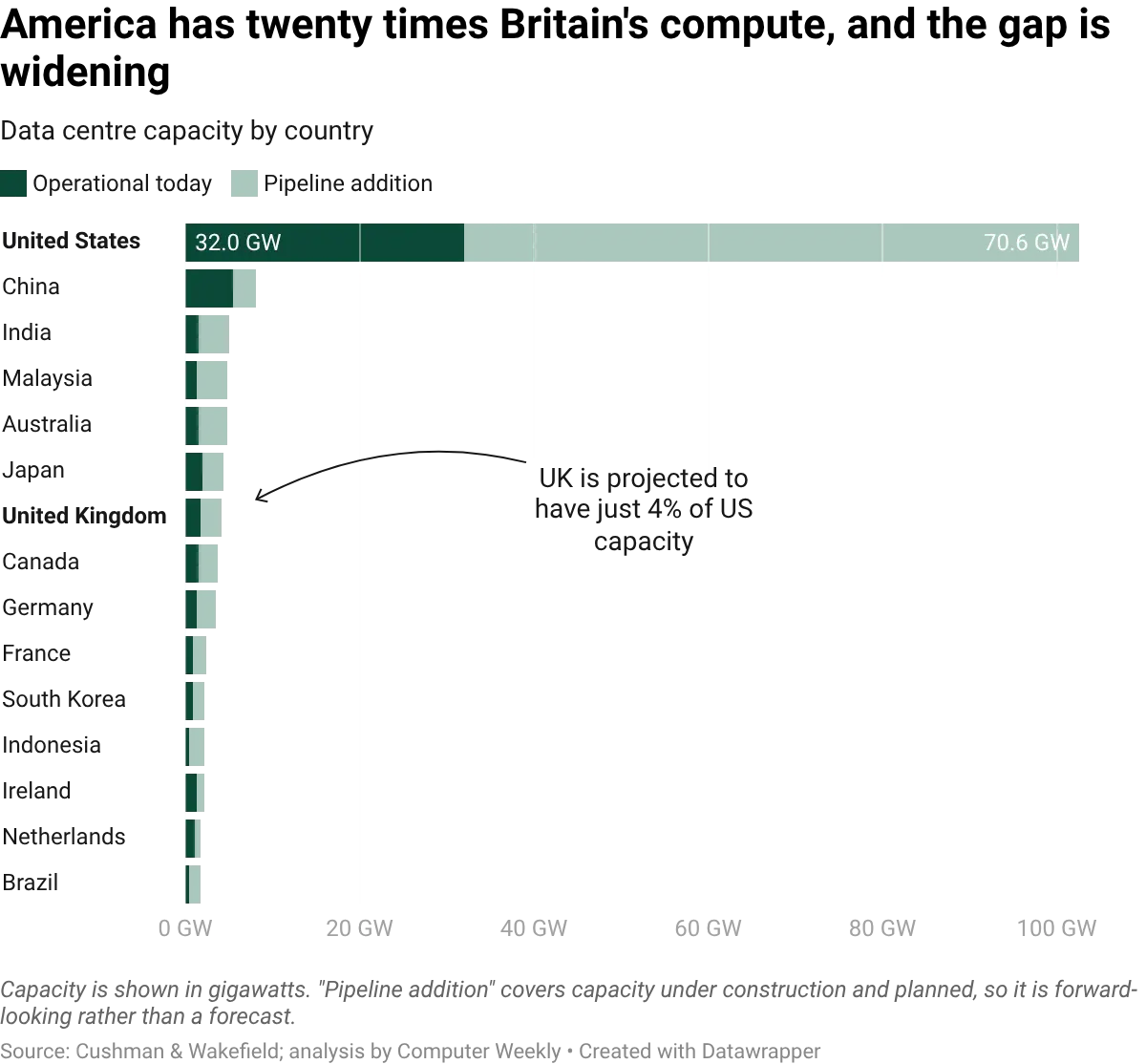
- The UK has limited compute capacity and is not on track to expand it. The US has roughly 20 times our data centre capacity (the best available proxy for compute), and this gap is projected to widen. American capacity is set to triple to around 102GW while the UK reaches just ~4GW, meaning American capacity will be about 25 times ours. The Government's own Compute Roadmap targets at least 6GW of AI-capable capacity by 2030 – a target we are not on track to reach. It is tempting to explain this by America's size and wealth, but France shows that explanation would be wrong. At the end of 2025 France had a smaller installed base of data centres than Britain. Yet by May 2026 the French grid operator had reserved 18GW of connection capacity for around 80 data centre projects, up from 5GW eighteen months earlier. That is more than four times Britain's entire pipeline.
- Data centres need power, and Britain's grid isn’t connecting them. Reforms of grid connections so far have been focused on the generation side and have tried to solve the problem through better central planning. Meanwhile, on the demand side, the queue of projects seeking to draw power has tripled in just seven months, and many are speculative. This means that viable data centre projects are being offered connection dates in 2037 and beyond.
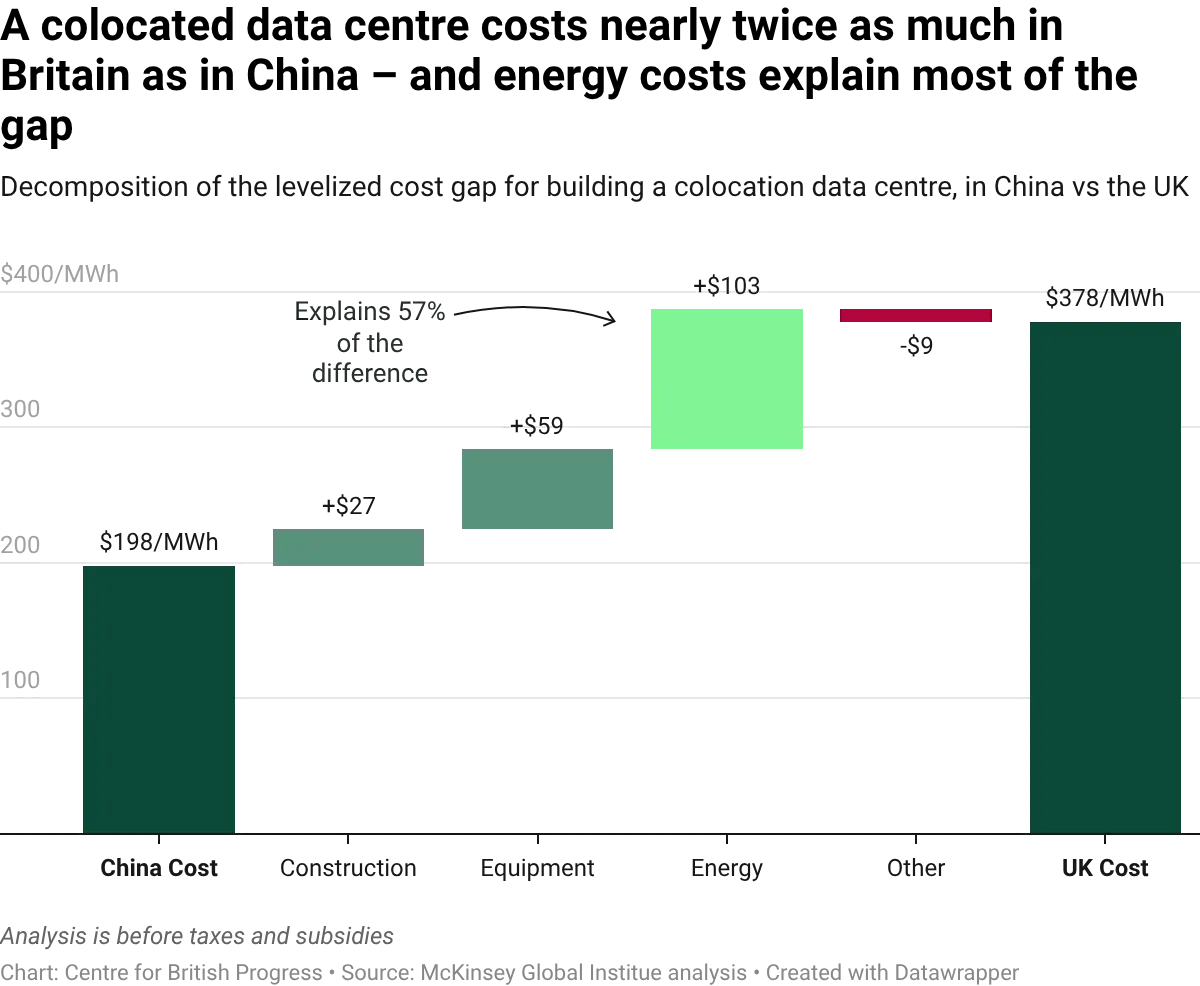
- Colocation data centres (multi-tenant facilities where customers rent space and power and bring their own servers) cost nearly twice as much to run in the UK than in the lowest-cost location, China. Electricity prices explain about 60% of the levelised cost gap of a colocation data centre built in China compared to the United Kingdom. Powering a data centre in the UK is more expensive than in other European markets, and four times more expensive than in the US.
- Regulatory friction is delaying access to frontier models. Compared to the US, 7% of model releases were delayed or not released to the UK (11% of model releases were delayed or not released to the EU). Two regulatory regimes are said to have outsized influence on the speed of release of models onto the British market: GDPR and the CMA. This has wider economic costs since slower access means slower diffusion of the technology in the economy and, as a result, fewer complementary innovations and slower productivity gains.
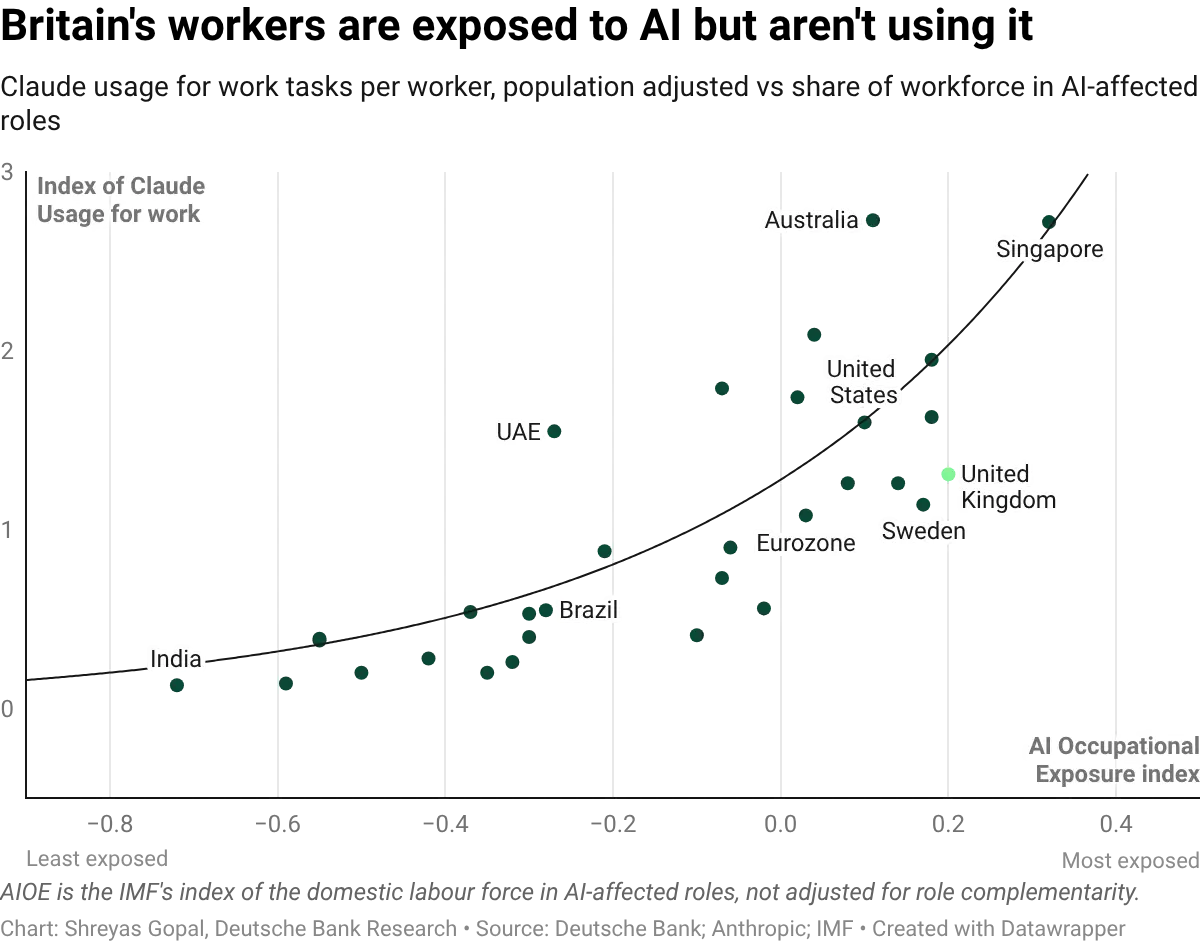
- In the second half of 2025, the UK was ranked 8th in the world for AI diffusion, with only 39% of working-age adults using AI, despite the Government's claim that Britain is the third-largest AI market in the world.
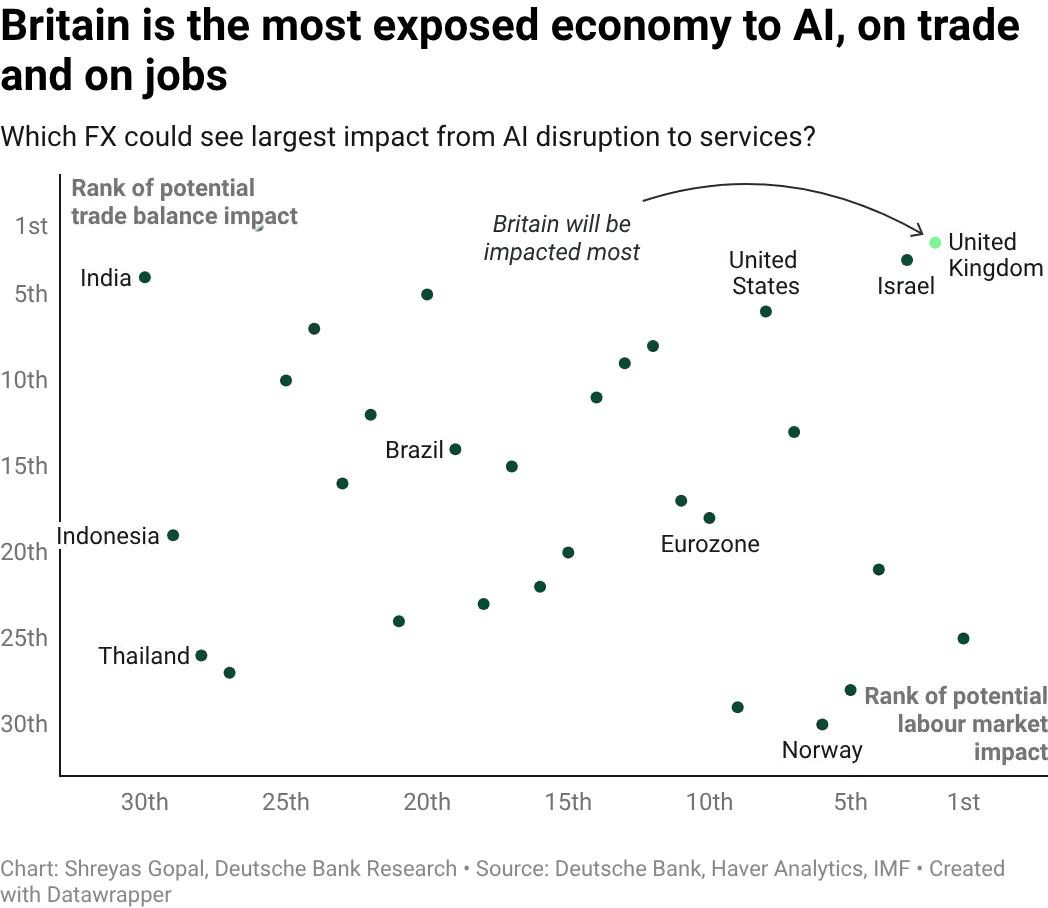
- Because we depend on services, our economy is uniquely exposed to AI disruption. The service industry and other knowledge work are the most immediately exposed to AI. They also account for 81% of Britain's output and 83% of its jobs, and £545bn of our exports in 2025.
A dominant strategy for Britain
The following recommendations constitute policies that would hold across a wide range of possible scenarios. This is our dominant strategy – a plan that leaves Britain better placed in every scenario, and which the Government should therefore pursue without needing to know which world it is in. The term comes from decision theory, where it describes an option that leaves you at least as well off as the alternatives regardless of which state of the world obtains.
Strategy 1: Build infrastructure. Build leverage.
Preserving our sovereignty – avoiding dependence on foreign companies or governments – should be a priority in all scenarios. While we will never control the full stack of AI technologies we rely on, we can take steps to increase our bargaining power and protect British workers and businesses.
A key way to do this, irrespective of what happens at the model layer, is to increase the quantity and value of physical infrastructure on British soil. If frontier models become scarce and a handful of companies or nations control access, domestic compute gives us something to bargain with for privileged access. If models commoditise but capabilities keep advancing, compute will be valuable because the applications built on top of it depend on it. In ‘take-off’ scenarios, domestic infrastructure gives the British state greater command over critical systems and reduces dependence on decisions made abroad. Even if AI turns out to be a disappointment, Britain still ends up with cheaper power and faster grid connections. And in the small possibility where the data centres sit half-empty, it is the investors who lose money, not the taxpayer.
Compute builds leverage in two ways:
- By diminishing our dependence directly and building capabilities under British control. Britain will never build enough to match the scale of compute abroad owned by private companies – nor should it try to. The best bet for domestic capabilities is building secure compute and inference capacity for national security, meaning building enough to run the models our intelligence services, defence establishment and public services depend on. This would not require training a frontier model ourselves.
- By creating reciprocal dependence and making Britain valuable to the frontier labs and providers. ‘Compute for access’ deals are the clearest example of how this tactic could work. If the labs run large workloads in British data centres, they acquire a stake in our access and have incentives to lobby their governments on our behalf. Thus, compute becomes leverage in negotiations about topics like model access and coordination on AI-enabled cyberattacks and biosecurity.
Therefore, the Government should make Britain a good place for private capital to build, power and securely host AI infrastructure, while reserving public investment for strategic needs such as national security.
Many are reasonably concerned about the environmental impacts of data centres or want to slow development for other reasons, but these arguments miss the fact that if Britain doesn’t build compute, someone else will. If Britain does not build, power will simply further concentrate in the United States, or accrue to states like the UAE, which are building at scale and will use the leverage that comes with it. Neither outcome is good for a liberal democracy that depends on access to a technology it does not control.
Connecting data centres to the grid can also lower bills for everyone else. Britain's electricity demand fell 11% between 2015 and 2024, and BCG estimates that spreading fixed network costs over this shrinking base explains 39% of the rise in system costs, more than any other single factor. Increased demand can thus be paradoxically good for household bills, though this depends on how the demand profile is spread during the year and across various times of day. BCG estimates that delivering 14GW of the data centre pipeline would cut household bills by £35 a year by 2035 if done in a grid-positive way.
Implementing the following policies would give Britain a larger, cheaper and more secure domestic compute base:
1. Reform grid connections now, using existing powers.
If you want to build a data centre in Britain, your biggest obstacle is getting connected to the electricity grid. New connections are handled through a queue that is glutted with speculative demand. The capacity of projects waiting to connect to the grid has tripled in just seven months, going from 41GW in late 2024 to 125GW by mid-2025 (nearly three times the entire country's peak electricity demand). Many of these projects will never be built, and they block genuine, funded projects. Data centres are being quoted connection dates in the mid-to-late 2030s, which for the AI industry is equivalent to a refusal. Many operators would pay for speed, directly or through higher electricity prices, but the system gives them no way to. Conversely, if projects do not get a connection in time, the investment may not happen at all.
The buildout is also throttled because only monopoly grid companies can build connections to the high-voltage network. This means a handful of companies set the pace for the whole industry. Britain had the same problem on local networks twenty years ago and fixed it by licensing independent operators to build connections. These independent operators now successfully handle 70–80% of new connections, because their business depends on connecting customers fast. No equivalent exists at the high-voltage level.
Ofgem has proposed fixes for both these problems. It consulted over the summer on stricter readiness tests and a refundable per-megawatt commitment fee to clear speculative projects from the queue, and has said it will consult in autumn 2026 on letting large energy users build and own their own high-voltage connection assets, including a new independent transmission owner licence.
These reforms are welcome, but they do not go far enough and are moving too slowly. A refundable commitment fee removes projects that were not serious in the first place, but it does not help choose between two serious projects competing for the same scarce capacity. Nor do the consultations address the basic problem that Britain gives valuable capability away for free and leaves monopoly companies responsible for building almost all of it.
Things do not have to be this slow. The Planning and Infrastructure Act 2025 gave the Government and Ofgem temporary powers (expiring in December 2028) to change grid rules and connection agreements without the usual multi-year industry process. Ministers should use those powers, alongside powers they already have under electricity legislation, to:
- Open transmission connections to competition. This would involve (a) creating an independent transmission licence that allows private connections, (b) removing the 2km limit on how much connection infrastructure a customer may build, and (c) letting developers own the assets they finance rather than forcing them to hand them back to the incumbent monopoly. While the permanent licensing regime is being created, ministers should use the existing Class Exemptions Order to exempt privately owned 275/400kV substations serving a defined site, so projects can proceed immediately.
- Make high-voltage connections available to large demand customers. National Grid, NESO and Ofgem should be required to offer direct 400kV demand connections in England and Wales before the next connections window opens in late 2026 and allow developers to put transformers and associated equipment on their own land rather than using scarce land inside a National Grid substation.
- Add transparency to the queue. Ofgem should regularly publish a register of large demand projects that hold connection offers. This would allow the Government and developers to see where capacity has been allocated.
- Price new capacity. For industrial demand, allocate new grid capacity by price rather than by queue position. Auctions would allocate scarce capacity to projects that value it most. This reform also lets network companies see where additional capacity is worth building. Auction revenues could also pay for the reinforcement needed to create capacity rather than putting the cost onto household and business bills. Ministers should set up a framework to ensure nationally strategic or politically sensitive projects are carefully balanced against industrial demand.
- Test an auction model with one substation in the next connections window. DESNZ, Ofgem and NESO should select one constrained substation with several credible demand projects and run a pilot for the auction model. NESO would publish the available capacity, invite qualified projects to register, and auction the resulting capacity.
2. Pass the Nuclear Regulation Bill undiluted, and keep to the delivery timetable.
The Government accepted all 47 recommendations of the Nuclear Regulatory Taskforce – the most ambitious overhaul of nuclear regulation proposed by any Western government in decades. The May 2026 King's Speech announced a Nuclear Regulation Bill, which has yet to be introduced. The Government now needs to introduce it this session and pass the bill quickly and intact.
3. Give data centres an explicit ‘gas now, grid later’ framework for on-site power.
Even with a reformed queue, grid connections will take years. The fastest way to power a new data centre is for it to generate its own electricity on site (‘behind-the-meter’) using fleets of small gas engines and turbines while it waits for grid connection. This would let the data centre temporarily sidestep the connection queue and come online much faster. The Government already permits on-site generation in AI Growth Zones in principle, but several obstacles make it impossible in practice.
Today a developer who wants behind-the-meter electricity faces various barriers. On-site gas above 50MW is a Nationally Significant Infrastructure Project in England, so the ‘fast’ behind-the-meter route runs into the same slow regime it was meant to escape, plus environmental permits and no assurance of how long the plant may run. As a result, no one builds it. An explicit framework would give developers the certainty they need to build in the UK.
The Government should permit data centres to bring their own gas generation, on three conditions:
- Any data centre powered this way must hold a place in the grid connection queue, and may use gas as its main power source until its grid connection arrives.
- After that point, the gas generator should become backup or flexible capacity in the wider electricity system that the grid can call on at moments of stress, which Britain's renewables-heavy grid will need.
- Facilities running ‘behind the meter’ should make a mandatory financial contribution to a fund for clean firm power (such as a capacity market or nuclear financing fund) so the shift to clean energy sources is paid for by the data centres. This should be sized to match roughly what a grid-connected site would have paid in policy levies, so that a behind-the-meter site continues paying towards system fixed costs.
4. Make Britain a trusted location for frontier AI.
AI will increasingly be used in sensitive settings, such as running national security systems and processing personal data in disciplines like health. Some of this processing has to happen on British soil, and can only happen safely if Britain builds for it.
Access is also a question. The security requirements for hosting frontier model weights are still being developed, and a country that cannot meet them will not be trusted with the best models. Britain should help shape these standards as well as ensure that UK facilities can meet them.
The Government should set up an AISI–NCSC programme to develop expertise on frontier-weight security, and work with allied governments and AI labs to establish the emerging international standard. Once the standards are established, Britain should negotiate mutual recognition so that UK-accredited facilities can host US-origin models and controlled chips, and accredit British data centres against the standard.
This would give Britain both secure domestic compute for sensitive applications and a strong market position for hosting frontier AI.
5. Reject mandatory curtailment for AI data centres, but encourage voluntary curtailment for faster or cheaper connection.
Ofgem is exploring whether very large users like data centres should face mandatory curtailment as a ‘backstop’ during system stress, alongside voluntary non-firm connections, and will consult this autumn.
There are three approaches to curtailment: (1) curtailment imposed by government without consent; (2) curtailment a provider agreed to in advance (possibly in exchange for faster or cheaper connection); (3) voluntary curtailment in response to peak pricing.
The first approach should be rejected. Operators should decide whether a facility can afford to be interrupted. Some uses (like AI data centres) require continuous access. Making curtailment compulsory for these users would risk pushing the projects to countries that do not impose it and stymie data centre investment in the UK.
However, curtailment where a provider has agreed to in advance could be actively beneficial, especially if this is being done in exchange for faster or cheaper connection. Non-firm, or ‘flexible’, connections may benefit data centre builders and ordinary consumers. Voluntary curtailment in response to peak pricing also makes sense. Flexibility from big users helps a renewables-heavy grid, and operators who can tolerate interruption should be free to sell that flexibility.
6. Legislate a Building Britain Act to fast-track planning permission in AI Growth Zones.
Britain's planning system is slow. It approves major projects through a gauntlet of sequential steps (consultations, assessments, decisions, litigation), each taking months or years. This process is too burdensome for data centre providers with many options, which helps explain why projects here take longer and cost more and why so few have recently chosen to invest in Britain.
The Government has taken some good first steps to solve this problem. Data centres can now use the national planning regime for major infrastructure rather than relying on local councils, the Planning and Infrastructure Act has passed, a dedicated national planning policy for data centres is in preparation, and judicial review reform has begun. But it could go further. A Building Britain Act (modelled on legislation Mark Carney's government passed in Canada) would compress approval processes so build-out could move quickly. A British version would work as follows:
- Streamline planning permission within designated AI Growth Zones. Identify suitable land (former industrial sites, quarries, ports), and any project that fits the designation rules should receive streamlined permission after a fixed period, unless the Secretary of State objects. Each designation should also set clear limits, such as maximum heights, footprints, and on-site power generation (which the Act should allow above the current 50MW threshold).
- Empower city-region mayors to designate areas as AI Growth Zones, so places that want data centre investment can designate zones themselves and levy developers to recover their costs.
- Reform business rates to increase local retention. Currently, councils keep only a share of any growth in business rates and the resets redistribute most accumulated growth nationally, leaving little incentive for a council to host growth-generating development. The result is a system in which host communities bear the costs of development while the Exchequer captures the fiscal upside, disincentivising development. The Government has committed that local authorities in England will keep 100% of business rate growth in AI Growth Zones for twenty-five years, but only from April 2027 and only through secondary legislation yet to be made. It should legislate now and apply retention from the date of designation, so that host areas have the incentive to build now. The Government should also agree equivalent arrangements with the Scottish and Welsh governments.
- Replace project-by-project environmental assessment with one assessment per AI Growth Zone. Instead of every project producing its own Environmental Impact Assessment, the Government should assess the whole zone once, up front, through a Strategic Environmental Assessment, identify likely effects, and set the rules and exclusions that follow. Germany, France, Spain, and Denmark already use this approach successfully for renewable energy zones under EU law.
- Guarantee nature gains through an Environmental Improvement Levy. Under this system, every developer in a zone pays a levy, sized so that development leaves nature better off overall. This levy would fund habitat creation where it does the most good.
Alongside the Act, the forthcoming national planning policy for data centres should designate them a ‘critical national priority’, which increases the chance of planning approval. This designation should be applied without the qualifying language that weakens the clean energy designation.
Strategy 2: Diffuse, adapt and let new firms emerge.
There is nothing to stop Britain leading the world on AI adoption. British innovators laid the foundations for the AI revolution we are living through, and we still have some of the best talent and one of the most dynamic startup ecosystems in the world.
Regardless of who produces frontier models, Britain will capture more value if it can adopt AI quickly and reorganise its economy to ensure wealth is created in Britain and flows to the British people. However, we risk missing out on this enormous opportunity if our firms lack the right environment to act quickly and confidently, or cannot access the talent they need.
This is the right strategy irrespective of the dynamics of frontier AI progress. If intelligence becomes a commodity, a lot of the value will accrue to firms that use cheap intelligence to build valuable products and services. On the other hand, if value becomes highly concentrated at frontier firms, broad implementation remains one way Britain can capture productivity gains. Periods of fast technological change are precisely when creative destruction matters most. In the right environment, we may see a new era of firm and value creation across the country.
The Government should therefore focus on removing barriers to adoption and increasing the economic dynamism that allows new firms to form, talent to move and successful businesses to scale:
1. Reform the regulations that limit AI adoption.
Much of the value AI produces will come not from the models themselves but from the applications built on top of them, and from diffusion across the economy as firms use AI to raise productivity. Usually, the market drives adoption: firms that adopt better technology beat those that don't, so competition pulls the technology through. But where rules limit adoption, this competitive pressure disappears, and productivity gains go unrealised.
In Britain, some of the highest-value adoption sits in regulated industries (like finance, law, health, and insurance). Our economy is services-heavy: Britain is the world's second-largest services exporter, behind only the United States. If British firms adopt AI more slowly than their rivals, we forgo the productivity growth adoption brings at home and cede the export share that pays for the country's trade.
Six questions need to be answered by the law if we want AI to safely diffuse in our regulated industries:
- Can AI use the data it needs? AI systems need access to large, representative datasets. Britain has public and regulated data, including clinical records, population statistics and financial information that could be used to build important use cases. But access to this data is often limited to individual research projects rather than the development and continuous improvement of deployable products. More fundamentally, our data access rules were written for a pre-AI world. Under the UK GDPR and Data Protection Act 2018, data gathered for one purpose (like treating a patient) cannot easily be reused for another (like training a diagnostic tool). Furthermore, the law's concept of consent assumes an identifiable person who can be asked and can consent, which breaks down when you have applications like robots in a public space gathering data, or when an AI agent acts autonomously on someone's behalf. Section 251 of the NHS Act 2006 opens confidential patient data for research and audit, but whether that approval extends to AI systems is uncertain. The Statistics and Registration Service Act 2007 only allows access to ONS data by accredited human researchers within secure research environments, but there is no pathway for autonomous AI systems to work with, or learn from, the data. And the Computer Misuse Act 1990 leaves everyday data-gathering for training in a legal grey area.
- Can AI do work currently reserved for licensed professionals? Professional regulation reserves certain activities to authorised people. This ensures the work is carried out by someone who meets minimum standards, carries insurance and can be disciplined when things go wrong. But the same rules can prevent AI from doing work that it may be better placed to do. For example, the Human Medicines Regulations 2012 restricts the prescribing of prescription-only medicines to recognised practitioners, while regulation 11 of the Ionising Radiation (Medical Exposure) Regulations 2017 requires a registered healthcare professional to justify each individual medical exposure to radiation. Currently, legal advice given by a solicitor may be protected by legal professional privilege, whereas advice generated directly by an AI system generally is not – the Upper Tribunal has even observed that uploading confidential or privileged material to a public AI tool such as ChatGPT places it in the public domain and waives privilege. This limits much of AI's promise to widen access to legal help.
- Can AI work safely in the physical world? Robotics is the next frontier, and soon we will see delivery units on pavements, drones in the air, and cars on the road – all powered by AI. But rules still limit seemingly basic technology. UK drone rules permit beyond-visual-line-of-sight flights only under bespoke case-by-case authorisations that assume a remote pilot able to intervene. Across our entire regulatory framework, safety requirements are built for predictable, deterministic machines, not systems whose behaviour shifts as they learn. Most AI systems learn and update continuously, which, in the British regulatory system, means each material update can trigger a fresh round of approval.
- Who owns what AI creates, and what may it learn from? AI learns from existing work and from what its users feed it, and it produces new work of its own – and British law is unclear or unhelpful on all three. The Copyright, Designs and Patents Act 1988 allows text and data mining only for non-commercial research, so a developer who trains a commercial model on copyrighted material in Britain risks infringing it. Most therefore train abroad, where the position is clearer, then launch the resulting product on the British market regardless. The High Court confirmed in Getty Images v Stability AI that a model trained abroad which retains no copies of the works is not an infringing article when imported, and the Government's March 2026 report on copyright and AI abandoned its preferred text-and-data-mining exception without proposing an alternative, so this position is likely to persist. Furthermore, the line between training and inference is blurring, and the law isn’t clear on how to govern use. Every prompt, document and dataset a user puts into an AI system could hypothetically be used for further training abroad. Modern AI systems also read new materials every time they answer questions and copy data into their working memory when a question is asked (retrieval-augmented generation). Finally, it is unclear whether AI’s output can be copyrighted or patented. The 1988 Act nominally protects ‘computer-generated works’, but it is uncertain whether an AI's output meets the test. And the Patents Act 1977 requires a human inventor, so an invention devised mainly by an AI may not be patentable in Britain.
- Can AI make decisions, act autonomously, and be held to account? British law assumes a legal person stands behind every action – this person has the capacity to act, intent the law can recognise, authority to enter into contracts with others, and accountability to answer when things go wrong. AI agents are not recognised as legal persons. This means that, although an AI agent may make choices and perform tasks autonomously, it cannot enter a contract, possess legal authority, owe legal duties, or be sued or punished. The common law of agency lets one person authorise another to act and contract on their behalf, but it presumes both are legal persons, so an AI agent cannot have the same authority. When an AI agent causes loss, British law cannot say in advance who is liable. It might be the developer that built the model, the platform that deployed it, or the user who instructed it, and today the answer depends on a fact-specific analysis of each party's role. This limits the role AI agents can play in the economy. For example, strong customer authentication under the Payment Services Regulations 2017 is built around verifying a human payer, so an agent cannot straightforwardly authorise payments. And when an agent causes loss, no dedicated regime settles who bears the cost.
- Can AI be safely built and tested here without committing an offence? To align a model and ensure it, for example, refuses to help with terrorism or biological weapons, a developer must generate, collect and handle unlawful material. This is because currently the way we align AI involves labelling examples of unlawful material, prompting a model to produce it and testing its capabilities. The problem is several offences make this process difficult because they bite on possession or production of the material without requiring harm or intent. Rules like section 58 of the Terrorism Act 2000, the Biological Weapons Act 1974, the security regime for dangerous substances under the Anti-terrorism, Crime and Security Act 2001, and the illegal-content duties of the Online Safety Act 2023 all restrict this kind of testing.
The answers to each of these questions will be contested, and the right reforms may tighten regulation in some places, while liberalising it in others. The common law system will also address some of these issues. In designing solutions, Britain must keep abreast of what is happening internationally. We will not always want to conform to foreign rules, but our firms sell into foreign markets, so we should shape global standards where we can and avoid needless divergence where we cannot.
To stay flexible and responsive as we find the right answers to regulating AI adoption, we should create a single body with the power to answer these questions and to act and learn as it goes. This would look like a central, cross-cutting regulator with the power to reach across the individual regulators, run sandboxes that suspend or reform a rule so a new technology can be tested in the real world under supervision, and make what works permanent through fast-track reform. The Government is already moving in this direction.
This body should also provide advice to those adopting AI where they are unsure how their use case interacts with regulation. Often the law permits AI but the guidance is unclear, and firms in regulated sectors treat uncertainty as prohibition. In these instances, the remedy is not regulatory reform but clarity and assurance from regulators.
Finally, this body should publish recognised technical evaluations (‘evals’) for common use cases so that a system passing the relevant tests is presumed to meet the regulator’s expectations for that use. AISI's open-source evaluation framework, Inspect, gives us a base to build on. The private market should develop the tests with regulators certifying them. Firms should still remain free to deploy AI without passing a certified test and to demonstrate compliance in other ways, as they do now. The aim is to give firms adopting AI a fast route to certainty, not to add a new requirement they must fulfil. A certified test should be a safe harbour on the regulator's expectations, not a transfer of liability from the firm.
2. Let talent move to increase productivity.
The firms that get value from a new technology are rarely the firms that existed before it arrived. Technological advances create new business models, make old ones obsolete and reshuffle which combinations of people and capital are most productive. Creative destruction rests on skilled people working at the firms and on the ideas where they will bring the most value. The great companies of our times came from people leaving one firm to build the next. OpenAI drew its founders from Google and Stripe, and Anthropic in turn splintered from OpenAI.
Evidence suggests that restrictions on labour mobility have negative economic consequences. OECD research finds that non-compete clauses in job contracts are associated with weak productivity because they reduce worker mobility, slow the reallocation of talent towards productive firms, and impede the diffusion of knowledge and technology in the economy. When Italy raised dismissal costs for small firms in 1990, hiring fell and so did the entry of new small firms. New European Commission research finds that stricter employment protection is associated with lower adoption of AI and other technologies that require firms to reorganise their workforces.
Worker protection matters, especially when employees have little bargaining power or are highly vulnerable. We do not suggest rolling back important reforms to protect those most vulnerable in our society. But many of the workers whose movement creates the largest spillovers are highly paid, very employable, and able to negotiate their employment terms. Our labour laws should not treat all workers the same. The goal should be to provide security where vulnerable workers need it, while maximising mobility among those with high bargaining power where the wider economy benefits.
Three contractual mechanisms can delay a departing employee from joining a new employer: notice periods, garden leave, and post-termination non-compete clauses. During a notice period, the employee continues working as normal. Garden leave operates similarly insofar as the employee is legally employed, but it prevents the employee from working during some or all of that period. A non-compete, by contrast, restrains the employee from working with a competitor after the employment relationship has ended.
Reform has to address each instrument separately:
- Limit non-compete clauses to three months. The burden of proving that a restraint within the cap is reasonable should remain with the employer, as now.
- Set garden leave off against any non-compete. The Court of Appeal has held that there is no automatic offset between time spent on garden leave and the length of a post-termination restriction, though – in some cases – garden leave is considered relevant when a court assesses the reasonableness of a restriction. Legislation should make the offset automatic, so an employer cannot stack a period of garden leave on top of a full non-compete.
- Cap the notice an employee can be required to give at three months. Section 86 of the Employment Rights Act 1996 sets minimum notice periods but no maximum, so employers often write long notice periods into contracts. The notice an employee can be required to give should be capped at three months. Combined with the three-month non-compete cap, this would mean that contractual notice and non-compete provisions could never prevent an employee from joining a new employer for more than six months after giving notice. Where some or all of the notice period is spent on garden leave, the automatic offset would shorten that period further.
None of these changes would weaken the protections that survive an employee’s departure: confidential information and trade secrets would remain protected, and the equitable duty of confidence and intellectual property law would also be untouched.
Beyond restraints on leaving, the Government should also:
- Remove ordinary unfair-dismissal protection for the highest earners. Employees earning above the threshold for the additional rate of income tax should be excluded from ordinary unfair-dismissal claims under section 94 of the Employment Rights Act 1996 by amending section 108(1) so that high earners are treated the same as employees who lack the required qualifying service. This policy would have international precedent: Australia has excluded high earners from unfair dismissal protection since 2009, and New Zealand followed in February 2026.
Section 108(3) would continue to preserve claims for automatically unfair dismissal, meaning protections for automatically unfair reasons like whistleblowing or trade-union activity would remain enforceable. Nothing would change an employee’s rights under the Equality Act 2010, and the reform would not affect contractual notice. An employer would still have to dismiss an employee on the notice required by the employment contract, or make any payment in lieu permitted by that contract.
3. Make Britain the best place in the world for AI talent.
Globally, there is a fight for top AI talent, and other countries are increasingly using immigration and public money as tools in that competition. Canada, Singapore, China and various Gulf countries have all launched programmes aimed at attracting international AI talent.
There are many benefits to having AI researchers in your country, even if they work for foreign companies or institutions or the intellectual property they produce accrues abroad. They are highly paid and contribute directly to the British tax base, deepen the pool of technical talent available to domestic firms, and the knowledge they bring spills over into the wider economy. Agglomeration effects also mean their presence makes Britain more attractive to other researchers, investors and AI companies deciding where to locate teams.
We already have visas that let these researchers come, but the default route is poorly suited to the labour market we want to create. The default pathway (the Skilled Worker Visa) ties a researcher to a sponsoring employer and requires a new immigration application if they change employer. The Global Talent Visa (GTV) is much more conducive to labour mobility and entrepreneurship because it allows holders to change employers, become self-employed, or start a company. The problem is that there is no straightforward GTV pathway simply for being a frontier-AI researcher, and endorsers do not necessarily have the technical knowledge to identify top AI talent.
The government has already created a Global Talent Taskforce to identify and attract exceptional international talent. However, the taskforce has no immigration powers, and its role is limited to headhunting, concierge support and, since January 2026, referring firms for fast-track sponsor licences. The government should therefore designate the Global Talent Taskforce as an endorsing body for a new frontier-AI pathway under the Global Talent Visa. Researchers should be able to apply directly to a new Frontier-AI Talent Endorsement Stream. Applicants would need three things:
- An offer to conduct qualifying frontier-AI research in the UK;
- A CV demonstrating relevant technical or research experience; and
- Three recommendation letters from recognised experts in AI research who can attest to the applicant's ability and suitability for frontier research.
Decisions on endorsement applications should be made within five working days, after which the applicant would go through the normal Home Office process.
But none of this will count for much if the settlement rules are changed in a way that disadvantages this class of talent from settling. The Government's consultation on ‘earned settlement’, which closed in February, proposed lengthening the standard route to permanent residence. Frontier-AI talent should be on the fastest possible track for settlement.
Strategy 3: Build state capacity to adapt as the world changes.
Many of Britain’s current policy challenges have been ascribed to a lack of ‘state capacity’ – the ability of the Government to set out to do something, and then do it well. This will only become more important as the world goes through rapid change driven by AI. Changes to people’s jobs and livelihoods, shifting sources of wealth and tax revenue, and geopolitical turmoil will all require the Government to rapidly develop policy solutions and deliver them. AI will also provide ways to expand state capacity, allowing the state to do more for less – though this will not happen without a thoughtful plan for adoption.
Nations’ success in the age of AI will depend on governments’ ability to stay flexible and responsive to AI's unexpected effects. A failure to do so could see Britain face a shrinking tax base, a deteriorating social contract, and a drift to diplomatic irrelevance.
The government should:
1. Build a tax base resilient to AI disruption.
The tax system should be robust across circumstances in which AI gains accrue in different places. Despite warnings from tech CEOs, it is not certain that AI will create mass unemployment or even that employment will fall substantially. In many plausible scenarios, wages continue to grow, and employment remains steady. However, significant labour-market disruption is possible, and that scenario produces considerable socio-economic concerns.
The British state currently relies heavily on taxes on labour income. In 2025-26, income tax is forecast to raise £331bn and National Insurance a further £204bn – together almost half of all tax receipts. In a context where AI reduces employment, compresses labour's share of national income, or creates prolonged periods of churn between jobs, this tax base could come under pressure as demands on the state increase.
Reform should be treated as fiscal insurance against changes in the composition and location of value. It is difficult to predict which tax base AI will enlarge and tax it pre-emptively (doing so would be highly speculative and could have negative consequences). But we should reduce excessive dependence on any single mobile base and shift some of the burden towards things whose taxability survives across scenarios and still makes good fiscal sense in the status quo.
The government should:
- Model a destination-based cash flow tax and build the capacity to introduce it if needed.
- Corporation tax taxes profits where they are booked, not where customers are, so firms can sell to British consumers while paying tax on their profit in Ireland or Luxembourg. The Digital Services Tax and the Pillar Two minimum tax are partial responses to this problem, but neither cleanly moves the tax base to where the customer is. A destination-based tax on cash flow would tax sales to UK customers, minus UK-based expenses such as wages and capital investment, which could be deducted immediately. This would remove bias against investment and towards debt, and the tax base would follow the customer, not the company's location choice.
- If Britain is a net importer of AI, the value created by AI would reside in mobile assets such as model weights and intellectual property, so under the current system a large chunk of what British firms and consumers spend on AI would not appear in the British tax base. A destination-based tax would capture it. But the reverse is also true: if Britain becomes a significant producer, a destination basis would forgo the rents on its exports.
- The Treasury should model the tax on Britain's economy (including the shift in burden from exporters to domestic-facing firms) and resolve the legal architecture (tax treaties and WTO rules could pose issues; although, in this case, the same economic result can be reached by pairing a destination-based VAT with a separate cut in taxes on wages) that would allow this tax to be enacted. The aim should be to have the option ready if Britain's position as an AI importer becomes entrenched.
- In the meantime, we should expand full expensing to structures at the next Budget. Full expensing for plant and machinery has been permanent since 2023, but structures are still written off over 33 years. This is worth doing in any scenario and would reduce the cost of building homes, data centres and power infrastructure.
- Shift more of the tax burden onto land and property.
- Britain already raises a large amount from property, but it does so badly, and it taxes land itself hardly at all. Land supply is fixed and cannot move in response to taxation, and its rents cannot be shifted to another jurisdiction – that makes land and property among the least distortive tax bases and, in a situation where value pools in highly mobile AI assets, a revenue base that remains available across very different development scenarios.
- To better seize economic rents from property taxes, the Government should replace stamp duty and council tax with a proportional recurrent property tax. This is a good tax reform even without AI, but it also makes the tax system more resilient to technological change. Greater reliance on recurrent property taxation provides a stable revenue base if other tax sources are eroded.
- The government should also introduce a land value tax on the non-agricultural value of undeveloped land. Taxing the underlying value of land, rather than work, investment, or transactions, does not reduce the incentive to produce or invest. Applied to undeveloped land, it also raises the cost of holding valuable sites unused, strengthening incentives to bring land into productive use.
- Use VAT to increase tax revenue and build the infrastructure for a ‘progressive VAT’.
- Britain taxes a smaller share of consumption than most rich countries. For every pound of VAT that would be raised if a 20% rate applied to all consumption, the UK collects around 49p, compared with an OECD average of 58p. HMRC's latest figures put the cost of VAT exemptions at over £100 billion a year in total, against £181 billion of VAT actually collected.
- If the Government needs to raise tax revenue, it should focus on VAT. VAT is popular with economists: of the three major taxes, it is seen as the least economically damaging way to raise revenue. Consumption has the added benefit of being the strongest base available in an environment of advanced AI. Spending continues whether purchasing power comes from wages, capital income or transfers, and VAT is taxed at the place of consumption, which means that the base stays in Britain even if AI inputs like the model weights and headquarters do not. VAT can also raise a lot of money: each point on the standard rate raises around £9–10bn a year.
- Currently, many VAT exemptions are poorly targeted. Zero-rating food, children’s clothes, books and other goods is intended to protect vulnerable households from the cost of necessities. But tax relief at the point of purchase supports households that do not need it, rather than concentrating support on those who do. Because richer households spend more in absolute terms, they actually receive more of this benefit. The problem is that removing these reliefs is politically difficult. VAT exemptions are highly visible benefits, and proposals to tax currently untaxed goods can be framed as making everyday essentials more expensive.
- A better approach would separate the tax base from distributional support. Under a ‘progressive VAT’ system, instead of exempting particular goods, the state would compensate eligible households directly by refunding VAT at the point of purchase. The consumer would pay the VAT and, if eligible, receive a rebate automatically at the till. This would allow the Government to replace expensive, poorly directed support with targeted transfers to those who actually need support. Uruguay already refunds VAT at the point of sale to holders of social-programme cards, and Argentina has refunded VAT on debit-card purchases by pensioners and benefit recipients.
- An additional obstacle to implementing this policy is that the UK currently lacks the infrastructure to deliver such a system. The Government should therefore build the capability to calculate and pay VAT rebates in real time at the point of purchase. The immediate policy would not be to abolish VAT reliefs. Instead, the Government should build the infrastructure to identify eligible households, calculate the right rebate and transmit it to a retailer or payment provider at the point of sale. Once that capability is in place, the Government could replace individual VAT zero rates and exemptions with targeted household rebates.
2. Make the state a thoughtful adopter of AI.
Britain has already begun building technical capacity in the state. The Government Digital Service (launched in 2011) showed the value of having internal teams work directly on difficult problems. More recently, the No.10 Data Science team and i.AI have brought engineers into government to work alongside officials and frontline staff, while the No.10 Innovation Fellowship has recruited engineers for six-to-twelve-month tours of duty across the public sector. The AI Opportunities Action Plan advocated the right approach to implement AI in public services: scan for important problems, pilot solutions rapidly, and scale those that work. But this approach has so far not been implemented.
Meanwhile, policymakers use AI in an ad-hoc fashion to draft speeches and correspondence, analyse consultation responses, and even produce material that may have entered official legal and administrative decisions. This is not inherently bad. Used well, AI can increase state capacity by making government faster, cheaper and more rigorous. However, there are risks to the use of AI in these functions, especially where the use is fragmented among different tools, providers and models and not being monitored. These risks include shifting or hidden biases, security vulnerabilities and data leakage. Some of the most serious risks come from increasingly autonomous or potentially misaligned systems.
The right response is not to restrict adoption but to build the capacity to deliver it well and the capability to monitor its use – especially in high-risk domains such as national security and the judiciary. The government should:
- Launch AI delivery teams in every department. The teams should sit operationally inside departments but report to the Prime Minister's AI Taskforce. These teams would be embedded directly with the civil servants and frontline personnel running a service, and have the authority to build new systems rather than merely advise departments on how AI might be used. In particular, they would be empowered to build parallel alternatives to existing government systems and processes. The existing service should continue operating while the new system is tested alongside it; where literal parallel operation is impossible, departments should use controlled trials or phased deployment. This would allow the Government to compare a new system against the service it is intended to replace. All systems that pass three tests should then be scaled:
- (1) The new system must be at least as safe, secure and reliable as the incumbent system; (2) it must materially reduce cost, staff time, processing time or another clearly defined resource requirement; and (3) it must maintain or improve the substantive outcome of the service and the experience of the people using it.
- Fund a team to monitor AI use across government. The government should not, at this stage, tightly regulate how policymakers use tools. Experimentation diffuses the technology through the state and reveals where it improves delivery. But it should monitor experimentation for emerging risks and failures, especially in high-risk domains such as national security and the judiciary. The most serious risks may not be visible from outputs alone and will require adversarial testing and an understanding of how models behave in deployment, so this must be a highly technical team. AISI is likely the best place for this work.
- Legislate a narrow Freedom of Information (FOI) exemption for exploratory exchanges with AI. Policymakers need to be able to test ideas with an AI model as they would in a conversation with a colleague – floating a bad option to see why it fails or drafting something rough to see where it goes. Until now, that kind of deliberation has always been protected because it happens verbally or in temporary notes. When it happens with AI use, it leaves a transcript, and because this can be requested under FOIs, many avoid using AI. The result is worse advice. The FOI exemption should be expanded to cover AI use in brainstorming, drafting, analysis and the development of advice. However, it should not apply where an AI output is materially relied upon in official decisions, nor should putting pre-existing content into an AI system render that content exempt. In any case, all conversations should remain securely available for internal audit, AISI monitoring and other reasonable oversight.
- For nationally significant public services and critical services, prioritise technology that is interoperable and able to switch between model providers. Britain's access to frontier models depends on a small number of foreign firms and on the policies of the Governments that host them. As access becomes more precarious, AI systems should be designed so underlying models can be replaced without prejudicing public and critical services. Beyond protecting against a loss of access, this would keep competitive pressure on the providers the state uses.
3. Make Britain a leader in AI diplomacy.
In the next few years, diplomacy will increasingly focus on AI-related issues. Questions of model access, compute availability, chip supply, and security standards will sit alongside traditional topics of diplomatic discussion like trade and defence. To navigate these issues, the Government will need to bring together knowledge and capabilities that are currently scattered across AISI, the FCDO and the intelligence agencies with no single owner. Developing this expertise in the British diplomatic service will matter if Britain is to weather this next phase in its history.
Britain is also well placed to play a larger diplomatic role on AI. It is still a major diplomatic player, as a permanent member of the UN Security Council and the G7, and is uniquely positioned to bridge the United States and Europe, with strong bilateral relationships with other middle powers and with China. But AI is still treated as a side issue in government, and responsibility for the policy area is currently fragmented across the Government.
Whoever leads AI diplomacy needs technical expertise, trusted industry relationships, and a clear view of what AI can do domestically for the country. The most consequential actors in AI will not necessarily be states: frontier labs are becoming geopolitical actors in their own right. Relationships with industry may end up more important than traditional diplomatic ones.
The AI Minister should own this brief. The minister already leads the Government's domestic AI strategy working closely with the Prime Minister through the AI Taskforce, maintains relationships with frontier labs, has a technical team, and sits within the same Cabinet Office portfolio as AISI. They would be very well positioned to lead the AI diplomatic function too.
The government should:
- Establish an AI Diplomacy Unit within the Prime Minister's AI Taskforce, led by the AI Minister. The unit should draw secondees from AISI, FCDO, GCHQ and NCSC. Its mandate should include setting negotiating objectives for Britain's most important AI diplomatic relationships (particularly with the United States and China), evaluating emerging international standards and treaties and coordinating Britain's positions, and exploring alliances with middle powers such as South Korea, Germany, France, the Netherlands, Canada and Japan in projects like pooling demand and securing access to frontier models and compute.
- Place AI and economic expertise inside the National Security Council. The National Security Secretariat should gain a stronger economic security function focused on AI, with a team covering frontier AI, compute and supply chains, drawing on the Investment Security Unit and the economic security directorate in BIST.
- Fund a compute verification programme to give Britain something to bring to the table in frontier negotiations. When governments eventually seek agreements to regulate the development or deployment of the most capable AI systems, those agreements will depend on inspection and verification, as arms control currently does. The world will need to develop technologies to allow external parties to confirm what computation has taken place without exposing model weights or data. Without this technology, any agreement to pace the frontier will be difficult to implement. The technology that would enable verification is still immature and there remains an opportunity in the market for Britain. AISI should establish a dedicated verification R&D programme and fund British research into compute verification. ARIA should also make compute verification an explicit strand of its Safeguarded AI programme.
- Host verification experiments with industry and governments in British data centres. In the 80s and 90s, Britain ran trial inspections of chemical plants and military sites and pioneered ‘managed access’ techniques. These techniques had the benefit of letting a host prove compliance without exposing sensitive information. The results of this work shaped the Chemical Weapons Convention. Britain could play the same role for AI. We should run tests on real systems with frontier labs and governments to make British tools and institutions central to any future international arrangement.
For more information about our initiative, partnerships, or support, get in touch with us at:
[email protected]For more information about our initiative, partnerships, or support, get in touch with us at:
[email protected]