
Table of Contents
- 1. Summary
- 2. Overview of the current system
- 3. Key weaknesses of our system
- 4. A contributory migration system
- 5. Policy Recommendations
- 6. Authors
- 7. Appendices
Summary
The debate around Britain's migration system is often framed as a choice between ‘open’ and ‘closed’. But this misses what voters actually care about.
Voters care about fairness. They want a system that protects the public who fund the welfare state and expect it to be sustainable; that offers predictable rules to migrants who work hard and pay taxes; and that proves durable across generations in a country facing demographic and fiscal strain.
Immigration ranks as the top concern for British voters. To write this off as populism is to ignore what democratic governments owe the people they serve. Part of voters’ frustration comes from a sense that they have not been listened to. For years, governments have promised control: routes have been tweaked, thresholds adjusted, categories renamed, numbers have risen and fallen. But from the voters’ perspective, nothing has improved and our system has remained broken.
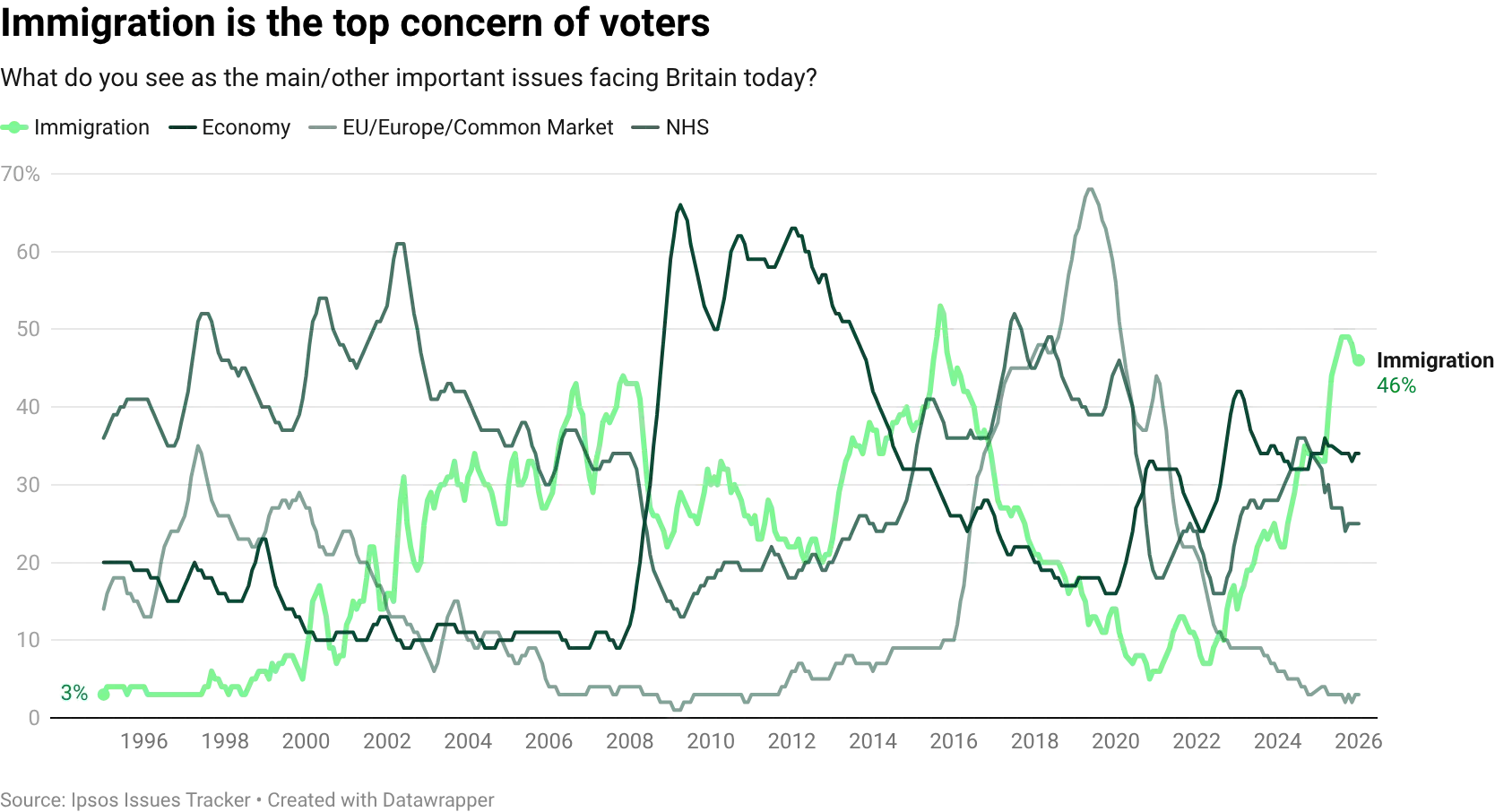
Britain faces competing pressures. Public support for migration has diminished, especially following large post-pandemic increases. Many voters are concerned about pressure on housing, public services and social cohesion.
At the same time, the fiscal pressures bearing down on the British state make it more important than ever that migration strengthens the public finances. An ageing population is driving up spending on health, social care, and pensions, while weak productivity growth has limited the tax revenues needed to fund them. Growth and fiscal sustainability increasingly depend on attracting people who put more into the system than they take out.
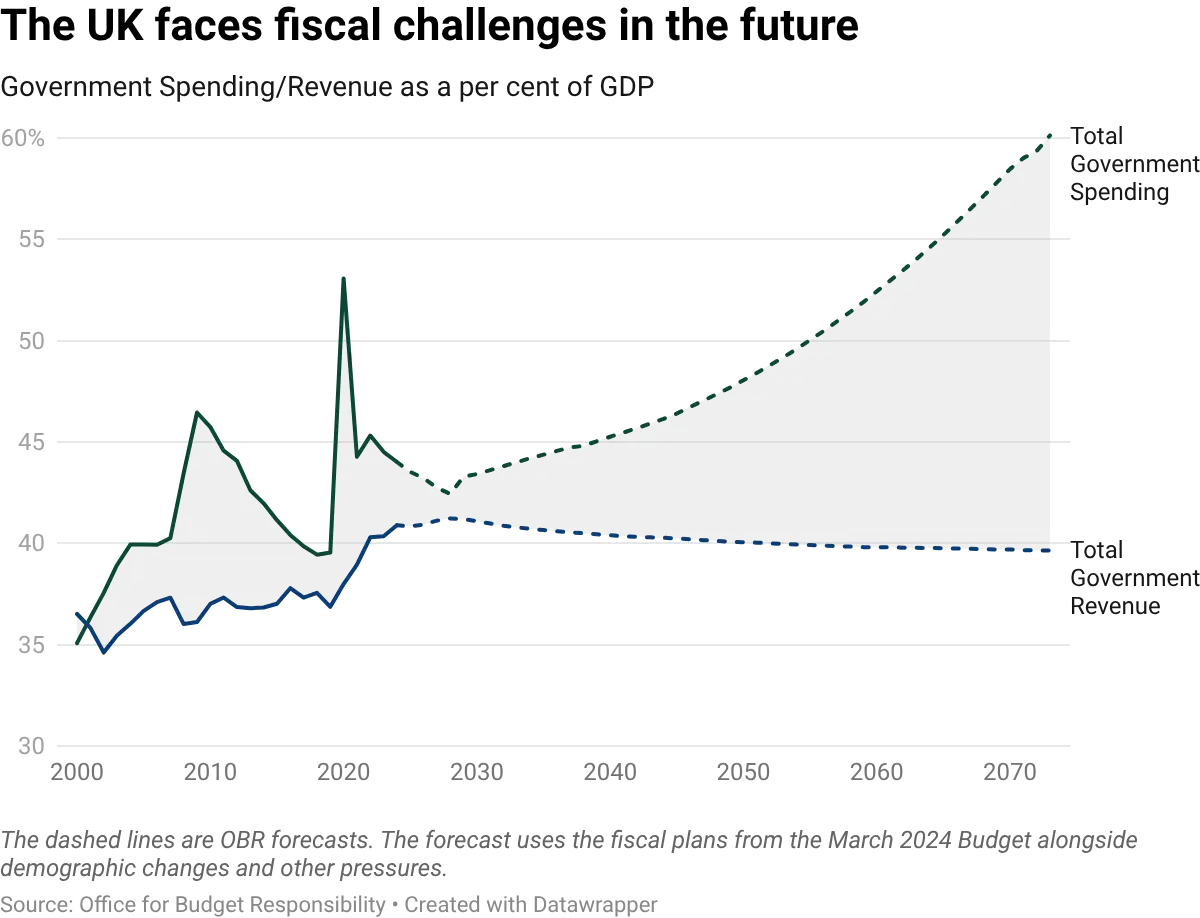
We need contributors, but we also need consent. The current system struggles to deliver either. Settlement is determined by time spent in the UK on the right visa category, not by what someone does while they are here. Flat salary thresholds ignore age and earnings trajectory, favouring older workers with lower earning potential over younger high performers with decades of tax-paying ahead. A labyrinthine system of occupation codes and carve-outs invites gaming. The UK's visa fees (among the highest in the world) deter the workers we most need to attract, while doing little to filter out those who will be net fiscal costs. And family migration can generate large lifetime fiscal deficits with no mechanism for accountability.
The result is a system that is arbitrary, reactive and politically brittle. There is, however, a foundation to build on. Voters are not opposed to all migration. Public approval tracks economic contribution.
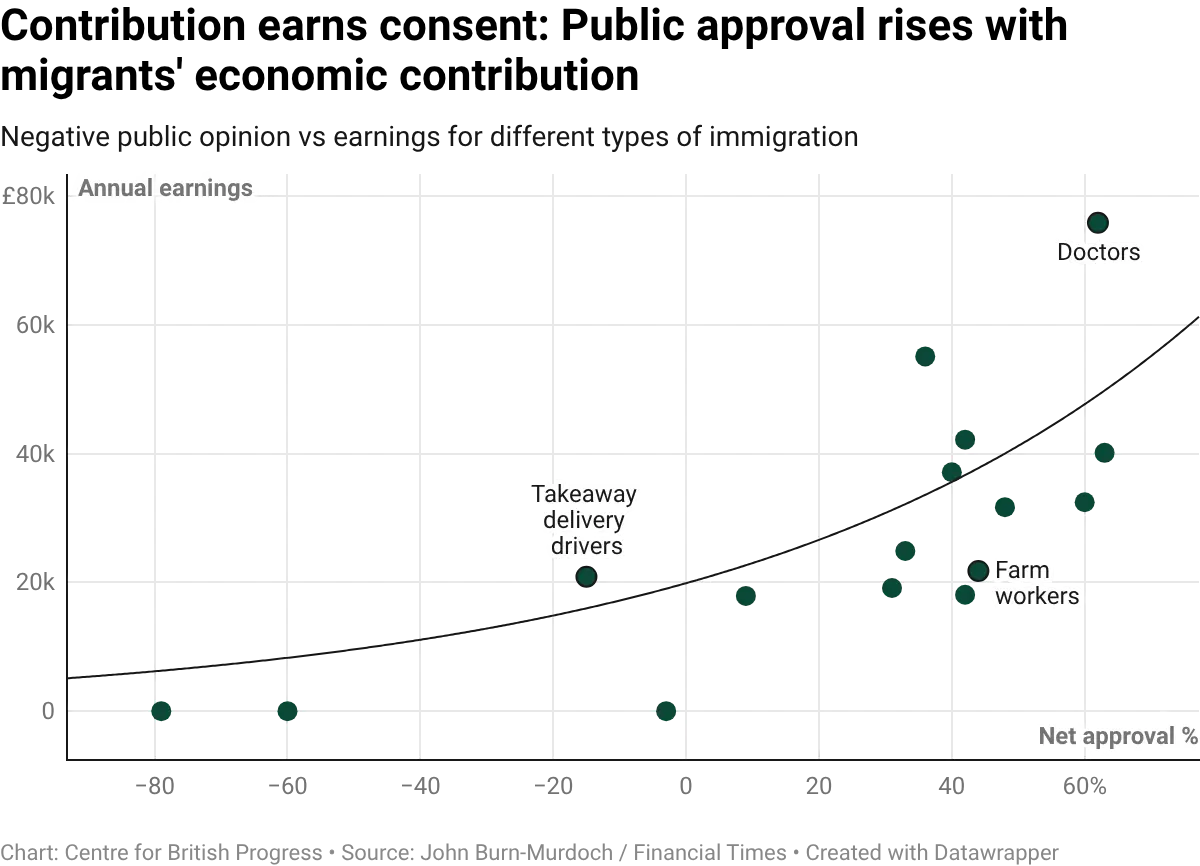
When presented with explicit trade-offs, a majority of the public favour legal migration that delivers tangible economic benefits. Voters want a system they can trust to let in people who will strengthen the country.
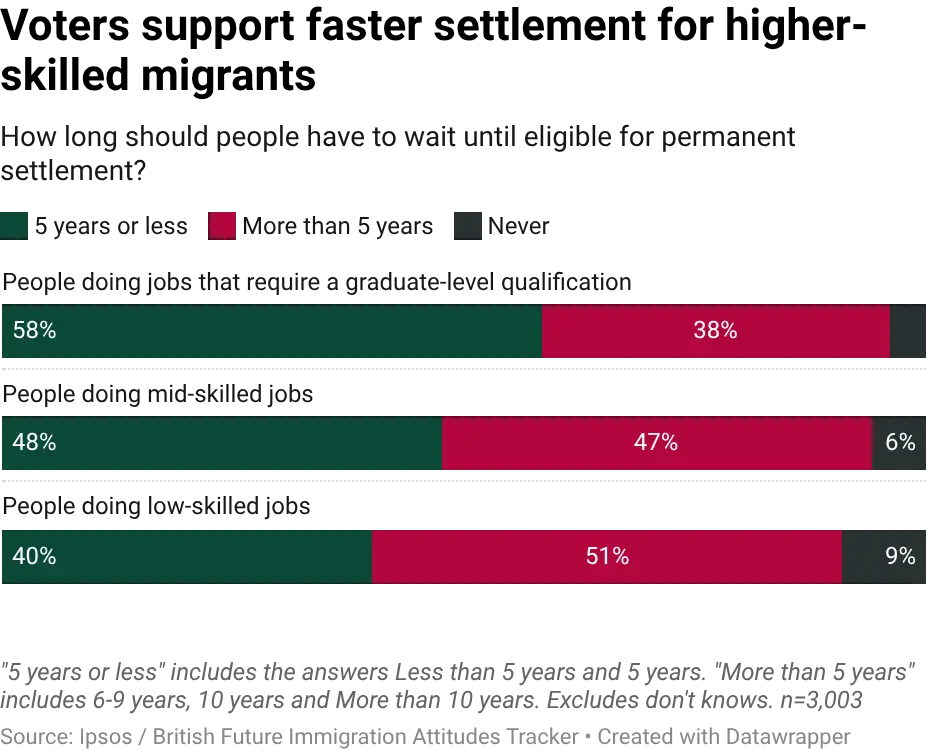
We propose a framework built around a clear deal: people can come to the UK if they contribute, and people can stay permanently if they contribute consistently over time.
To deliver on this deal, entry policy should be separated from settlement policy. Entry should be governed by what the UK needs now. Settlement (the decision to grant someone a permanent stake in British life, with full access to the welfare state) should be governed by whether that person will strengthen the country. To measure contribution, we have designed earnings benchmarks that adjust for age to ensure that migrants admitted and settled in the UK will be net contributors to the public finances over their lifetimes.
We propose five reforms:
- An annual Migration Contribution Report laid before Parliament with a transparent, route-by-route assessment of migration's fiscal impact, covering tax contributions, public service use, settlement outcomes, and the true long-term cost of public sector carve-outs.
- A points-based Skilled Worker visa that replaces the current flat salary thresholds and granular occupation codes with a transparent contributory framework. Points would be awarded based on age-adjusted earnings with a risk-buffer, adjustments for household composition and a public service top-up. The framework would make the fiscal cost of non-working dependants and children explicit.
- A contribution-accrual model for settlement, under which time spent on any visa route can count toward permanent residence, but only if the migrant meets their earnings benchmark in a given year. Settlement would still require five qualifying years, but those years would need to be earned.
- A reformed family visa assessed at the household level rather than on the sponsor's income alone. The household as a whole would need to demonstrate that it can break even fiscally, with the benchmark met through any combination of earners. Settlement via family routes would follow the same contribution-accrual principle.
- The abolition of the Immigration Health Surcharge (or at minimum the restructuring), which charges migrants thousands of pounds upfront and deters the people we want to attract. Under a properly functioning contributory system, migrants already pay their way through taxation and the IHS is redundant.
We have built this tool to help policymakers and the public understand how recommendations 2-4 would be operationalised under this system.
A contributory migration system would allow the government to make clear commitments to the public. First, that every person admitted on a Skilled Worker visa will be a net fiscal contributor over their lifetime. Second, that no household admitted through the family route will impose a net fiscal cost on the state. Third, that migration policy will, by design, raise GDP per capita.
Taken together, these commitments amount to a durable political offer: migration that strengthens the public finances, raises living standards per head, and operates under rules the public can understand and hold government to account against.
Overview of the current system
British immigration policy is currently organised around three main pathways:
- Economic routes are the largest managed category and covers workers, students who transition into work, and highly skilled individuals. The most used work route is the Skilled Worker visa, which requires employer sponsorship and meeting salary thresholds. Other routes meet specific labour needs or attract talent (e.g. Global Talent or intra-company transfers), while some act as bridges after study or as temporary mobility options (like the Graduate route, the High Potential Individual route, and the Youth Mobility Scheme).
- Family routes enable people to join close relatives who are British citizens or settled residents. Eligibility requires evidence of a genuine relationship, adequate accommodation, and meeting a minimum income requirement (currently set at £29,000 for the sponsoring partner).
- Humanitarian and protection routes cover asylum and other forms of protection for people fleeing persecution or serious harm. Those granted refugee status or humanitarian protection usually receive time-limited permission initially, with the opportunity to progress to settlement after meeting the required residence period.
Indefinite Leave to Remain (ILR) is the main form of permanent settlement. It removes time limits on stay, ends dependence on a sponsor or route conditions, and can lead to British citizenship if additional requirements are met.
ILR also marks a critical threshold for access to the welfare state. Most visa routes include a "No Recourse to Public Funds" (NRPF) condition, which restricts access to most benefits and social housing. Once someone is granted ILR, this restriction is lifted, and they gain the same entitlement to benefits, tax credits, and social housing as British citizens.
The criteria for reaching ILR is largely procedural. Some routes are directly settlement-leading, meaning time on the route automatically counts toward the standard five-year qualifying period. Others are explicitly temporary, and time spent on them does not count toward the ILR clock, regardless of what someone contributes while they are here. People on these routes may still settle by switching into a settlement-eligible route and completing the qualifying period there, or by accumulating ten years' continuous lawful residence under the long residence rule.
In practice, many people enter on transitional visas and only later move into a settlement route. The result is that the headline five-year qualifying period can understate the total time someone spends in the UK before becoming eligible for permanence, and the settlement decision does not take into account what the person has to offer the country.
Key weaknesses of our system
Settlement is arbitrary
ILR depends primarily on time spent on a settlement-leading visa, rather than what someone contributes once they are here. Some routes ‘count’ towards ILR and others don’t, even where people are working, paying tax and building long-term ties. The result is that settlement can feel like an arbitrary entitlement.
The irrationality is clearest at the extremes. The High Potential Individual route is designed to attract talented, flexible workers; 12% of HPI migrants earn £75,000 or more, which is significant given how young the cohort is. Yet time on HPI does not count towards ILR, so substantial contributors can spend years in the UK without building a pathway to permanence.
Meanwhile, a 48-year-old entering on a Skilled Worker visa at £41,700 – below the median for their age group in full-time work, with fewer remaining working years and a weaker lifetime fiscal profile – begins accruing qualifying years from day one. The system treats the second migrant as more deserving of settlement than the first, purely because of the route they entered on.
The Skilled Worker visa selects for the wrong people
The Skilled Worker system is intended to be economically valuable for the British economy, but the threshold is poorly aligned with lifetime fiscal contribution and inadvertently selects for older, less productive migrants.
A single flat salary threshold treats a 21-year-old earning £41,700 (a strong performer in the 75th percentile for their age, with decades of tax-paying ahead) as equivalent to a 50-year-old on the same salary, who sits below the median for their cohort and has far fewer remaining working years. The system excludes high-potential younger workers while admitting average-earning older ones who will contribute less over their lifetimes.
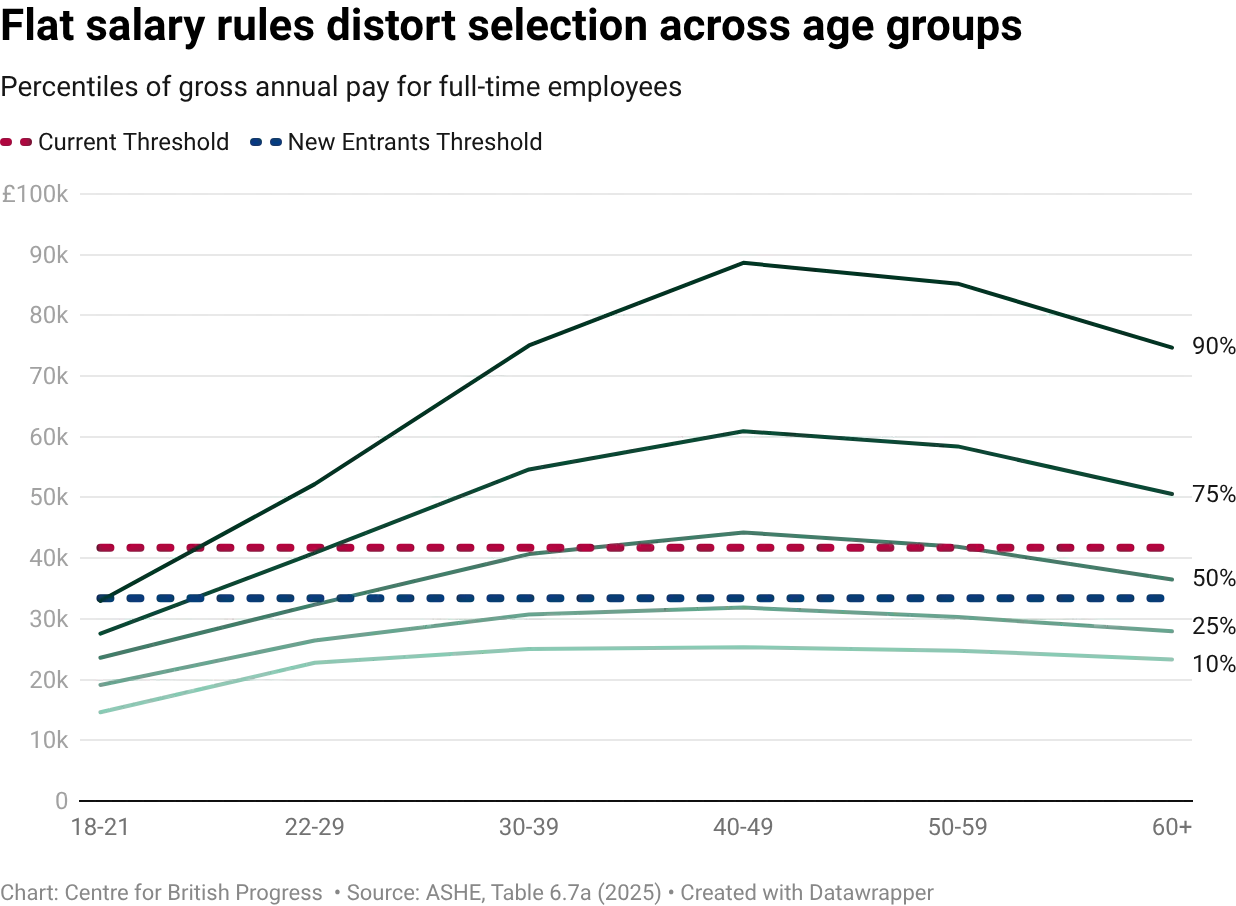
Rather than fixing this structural flaw, the system patches around it with a growing web of discounted thresholds and exemptions. The ‘new entrants’ rate can drop as low as £33,400, which for a 30-year-old puts the bar at around the 30th percentile of full-time earnings for that age group. The result is a system that is simultaneously too restrictive for young high performers and too permissive for older, lower-trajectory workers, while being complex enough to invite gaming.
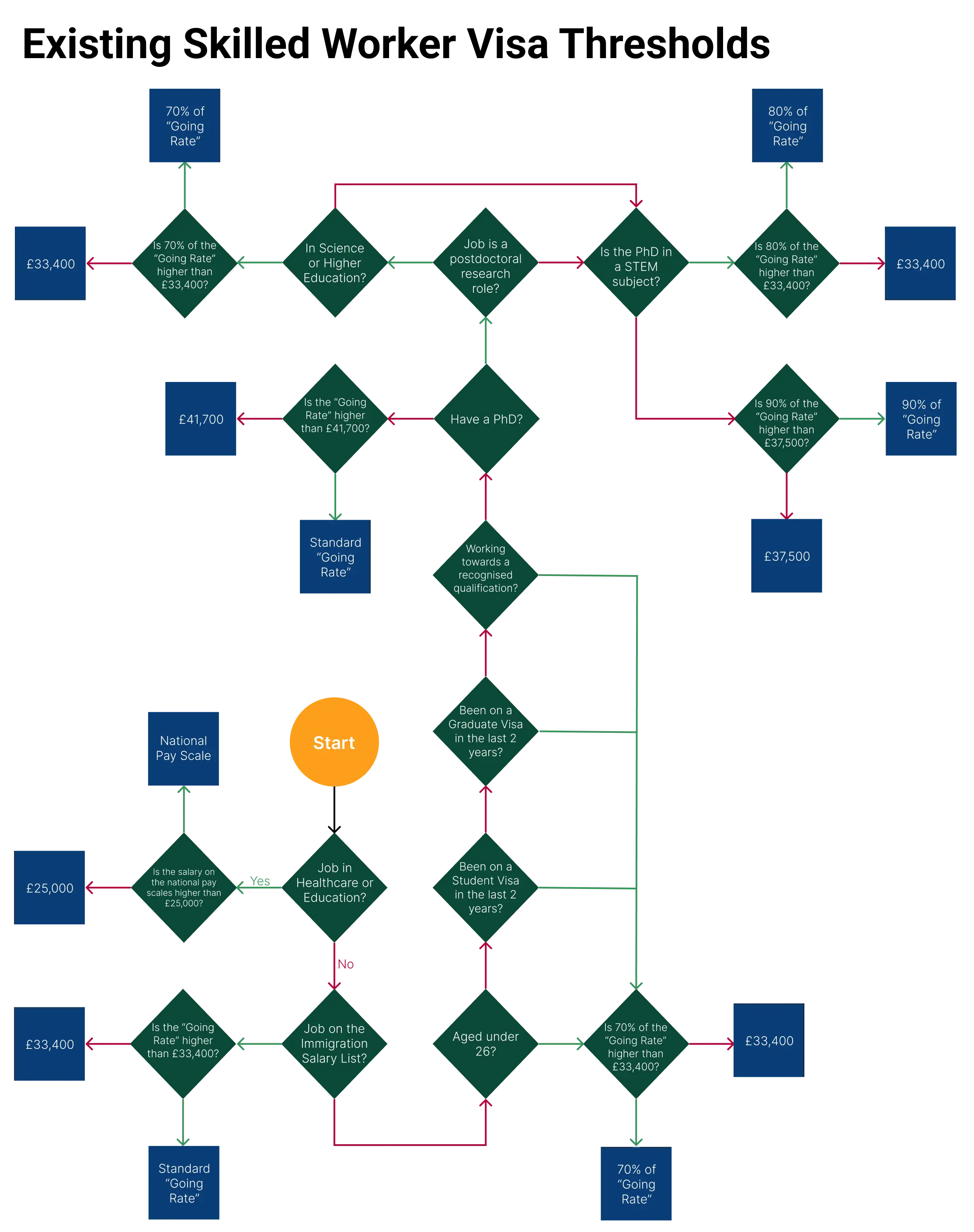
Granular occupation codes and job-title-specific "going rates" compound the problem. National going rates are pulled upward by London salaries, disadvantaging employers outside the South East and blocking hires that make economic sense locally. Job titles in the modern service economy are fluid and ambiguous, and the system encourages employers to choose whichever occupation code makes sponsorship easiest rather than the one that best describes the role. Other countries that prioritise long-run contribution avoid this micromanagement, relying on broad signals (wages, age, skills, language) rather than trying to centrally price thousands of job titles.
Visa fees are a blunt instrument that deter the wrong people
The UK's visa fees are among the highest in the world. The Immigration Health Surcharge alone costs £1,035 per person per year, charged upfront for the entire visa duration. For a family of four on a five-year Skilled Worker visa, the IHS bill exceeds £20,000, paid as a lump sum before arrival, on top of application fees.
The usual justification is that fees ensure migrants are not a net cost to the state. But the charge is insufficient to cover the fiscal cost of net-negative groups. Meanwhile, upfront costs likely select against higher earners and fiscal contribution because fee sensitivity varies by migrant type.
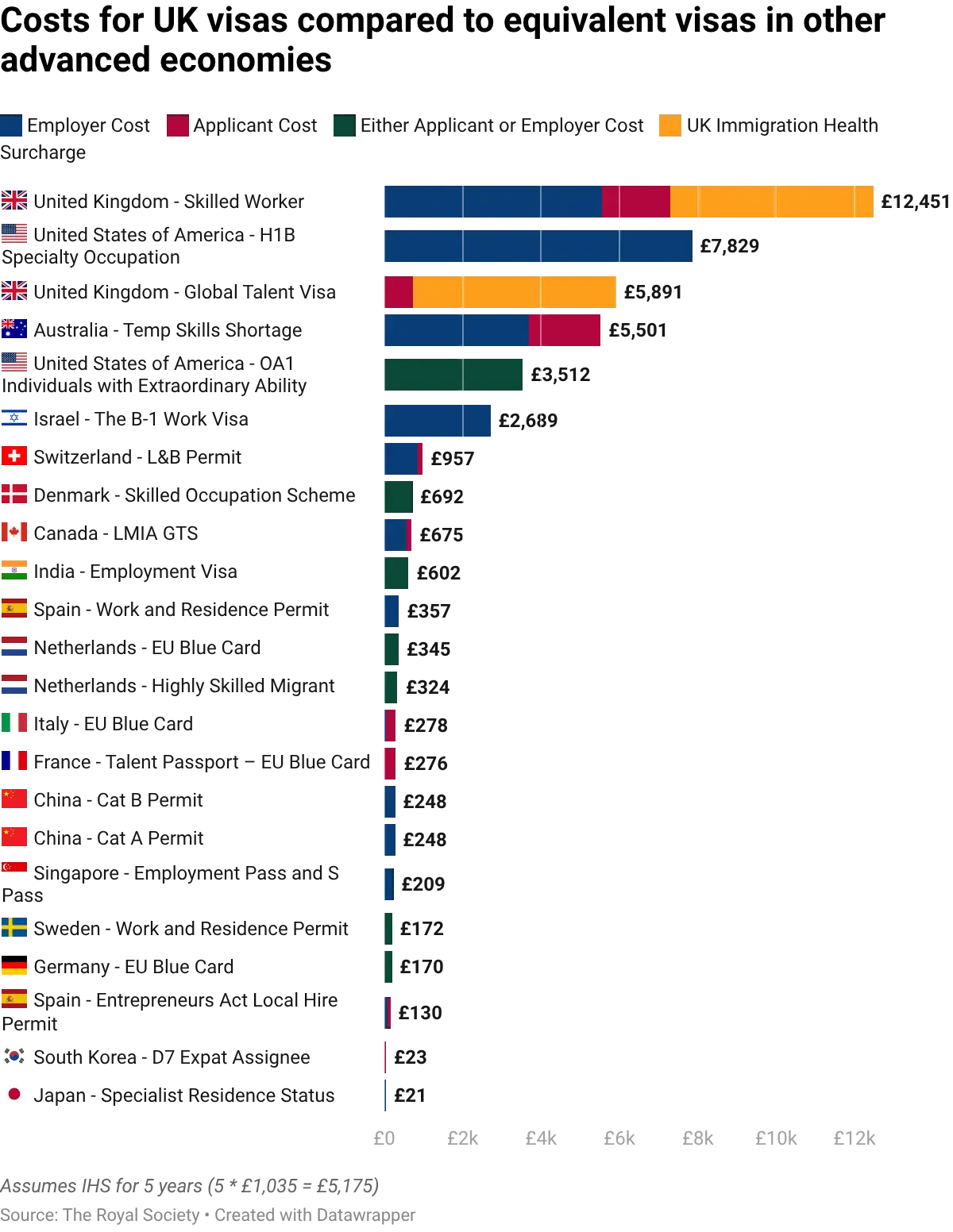
For migrants from lower-income countries, the UK wage premium is so large that even steep upfront costs rarely change the decision to come. A nurse from the Philippines or a care worker from Nigeria faces a fee equivalent to several months' local salary, but lifetime UK earnings are still many multiples higher. And those deterred can often be replaced by others with similar profiles and similar fiscal trajectories. The fee filters, but not for higher contribution.
For researchers, entrepreneurs, and high earners from wealthier countries, the calculus is different. They have credible alternatives (like Canada, Australia, the United States) where comparable health charges either do not exist or are substantially lower. For globally mobile workers, especially those with families, a £20,000+ upfront bill is a reason to go elsewhere. No other major advanced economy imposes a comparable lump-sum; the standard approach is monthly payments through insurance or public systems.
Country | Health Cost Requirement for Work Visas | Upfront Cost? |
|---|---|---|
United Kingdom | NHS Surcharge: £1,035 per person/year | Yes (£5,175 for 5 years per person) |
United States | Employer/private health insurance required | No (monthly payments) |
Germany | Public/private insurance required | No (monthly payments) |
Australia | Overseas Visitor Health Cover (private insurance) | No (monthly payments) |
Canada | Provincial healthcare or private insurance | No (monthly payments) |
The IHS only raises roughly £2.5 billion annually, is a poor proxy for long-run fiscal value, and deters the high-productivity workers the UK should be competing hardest to attract.
Family visas generate large fiscal deficits with no accountability
The Migration Advisory Committee's 2024 fiscal analysis found that the 2022/23 cohort of Partner route applicants will generate an average net lifetime fiscal deficit of £109,000 per person. This figure already accounts for the savings from the NRPF condition and ILR application fees; without those restrictions, the deficit rises to £126,000.
Comparing this to the average UK resident's lifetime fiscal contribution of −£39,000 understates the problem, because the UK population includes many older people who have already contributed through decades of work. When the age distribution is adjusted to match the Partner cohort’s demographics, the comparable figure for UK residents is +£110,000.
Family visa holders are therefore not just more expensive than the average citizen, they are roughly £220,000 more expensive than demographically comparable citizens. This is remarkable given that migrants should, in principle, be cheaper: the UK bore none of the costs of their childhood education, healthcare, or upbringing.
The minimum income requirement for sponsoring a partner (£29,000) is set far too low to offset these costs. It treats family reunification as a categorical entitlement triggered by a minimal earnings threshold, rather than as a decision that weighs family rights against fiscal sustainability. The result is an implicit fiscal transfer that is neither acknowledged nor debated.
Public sector carve-outs hide long-term fiscal costs
The current system includes discounted salary thresholds designed to ease recruitment pressures in public sector roles. These carve-outs are typically justified as necessary to fill essential vacancies that the state cannot afford to fill at market rates.
But when the state struggles to recruit at the wages it has set, lowering the migration threshold is faster and cheaper than raising pay. Because the long-term fiscal costs of that choice are never measured, there is no mechanism to check whether it represents genuine value.
The immediate saving is easy to measure; the lifetime cost of admitting and settling a worker below the contribution threshold is not. A nurse recruited on a discounted threshold of £25,000 reduces the NHS staffing bill today, but if they settle and their lifetime fiscal contribution falls short of what they draw from the system, the saving is a cost deferred, not avoided.
The problem is compounded by the absence of any reporting on these trade-offs. There is no public, route-by-route accounting of what different migration categories (including carve-outs) are expected to cost or contribute over the long term. A well-functioning system would force trade-offs into the open: quantifying lifetime fiscal impacts, publishing the results transparently, and requiring policymakers to justify any gaps.
A contributory migration system
A well-designed migration system should be judged by whether it is financially sustainable, politically credible, and fair to both the public who fund it and the migrants who live under its rules. A contributory framework is the best way to meet all three tests.
This system is built around a simple bargain:
- People can come to the UK if they contribute.
- People can stay if they contribute consistently over time.
- Settlement is earned through demonstrated behaviour, not granted automatically.
This framework does not prevent the UK from pursuing other objectives like meeting humanitarian obligations, supporting universities, or delivering strategic mobility agreements. But it strengthens the core of the system by making the long-term costs and trade-offs of those choices explicit, and by aligning the most consequential decision in the system (who gets to stay permanently) with the thing that matters most for the country's future.
Contribution should be the organising principle
The UK faces a structural fiscal challenge. An ageing population is driving up spending on health, social care, and pensions, while weak productivity growth limits the tax revenues needed to fund them. In this environment, migration must strengthen the state's balance sheet over the long run. A system that admits and retains net contributors reduces pressure on public finances and helps sustain public services.
This can be achieved through a self-correcting mechanism. If contribution benchmarks are pegged to median earnings and updated annually, the system adapts automatically to wage growth, inflation, and shifting spending pressures, without requiring constant political intervention. This is a system designed to outlast any single parliament.
It is also a system the public can understand and support. Voters are less concerned with headline migration numbers than with whether the system feels controlled, consistent, and fair. Polling consistently shows that the public distinguishes sharply between migrants perceived as high contributors and those perceived as low contributors.
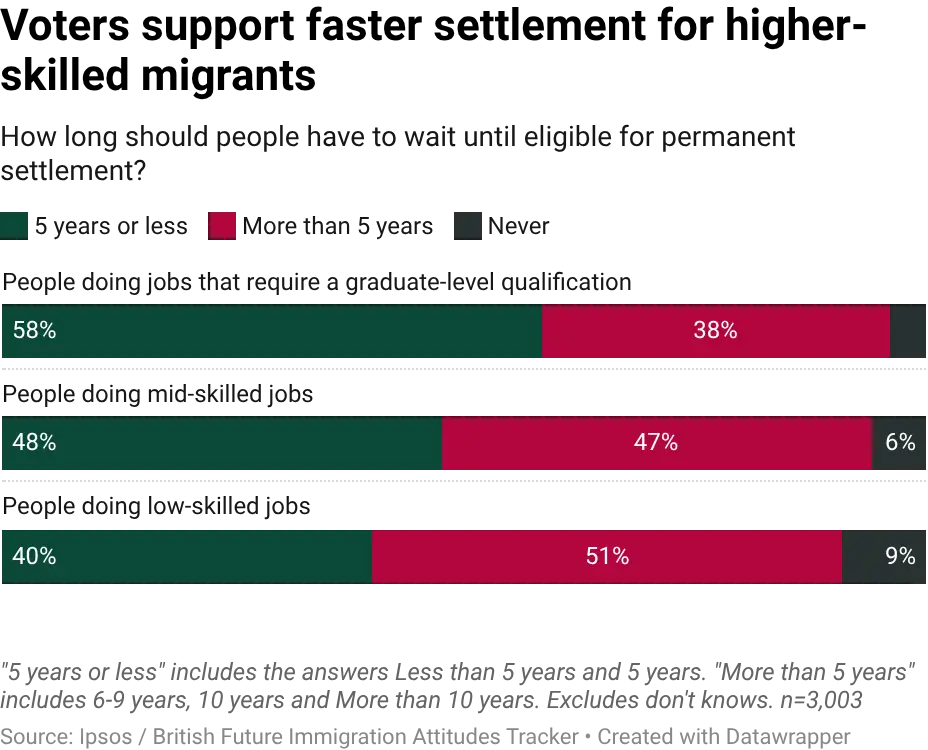
And it is fairer for everyone. Fairness to taxpayers means recognising that the public has a legitimate interest in whether migration strengthens the country. Fairness to migrants means predictable rules: periodic tinkering at routes, thresholds, and caps is highly destabilising and demoralising.
The case for separating settlement policy from visa policy
Under the current system, entry policy and settlement policy are currently tightly coupled. Some visas lead to settlement; others do not. This produces arbitrary outcomes and forces governments into constant changes in visa design to respond to political pressure, without a view towards long-term migration strategy.
Entry and settlement are fundamentally different decisions and should rest on different principles. Entry policy should be guided by what the UK needs now: which roles need filling, which skills are in short supply, which strategic relationships the government wants to support. These are tactical, medium-term judgments that will change as the economy evolves.
Settlement is a different matter entirely. Granting someone ILR means recognising them as a permanent member of the national community with an unconditional claim on the welfare state. That decision should be based on whether the person has demonstrated, through years of sustained contribution, that they will strengthen the country over the long run, through fiscal contribution, through economic participation and integration, and through consistent compliance with the rules.
This separation is not novel. Countries like Canada, Australia, and New Zealand treat entry and settlement as distinct legal processes. In each case, entry is a tactical tool – temporary permits issued to meet labour market needs, with no automatic promise of permanence. Settlement is a separate, meritocratic assessment where candidates must demonstrate long-term value through earnings, age profile, language ability, and integration. The UK is unusual among comparable countries in coupling the two so tightly.
Defining and measuring contribution
A contributory system depends on a clear, workable answer to the question: what does it mean to contribute?
The most workable basis for settlement policy is lifetime fiscal contribution, because it:
- Reflects value creation: productive work generates tax revenue, supports public services, and sustains the social infrastructure from which all residents benefit.
- Aligns incentives: it encourages participation in the labour market, professional development, and integration.
- Is measurable and transparent: economic contribution can be verified through employment and tax records, reducing room for gaming or arbitrary decision-making.
- Is fair and aspirational: it rewards effort and success, not origin or privilege: people are judged by what they give, not where they come from.
English language ability, good character, and compliance with the law all matter too, and the current system already filters for them. But lifetime fiscal contribution is the dimension the current system fails to capture, and it is the one most directly relevant to whether migration strengthens or weakens the public finances.
Lifetime contribution is not the same as a salary snapshot at a single point in time. Two people earning identical salaries could have radically different lifetime contributions depending on their age, career trajectory, and remaining years in the workforce. Any workable benchmark must reflect this.
Many countries already build age into their migration systems. Canada awards the most points to applicants in their mid-20s to early 30s, declining to zero around 45. Australia's skilled points test similarly favours prime working ages. Several European systems also include age as a formal criterion.
We propose contribution benchmarks that are age-adjusted, so that younger workers face lower thresholds reflecting their longer contribution horizon while older workers must earn more to offset shorter remaining careers. The benchmarks should be pegged to median wage growth and updated annually, so they evolve with the economy without requiring political renegotiation.
For economic routes, they should be set above the fiscal break-even point with a risk buffer, to account for the ordinary disruptions of working life (periods of unemployment, career breaks, economic downturns) that mean not every qualifying year will deliver the modelled contribution.
Modelling based on current wages would suggest contribution benchmarks at the following minimum salaries:
Age | 10% risk buffer | 15% risk buffer | 20% risk buffer |
|---|---|---|---|
21 | £26,000 | £27,000 | £29,000 |
25 | £27,000 | £28,000 | £30,000 |
30 | £35,000 | £37,000 | £39,000 |
35 | £44,000 | £46,000 | £48,000 |
40 | £51,000 | £54,000 | £56,000 |
45 | £59,000 | £62,000 | £65,000 |
50 | £72,000 | £76,000 | £79,000 |
55 | £86,000 | £90,000 | £93,000 |
These benchmarks can then be applied consistently across the system, informing entry thresholds, settlement criteria, and the assessment of household-level contribution on family routes.
Policy Recommendations
1. Introduce an annual ‘Migration Contribution Report’
The most consequential fiscal decisions in the migration system are currently made without a systematic evidence base. There is no public, route-by-route accounting of what different categories of migration cost or contribute over the long term. Policymaking is instead driven by headline volumes, political pressure, and short-run recruitment needs.
The government should introduce an annual Migration Contribution Report, laid before Parliament, providing a transparent assessment of migration's fiscal impact across the entire system. The report should:
1. Provide fiscal impact assessments across the entire migration system
- Assess both short-term fiscal effects and projected long-term fiscal impacts
- Break down analysis by visa route, entry cohort, and age group
- Cover all categories, including non-economic routes (for example, family, humanitarian, student)
2. Track settlement outcomes for those granted ILR
- For each route, cohort, and age group, report:
- Labour market participation: employment rate, unemployment rate, and detailed breakdown of economic inactivity (studying, long-term sick or disabled, retired, looking after home or family)
- Work intensity and type: average hours worked per week and occupation categories
- Housing status: proportion in social renting, private renting, and owner-occupation
3. Evaluate the cost of public sector carve-outs
- Where salary thresholds are reduced for public sector roles (e.g. NHS, education):
- Quantify the immediate benefit: how much the lower threshold saves in recruitment and wage costs
- Assess the long-term fiscal trade-off: expected lifetime tax contribution versus expected use of public services and benefits
- Present the results transparently so policymakers can judge whether the short-term savings justify the long-term fiscal cost
- Adjust ‘public contribution points’ (see ‘Reform the Skilled Worker visa’) based on this evaluation
This data should then be used by policymakers to evaluate whether the visa and settlement criteria are yielding sustained net contribution over time and are financially beneficial for Britain. Over time, this would help policymakers identify where adjustments are needed; for example where a route is systematically producing low lifetime contributions or high long-run fiscal costs.
2. Reform the Skilled Worker visa
The current Skilled Worker visa relies on flat salary thresholds that ignore age and earnings trajectory, sector-specific exemptions that invite lobbying and complexity, and job-title codes that bear little relation to actual economic value. The result is a system that is difficult to justify, easy to game, and often selects the wrong people.
We propose replacing the current system with a points-based Skilled Worker visa built around a transparent contributory framework. Rather than trying to centrally price hundreds of individual job titles, the reformed system would use a single set of age-adjusted earnings benchmarks.
How the points system works
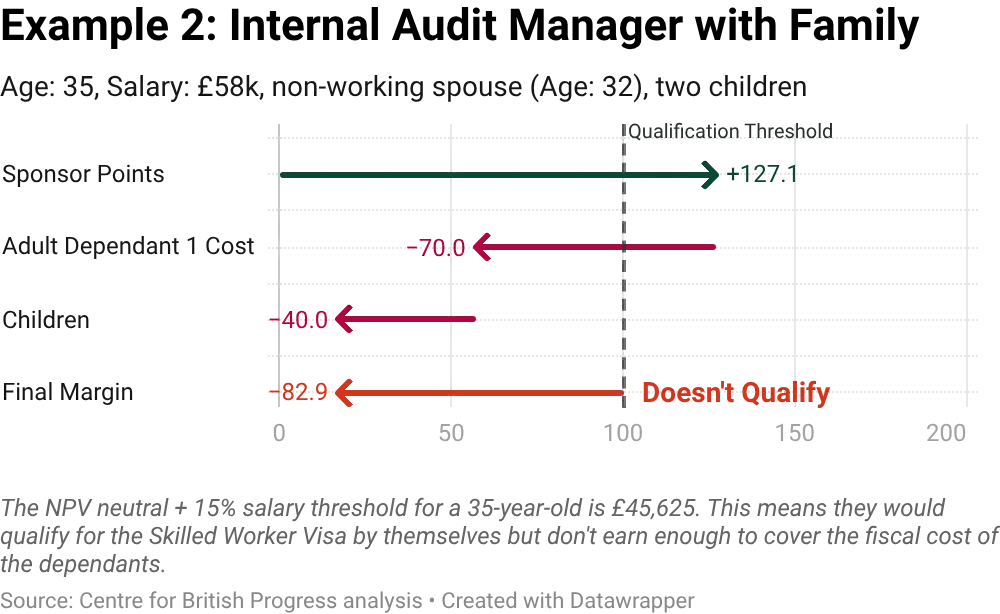
The reformed system requires applicants to accumulate 100 points to qualify for a Skilled Worker visa, plus additional points to cover any dependants they wish to bring. The 100-point baseline corresponds to meeting the age-adjusted earnings benchmark (plus risk buffer) for the applicant's age: a single applicant who earns at exactly the fiscally neutral threshold for their age scores precisely 100 points.
Applicants can get additional points in several ways: by earning a higher salary, by having an adult dependant take up sponsored work and contribute to the household's overall points total, or by combining moderate earnings with other factors such as the public service bonus.
The system works by taking into account five factors:
- Salary level: Salary points are awarded based on meeting or exceeding age-specific earnings benchmarks calibrated to ensure lifetime fiscal contribution. These benchmarks account for remaining working years and typical earnings trajectories, and are pegged to median wage growth and updated annually.
- Adult dependency adjustment: Each non-working adult dependant requires additional points. We recommend setting this at 70% of their age-adjusted benchmark threshold, drawing on the original OECD equivalence scale.
- Child dependency adjustment: Each dependant child should require additional points. We recommend setting this at 20 points per child; substantially less than adult dependants. This is because, while children impose short-term costs (education, healthcare), they likely represent future taxpayers. The reduced points requirement reflects this trade-off: children are not fiscally free, but they are a long-term investment in the tax base, which may be especially important considering our demographic challenges.
- Public service points top-up: Workers in designated critical public services should receive bonus points. We recommend setting this at a top-up of 50 points. This allows public service workers to qualify at lower salaries. The bonus would be time-limited and conditional (only applied while employed in the designated role), adjustable based on evidence of outcomes, and capped to ensure minimum contribution levels are maintained.
- Hard requirements: Regardless of points, all applicants would also need:
- English language proficiency
- Clean criminal record
- Employer sponsorship
- Genuine job offer in a skilled occupation
- NRPF during the visa period
.webp)
Example scenarios
The following scenarios illustrate how the reformed system would apply in practice, using our recommended points allocation and a 15% risk buffer. You can adjust the points allocation and risk buffer to see how different variables affect the model here.


3. Reform ILR and Settlement Policy
ILR is the most consequential decision in the migration system. It grants permanent residence, removes visa conditions, opens access to the full welfare state, and is a key step towards citizenship. Yet under the current system, ILR is largely a function of time served on the right visa category. This weakens public confidence, creates arbitrary outcomes, and fails to reward the behaviours the system claims to value.
We recommend replacing the current time-served model with a contribution-accrual system: every year you meet your benchmark counts toward settlement, regardless of which visa route you are on. Every year you fall short does not count, but it does not reset the clock either.
This makes the system fairer, because it judges people on what they actually do in the UK. And it makes the system more transparent, because the pathway to permanence is clear from day one. Anyone can look at the age-adjusted benchmarks, check their own earnings, and know whether they are on track for settlement.
How ILR accrual works
Each year spent lawfully in the UK on any visa route (including routes currently classified as temporary) can count as a qualifying year toward ILR, provided the individual meets their age-adjusted annual contribution benchmark. Years in which the benchmark is not met do not count, but they are neither penalised nor backdated.
Eligibility for ILR would still require five qualifying years, but these years would not need to be consecutive. Once five have been accrued, the individual becomes eligible to apply for ILR, subject to standard requirements on good character, English language, and compliance.
For example, an applicant could have the following pathway to settlement:
- Year 1: On HPI visa, earn above benchmark → 1 qualifying year
- Year 2: On HPI visa, earn below benchmark (career break) → 0 qualifying years (total: 1)
- Year 3-6: On Skilled worker visa, above benchmark → 4 more qualifying years (total: 5, now eligible for ILR)
Children under 18 are included in the main visa holder's application, with each child adding 20 points to the household's required contribution. Time spent in the UK as a child counts toward that child's own ILR accrual. Once they turn 18, they must meet their own age-adjusted benchmark for further years to count. For example, a child who arrives at age 15 accrues three qualifying years automatically, then needs two more at their own benchmark after turning 18.
Non-working adult dependants add 70% of their own age-adjusted benchmark to the household's required contribution, consistent with the OECD equivalence scale rationale. This can be met either by the main applicant earning enough to cover both benchmarks, or by the dependant working and contributing to the household total.
This system has various benefits:
- It creates better incentives. Qualifying years depend on verified earnings reported to HMRC, giving individuals stronger reasons to remain in formal employment and declare income accurately. Higher earnings make settlement more attainable, encouraging labour market participation and skill development.
- It removes arbitrary route distinctions. A high-earning graduate on HPI and a moderate-earning Skilled Worker are both assessed on their demonstrated contribution.
- It matches public expectations. Polling shows voters support settlement for people who contribute over time, and that support varies with perceived economic value.
Example scenarios
These are some example scenarios to see how the proposed settlement policy would look like in practice, using our recommended points allocation and risk buffer (15%). You can change the points allocation and risk buffer to see how different variables affect the model here.



4. Reform Family Visa routes
Family migration currently requires the UK sponsor to meet a Minimum Income Requirement (MIR), which is currently £29,000. This approach has two problems. First, it focuses only on the sponsor's income and ignores the household's total contribution. Second, it sets the bar at the same level regardless of household size or composition, ignoring the household’s total cost. As a result, the family visa route generates large lifetime fiscal deficits with no mechanism for accountability.
Family migration is one of the clearest cases where the system must balance competing interests. Article 8 protects the right to family life, but that right is not absolute. It can be qualified in pursuit of legitimate aims, including the economic wellbeing of the country and effective immigration control. The Supreme Court upheld the MIR on precisely this basis. It is proportionate to require families to demonstrate they can be maintained without recourse to public funds. That is a fiscal fairness rationale, rooted in the public's legitimate interest in the sustainability of the welfare state.
A contributory system would honour the same principle more honestly, by assessing family migration at the household level, calibrating the requirement to actual fiscal cost, and tying settlement to demonstrated contribution over time.
Entry: household-level contribution test
We recommend replacing the current flat income requirement with a household-level benchmark set at net-zero fiscal contribution. This means the household as a whole must be expected to break even fiscally, neither adding to nor drawing from the public finances over time.
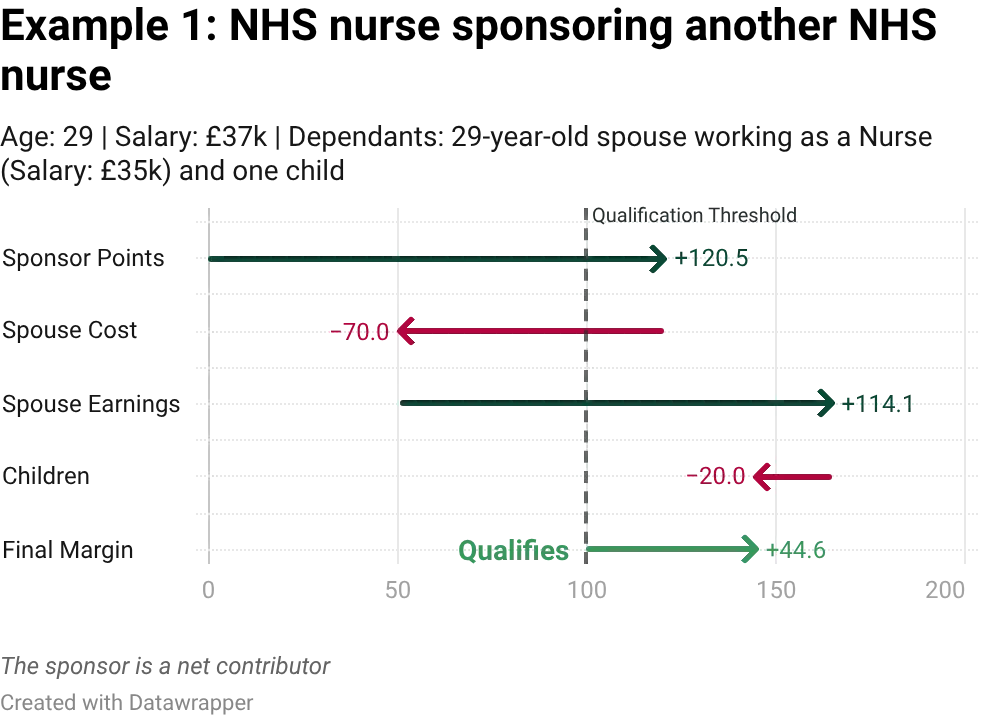
The test can be met by any combination of earners within the household. The sponsor could meet it alone, the joining family member could meet it alone, or both could contribute together. A household where the sponsor earns £40,000 and the partner earns £20,000 (proven either through a sponsored job offer or through median earnings over the past 2-3 years) would be assessed on their combined £60,000.
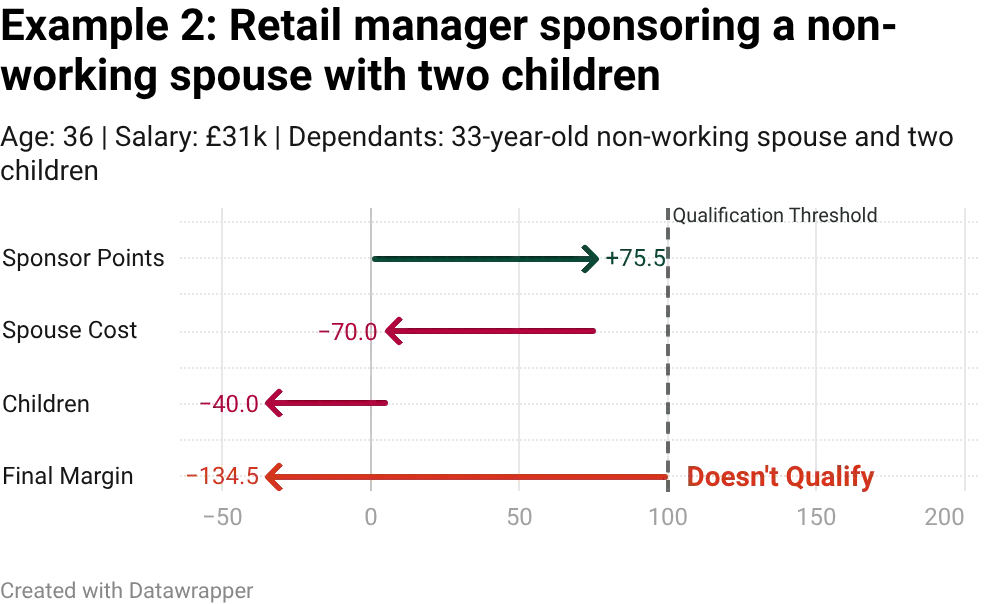
This is fairer than the current system, which ignores the joining partner's potential earning potential, penalising households where the sponsor earns modestly but the partner would also work, while waving through households where a single earner barely clears £29,000 and the partner has no intention of entering the labour market. The family route benchmark should carry no risk buffer, unlike economic migration routes, to reflect the importance of family unification. This would yield the following benchmarks:
Age | Break-even threshold |
|---|---|
21 | £24,000 |
25 | £25,000 |
30 | £32,000 |
35 | £40,000 |
40 | £47,000 |
45 | £54,000 |
50 | £66,000 |
55 | £78,000 |
Settlement: contribution-accrual on a household basis
For ILR via family routes, the household must meet or exceed the family route settlement benchmark for five qualifying years before settlement is granted. This follows the same contribution-accrual logic as recommendation 3, but assessed without a risk buffer.
Each year the household meets the benchmark counts as one qualifying year toward ILR. Years where the benchmark is not met do not count, but do not reset the clock. The five years do not need to be consecutive. Once the household has accrued five qualifying years and meets standard requirements, they become eligible for ILR. This brings the family route into alignment with the rest of the system and creates a clear incentive for both partners to participate in the labour market.
Example scenarios
These are some example scenarios using our recommended points allocation and no risk buffer. You can change the points allocation and risk buffer to see how different variables affect the model here.

5. Reform the Immigration Health Surcharge
The contributory framework does what the IHS is meant to do (ensure migrants are not a net cost to the state and contribute to public services like the NHS) but does so more effectively. Migrants who meet age-adjusted earnings thresholds year after year will contribute far more through income tax and National Insurance than they ever would through a one-off upfront charge.
The IHS also deters the wrong people. Higher earners and exceptional talent have credible alternatives in countries that impose no comparable lump-sum healthcare charge. For these workers, especially those with families, the IHS is a reason to go elsewhere. Meanwhile, for migrants from lower-income countries where the UK wage premium is overwhelming, even steep fees rarely change the decision to come.
The ~£2.5 billion annual revenue from the IHS is modest relative to the income tax and National Insurance that net contributors pay over their lifetimes. A single high earner on a Skilled Worker visa will contribute more in five years of income tax than they pay in IHS fees. A contributory system would significantly strengthen the overall fiscal position by attracting and retaining productive workers more effectively than the current IHS charge.
We therefore recommend abolishing the IHS entirely. If abolition is not politically feasible, the IHS should at minimum be restructured as an annual charge rather than a lump-sum payment covering multiple years. This would reduce the upfront financial barrier that disproportionately deters younger, high-potential workers while allowing migrants to pay only for years they actually remain in the UK. Annual payment could be made a condition of both lawful residence and ILR accrual, ensuring compliance.
Appendices
For more information about our initiative, partnerships, or support, get in touch with us at:
[email protected]For more information about our initiative, partnerships, or support, get in touch with us at:
[email protected]