.webp&w=1920&q=75)
Table of Contents
- 1. Introduction
- 2. Dodgy Shops
- 3. Phoenixing
- 4. Conclusion
- 5. Acknowledgements
- 6. Authors
Introduction
Some of the issues closest to voters’ hearts include the state of their high street, a sense of national decline and a concern for crime that goes unpunished. Perhaps no issue so neatly ties those issues together as the spread of dodgy shops and rogue traders on high streets across the country.
What might appear as an undifferentiated mass of shady establishments breaks down into two separate but overlapping issues: the general spread of dodgy shops and the specific phenomenon of phoenixing, where an individual cycles through companies to accumulate debts they have no intention of ever repaying.
This paper treats each issue in turn, concluding with a number of recommendations.
The key proposal is to introduce a clear ‘two strikes and out’ legal standard. allowing local authorities to shutter shops once they have violated two local or national ordinances within a 12 month period.
Four further important recommendations are to
- Place the burden of proof on directors of insolvent companies to demonstrate good conduct before they can serve as a director again for a five year period.
- Make basic changes to improve the transparency of corporate and legal records, including assigning a publicly identifiable unique number to each individual
- Work with the NCA Remuneration Review Body to address longstanding funding shortfalls for the NCA, including bringing pay up to parity with the police
- Accede to a Public Accounts Committee recommendation to publicly state the amount required for HMRC to meet its enforcement obligations and commit to meeting that funding gap
Dodgy Shops
Background
One of the most pernicious trends in recent years is the spread of dodgy shops on high streets in the UK. This kind of shady establishment typically attracts little custom while operating as a front for money laundering, the sale of illicit goods or other crimes. The archetype is the barber shop, nail salon, vape shop or other cash-intensive business.
For years, local residents and representatives have had their suspicions. Now, the evidence is piling up. Few believe that the astronomical rise in barber shops, from 1.4 per 10,000 people in 2013 to 3.1 per 10,000 in 2023, reflects a surge in demand for hairdressing services. One report looked at the number of companies with generic names in cash-intensive industries which shut down within months of incorporation. From 2016-2018 to 2023-2025, the number of incorporations in the UK fitting this description rose by more than 350%.
The spread of these dodgy shops is destructive to the public realm and legitimate competitors alike. A genuine barber shop cannot hope to compete with a rival paying no tax. A competitor unbound by the normal laws of supply and demand will artificially inflate local rents to the detriment of genuine local businesses. Some retailers estimate that they have lost tens of thousands of pounds in annual revenue to competitors selling black market goods. Then there is the cumulative impact on the local economy of falling footfall as locals choose to stay away from a high street in decline.
Legal action against illicit establishments has produced a steady flow of case studies. There was, for example, the car wash in Caerphilly whose proprietors were jailed for using the premises as a front to smuggle hundreds of people across Europe. This was part of a far broader trend that sees £1 billion laundered through British high streets every year.
NCA Gone AWOL
When it comes to combatting dodgy shops, the problem lies principally with the state of the UK’s law enforcement bodies. Foremost amongst these is the National Crime Agency (NCA), the UK’s lead institution against serious and organised crime. The story of underinvestment that recurs across the public sector applies with particular force in the case of the NCA. The UK’s premier force against organised crime has suffered from a destructive combination of low pay, deficient staffing and underinvestment.
While there are many metrics to demonstrate that NCA pay has fallen short, the most instructive is a comparison with their peers in the police. Despite its billing as the premier agency against organised crime, median pay at the Grade 5 level is £7743 lower than the equivalent rank of police constable, a trend reflected across organisational grades.
Rank | Pay Differential (2024) |
|---|---|
Constable/NCA Grade 5 | £7,743 |
Sergeant/NCA Grade 4 | £6,633 |
Chief Inspector/NCA Grade 3 | £11,295 |
Superintendent/NCA Grade 2 | £24,449 |
Chief Superintendent/NCA Grade 1 | £29,680 |
Source: National Crime Agency
The level of pay is only part of the problem. A failure over many years to establish a systematic mechanism to allow employees to progress within pay bands has meant that while 1.9% of officers are at the maximum of a pay scale, 71% are marooned at the bottom of their pay band. By contrast, police officers typically progress through annual pay points within each band. Against this background, it is hardly surprising that annual turnover in the NCA reached 24% among senior managers and as high as 41% in certain critical teams. As the National Crime Agency Remuneration Review Body emphasised in its report for 2025, there is an “urgent need to address pay reform” at the NCA.
Where there are problems with pay, issues of understaffing unsurprisingly follow. Here too the signs are all around. There is, for example, the determination of the Financial Action Taskforce (FATF) - an intergovernmental organisation that sets standards internationally on money laundering - that staffing within the NCA’s UK Financial Intelligence Unit was lagging at just 141 employees, despite recommendations from FATF fully 15 years earlier to expand its staff to at least 200. The understaffing issues are equally made clear by the £93.7 million spent on temporary staff and consultants in 2023/24, an eyewatering 369% increase from 2015/16.
While the current Government has improved upon its Conservative predecessor by offering a more generous pay award - and setting up a dedicated High Street Organised Crime Unit within the NCA - there appears to be little prospect of making the required progress on staffing. As the Security Minister conceded in his communications with the NCA’s Remuneration Review Body in October 2025, a recent pay rise for NCA employees “required trade-offs, including a slowdown in [the] NCA’s planned recruitment activity.”
The issues of underinvestment extend to the agency’s broader resourcing. An inspection of the NCA by His Majesty’s Inspectorate of Constabulary and Fire & Rescue Services (HMICFRS) found issues across the board, including vehicles left unused because the camera and recording equipment were out of date. Just 36% of NCA officers agreed that they had the tools they needed to do their job effectively, compared to an average of 71% across the civil service. In reviewing each of these issues, a report from the NGO Spotlight on Corruption simply asked: “Is Britain’s FBI on its Knees?”
Councils & Companies House
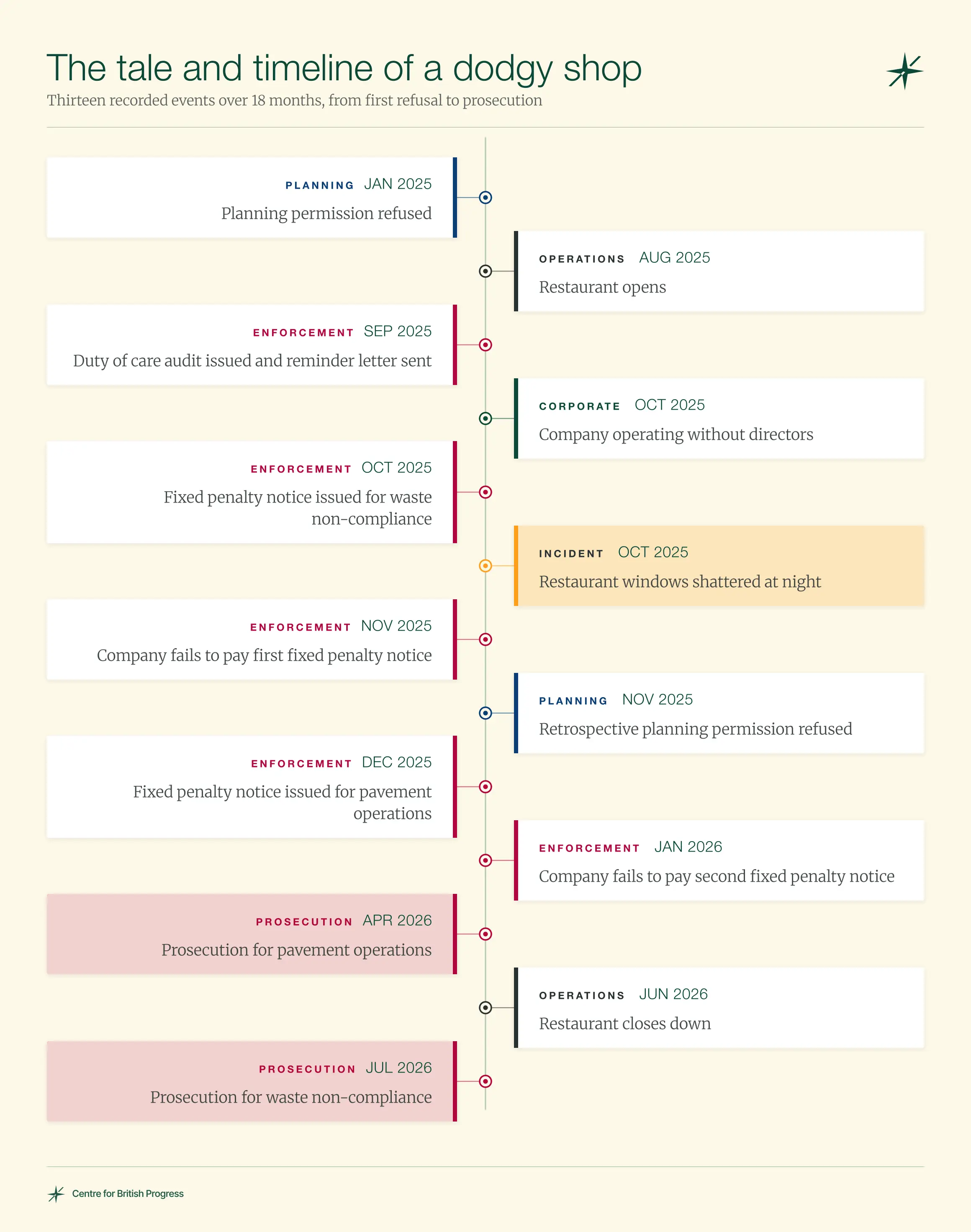
Although the NCA serves as the lead agency for countering serious crime,two other important players are Companies House and local councils. To illustrate the issues they face, consider an example from my own experience as a councillor in North London. In 2024, a tenant who had operated a high street beauty salon applied for permission to convert the site into a restaurant. Despite having permission refused, the proprietors proceeded to open a kebab restaurant. Within weeks, local residents were reporting anti-social behaviour - including the restaurant’s windows being smashed - and minimal evidence of the restaurant actually attracting customers.
In the meantime, the restaurant proceeded to break a whole host of local ordinances. This included failing to lawfully handle their waste and operating across most of the pavement without making any attempt to secure the necessary permissions. After around a year of this activity, the restaurant was fined £3700 for their pavement presence in a case where they failed to even turn up to court. A few weeks later, the council prosecuted the restaurant for its waste mishandling.
One might well wonder - as local residents did - how the business was able to continue operating through all of these infractions, particularly after having its planning permission refused. The answer is that the restaurant had filed an application for retrospective planning permission and - when this was refused - appealed to the Planning Inspectorate. As long as this decision was pending, the local authority lacked the power to close the store. At the time of publication, the Planning Inspectorate had yet to issue its decision. But in June 2026, nearly a year after the business began operating and in the face of as much pressure as the council could muster, the restaurant opted to shut itself down.
This episode also provided a glimpse into the impotence of Companies House as an enforcement agency. The Companies House register is infamous for the prevalence of companies with fraudulent or obviously false information; previous directors include Adolf Tooth Fairy Hitler. Before the introduction of the Economic Crime and Corporate Transparency Act (ECCTA) in 2023, Companies House estimated that between 5% and 20% of UK registered companies were fraudulent.
The organisation’s struggles came through clearly in the case of the illicit kebab restaurant. When I formally reported that the registered company for the restaurant had no directors, Companies House replied by confirming that this was illegal. They then sent back a form for appointing directors, failing to understand that I was a concerned local councillor and not the proprietor of the business.
For all the difficulties faced by national law enforcement bodies, perhaps the most basic issue illustrated by this episode is the powerlessness of local councils. Even at the point where the restaurant had been refused planning permission, refused retrospective planning permission, fined for operating on the pavement without permission, penalised for failing to properly handle its waste and operated without directors, the local authority still lacked the legal power to simply close the establishment.
In the absence of any alternative, I worked with council officers to pursue the restaurant for each of these infractions. Other local authorities have similarly employed an ‘Al Capone’ strategy, attacking dodgy shops which are very likely engaged in money laundering or other crimes for the more minor infractions they can prove and punish. But this strategy is extremely time-consuming and will not work against dodgy shops whose owners are intelligent enough to comply with local regulations.
Closure Orders
There is one other tool available to a council in this situation, known as a closure order. This allows the local authority to issue a closure notice shutting the premises for 48 hours while applying to a local court to extend this period to 3 or 6 months as part of a closure order. However, this tool suffers from a number of shortcomings, particularly in its prescribed legal standard.
To secure a closure order, a local authority has to demonstrate that one of the following three criteria has been fulfilled:
- that a person has engaged, or (if the order is not made) is likely to engage, in disorderly, offensive or criminal behaviour on the premises, or
- that the use of the premises has resulted, or (if the order is not made) is likely to result, in serious nuisance to members of the public, or
- that there has been, or (if the order is not made) is likely to be, disorder near those premises associated with the use of those premises.
While the ambiguity embedded in this standard might seem to be helpful to local authorities, in reality it creates legal uncertainty. This can make councils cautious about expending funds on the legal process, particularly when a successful closure order will still only see the shop shut for three to six months. (The Government’s recent announcement that the maximum length of a closure order will rise to 12 months is an improvement but does not fundamentally alter this equation.)
The result is that this legal tool has not been widely used by local authorities to stamp out dodgy shops. Where closure orders have been deployed, that will usually be the work of a particularly proactive trading standards or local police team. Conversely, a series of freedom of information requests found that several local authorities have never once used a closure order. That was the case, for example, in Cambridge and North Devon, despite no shortage of dodgy shops in those localities.
Policy Recommendations
To tackle dodgy shops, the Government will need to make changes both to the governing legal framework and law enforcement agencies. This paper proposes the following three recommendations:
- Provide local authorities with a right to shutter businesses on a ‘two strikes and out’ basis
- Adequately resource the NCA and other law enforcement agencies
- Create a channel of communication between the NCA and local representatives
Recommendation 1 - Empower Local Authorities
The most important change to counter dodgy shops is to radically improve closure orders by providing a clear and attainable standard for their use. At present, the legal bar for closure orders is too vague for local authorities to navigate with confidence. The result is that they are hardly used by local councils even where their high streets are dotted by dodgy shops.
A basic improvement would be to provide statutory guidance that local authorities can use closure orders on a ‘two strikes and out’ basis. For example, where a store has been caught selling illegal goods twice, or penalised once for that infraction and separately for violating a local regulation, or committed one of these transgressions while also being the site of anti-social behaviour, the local authority could issue a closure order. A time limit could specify that these two violations would have had to occur within, say, a 12 month period.
This would end the farce where a store remains open for business despite being found selling illicit tobacco nine times in two years. Similarly, in the kebab restaurant case study, a two strikes and out standard would have allowed the local authority to confidently shutter the store in October 2025, two months after it opened. There should also be the option to make the closure order permanent, effectively forcing the landlord to find a less troublesome tenant. The Government should consult widely among local authorities and law enforcement in clarifying this new standard and issuing accompanying guidance.
Providing councils with a clearer and quicker route to closing stores would in turn help national law enforcement bodies. At present, councils are largely powerless while national law enforcement bodies are overwhelmed by the scale of the task. The policies proposed here would create a new divide and conquer model: local authorities would clear out most small-scale offenders, allowing the NCA to focus on the more sophisticated actors.
Recommendation 2 - Fund Law Enforcement
There is ultimately no way around the reality that a Government looking to crack down on dodgy high street shops will need to properly resource the UK’s key law enforcement agencies.
While local police services can make an important contribution to this effort - for example, by working with local authorities to gather supporting evidence for a closure order - the NCA will need to lead the crusade against dodgy shops. This is partly because even shops which might seem to be standalone stores are more often part of a network that has no regard for local boundaries. In the case of the Caerphilly car wash, for example, the men involved had also set up car wash services in Manchester and Liverpool. The NCA’s investigation ultimately found a pan-European people smuggling operation and a flow of funds that extended to Iraq.
The methods used in enforcement also lend themselves more to a national body like the NCA. This includes specialist tools that are often only available to national agencies, such as advertising technology (adtech) data showing the presence of phones in a particular area to highlight shops with little custom. The NCA has shown in glimpses that they are capable of this work; special operations in April and November 2025 raided thousands of premises, arrested hundreds of individuals and seized more than £10 million in suspected criminal proceeds. But the scale of the problem clearly requires a more systematic response than sporadic special operations.
The Government has taken steps towards strengthening national agencies, above all by establishing a new taskforce to counter high street organised crime. The decision to set up a National Policing Service to encompass the NCA and other agencies is also a positive move. However, none of this can compensate for the basic requirement to properly invest in the NCA, addressing all of the issues with pay, staffing and resourcing.
As detailed above, the Government has effectively conceded that funding constraints are currently holding back recruitment. On pay, the NCA Remuneration Review Body cited estimates from the National Crime Officers Association (NCOA) that an 8% uplift would largely bring NCA pay at the Grade 5 level up to parity with the police. While there is no recent figure, it seems clear that these changes will cumulatively require tens of millions of pounds in additional investment. As a first step, the Government should task the NCA Remuneration Review Board with providing their best estimate for the sum that would be needed to finally address these longstanding issues of underinvestment in the NCA.
It has become overly fashionable in public policy to say that a given set of reforms will pay for themselves. That is not the contention here. However, it is clear that investments in NCA staffing would produce savings elsewhere. Most immediately, a hiring spree would allow the NCA to slash its £93.7 million expenditure on temporary staff and consultants. That is before one considers the savings that could be recouped from disrupting money laundering and tax evasion on the high street.
There are also multiple ways in which the Treasury could fund the required investment. One measure which would reinforce the fight against money laundering - as previously proposed by CBP - would be a ban on cash transactions of over £1000, a measure that would crack down on criminal activity while raising around £800 million annually.
Recommendation 3 - Lean on Local Intelligence
A properly resourced NCA should also make greater use of local intelligence; this would assist the NCA’s investigative work and help to restore local communities’ faith in law enforcement.
For a national agency like the NCA, distinguishing problematic high street shops from their legitimate neighbours might seem like finding a needle in a haystack. But for a local community, the distinction is much clearer. Ask a councillor, residents’ association or just a random group of residents and it will quickly become clear which hairdresser has been run by a friendly face for twenty years and which hardly ever seems to have any customers. There is increasing recognition of this fact. A number of local MP’s have begun setting up facilities on their website for local residents to report concerns about particular establishments. In providing oral evidence to the Home Affairs Committee earlier this year, the Lead Officer for Serious and Organised Crime at the Chartered Trading Standards Institute confirmed that “what is perhaps most important is intel from the public”.
There is, however, huge room for improvement here. Rather than leaving it to the sporadic efforts of councillors and members of parliament, the NCA should provide a dedicated facility for MPs and local councils to report concerns about specific establishments. This line of communication could help the NCA by collating local intelligence and providing them with advance notice where a council is planning to take its own enforcement action.
A channel between local representatives and the NCA could also make an important contribution to restoring public faith. One reason dodgy shops evoke such anger is the sense that law enforcement is totally absent even as shop-owners are utterly brazen. If councils and local representatives could confirm that they are in communication with the NCA - and provide updates where the case allows for it - that would serve a crucial purpose in reassuring residents that something is being done.
Forging stronger links between local representatives and the NCA is one of multiple ways in which there will need to be far greater collaboration across the relevant actors. For example, the Chartered Trading Standards Institute (CTSI) has asked for local trading standards teams to have access to the data held by Report Fraud, a service run by the City of London Police. The formation of the National Policing Service should be seized on as an opportunity to bring about the end of this kind of data fragmentation.
Phoenixing
Background
While many insolvent companies are the product of a failed but genuine effort at enterprise, others take advantage of limited liability at their creditors’ expense. A particularly pernicious version of this, known as phoenixing, involves repeatedly setting up companies and making them insolvent, effectively using the company as a vehicle to steal from creditors and run away from tax liabilities.
The effects are widespread. One survey suggested that 80% of small and medium sized businesses (SMEs) had written off debts due to phoenixing, with 23% of those affected suffering losses in excess of £25,000. Beyond these figures, the rise of phoenixing exacerbates the destructive sentiment that those who play by the rules are being taken for fools. The most recent figures show that phoenixing was responsible for losses to the Exchequer of £836 million in 2022-23, a sharp increase from around £500 million in previous estimations.
Cowboy builders have long mastered the dark art of phoenixing, leaving behind half-finished jobs and unpaid debts simply by setting up a new company. More recently, the same phenomenon has made its mark on the high street. An illustrative example comes from recent reporting in London Centric. Their investigation looked at 7 Coventry Street, a shop unit in Westminster. This premises was most recently occupied by Kingdom of Treats, a candy store that evaded taxes ranging from VAT to business rates. This was only the latest round in an ongoing saga. Between 2017 and 2024, London Centric found that “seven different companies have occupied the shop unit...with all of them failing to pay business rates”, coming at a cost to the council of more than £3 million.
A Legal System Left Playing Catch-Up
While laws exist to combat phoenixing, in practice there are immense obstacles to enforcing those laws. This becomes clear at each stage of the legal process, starting with the insolvency system.
When a company enters formal insolvency proceedings in the UK, a liquidator (or some equivalent) will have three months to report to the Insolvency Service on the conduct of the directors. Informed by this report, the Insolvency Service will decide whether to investigate further and ultimately whether to disqualify a director. In theory, they can also apply to the courts for a compensation order against the directors, compelling them to pay funds to the company’s creditors.
The primary basis for disqualification is ‘unfit conduct’, a legal standard established by the Company Directors Disqualification Act (CDDA) 1986. Directors’ unfit conduct could include a range of misdeeds, such as continuing to trade at a point when the company has no reasonable prospect of surviving or selling assets below value to a new phoenix company. Depending on the circumstances, the Insolvency Service could also push for a criminal conviction.
While this provides the legal framework for pursuing unscrupulous directors, the reality of proving and punishing misconduct can be extremely difficult. Some of the critical issues, like the question of whether a firm had a realistic prospect of survival at a given point in time, are often very subjective. Even where action is taken, there will typically be a time lag measured in years between the insolvency and any disqualification, during which time the director may continue to prey upon the public.
From the perspective of the taxman or any other creditor, the difficulties multiply when one turns to the task of retrieving funds. Even in the most extreme case where there is no question that money is owed, retrieving stolen assets is usually somewhere between difficult and impossible.
A creditor will first have to spend funds on a court process to acquire legal confirmation of their right to repayment. At that point, the court will still do little to nothing to assist the creditor with actually regaining their funds. Instead, the claimant will usually need to turn to the services of an asset tracing provider. If the stolen funds have already been spent and the debtor holds no other assets, there is no realistic recourse. Even if the debtor has just taken the basic step of moving money from one bank account to another, the creditor will likely need to initiate a separate legal process to trace the trail of funds, typically at a cost of tens or hundreds of thousands of pounds.
Each of these difficulties can be seen in a case like that of David Bowker. In 2006, Bowker set up Aristacars Limited, a cab company based in Wigan. By April 2010, the liquidators had been called in. Their report showed that the company had accumulated debts of around £128,000, nearly £100,000 of which was owed to HMRC. While Aristacars Limited was beginning its descent, Bowker was able to set up another company, Aristacars Wigan Limited, in January 2010. This new entity carried on the same business and lasted until 2012 before folding with debts of more than £200,000, including more than £150,000 owed to HMRC. The liquidator for Aristacars Limited explicitly referred to Aristacars Wigan Limited as a phoenix company.
The pattern continued with the incorporation in 2011 of Wigan Fast Foods Limited. When a liquidator was appointed for that company in 2013, they found nearly £30,000 in debts, including more than £12,000 owed to Wigan Council. The saga then resumed when Bowker set up Overall Hygiene Limited in July 2020 - months after the onset of the pandemic - only for the company to enter liquidation in 2022 with £50,000 owed to the Royal Bank of Scotland among others. The liquidator found that Bowker had taken out £12,639.24 from the company to the detriment of creditors, yet agreed to settle the matter in return for a £1000 payment since “this was the best settlement figure that could be reached”.
All of this demonstrates that once the phoenixing has occurred, the battle is already all but lost.
Policy Recommendations
To defeat phoenixing, the Government should make the following four changes:
- Replicate the Irish system whereby directors of insolvent companies have to demonstrate good conduct or provide a capital buffer before they can serve as directors again within the following five years
- Commit to providing HMRC with the funding necessary to comprehensively tackle phoenixing
- Make basic changes to improve the transparency of corporate and legal records
- Shift business rates liability from the occupant to the owner to remove the opportunity for business rates evasion
Recommendation 1 - Shifting the Burden of Proof
The British state has grappled with unscrupulous directors in one form or another for nearly a century. Landmark legislation in 1928 gave courts the ability to disqualify directors, a power that was expanded in the decades that followed. Just across the border, the Irish Government initially followed a similar path, with a Companies Act 1963 introduced “as a near copy and paste” of the UK’s Companies Act 1948.
By the 1970s, both countries were struggling with phoenixing. In the UK, the Labour Government in 1977 asked insolvency expert Kenneth Cork to review UK insolvency law, including finding a way to “deter and penalise irresponsible behaviour and malpractice on the part of those who manage a company’s affairs”. His committee’s work was complete five years later, producing a tome that, in the words of one peer at the time, “requires two pairs of hands to lift it”.
To guard against unscrupulous actors, the Cork Report proposed that directors of an insolvent company should be personally liable if a second company where they are a director enters insolvent liquidation. The Government responded with a white paper where they concluded that would present too great a risk to genuine entrepreneurship. Instead, the paper proposed that “if a company is wound up compulsorily, the Court will automatically disqualify from company management for three years from the date of the order all persons who were directors of the company”. This proposal made it as far as the initial versions of the Insolvency Bill 1984. However, amid concern for the effects that this clause would have on innocent directors, automatic disqualification was removed before the bill became law.
The Irish Government, by contrast, picked up the concept of an automatic ban and ran with it. Although there was a substantively similar debate in the Oireachtas to the one that had taken place in the UK Parliament, legislators there sided with making this change in the Companies Act 1990. This meant that in addition to disqualifications in cases of proven misconduct, directors of insolvent companies as standard would be subject to a restriction preventing them from serving as directors. Parliamentarians also added a number of sensible safeguards. First and most significantly, the law made it clear that no restriction would apply where a director could convince a court that they had acted “honestly and responsibly”. The provisions would also only apply to an individual who had served as a director or shadow director in the 12 months leading up to the company initiating insolvency proceedings.
Finally, restrictions as standard would only apply for five years, and even within that time period the affected individual could serve as a director at a company if the entity held substantial capital to protect creditors. These modifications ensured that, in practice, the automatic ban operated more as a means of shifting the burden of proof, allowing the director of an insolvent company to have another go if they could demonstrate good conduct or provide sufficient capital.
While the Irish Government has adjusted this process over time, the basic structure has remained in place ever since. It is easy to see why. Restrictions are an extremely useful facility, penalising directors of insolvent companies and protecting future creditors without requiring the authorities to meet a high evidentiary standard. Unlike protracted disqualification proceedings, restrictions can also take effect relatively quickly. Directors can save their funds by accepting their fate rather than contesting the decision in court. Most do choose this option; in 2025, 82 of 98 restrictions were voluntarily accepted by directors. Restrictions therefore act as a largely self-enforcing mechanism, contributing to the smooth operation of the legal process around insolvency.
Ireland-UK Comparison
As the Irish Government does not collect statistics on the cost of phoenixing, there is no basis for a direct comparison between the two countries. However, there are several compelling data points which indicate that phoenixing is now a far less severe problem across the Irish Sea.
One basic measure is the degree of attention paid to phoenixing in each jurisdiction. The fact that the Irish Government does not collect figures on phoenixing is reflective of the reality that it is a far less pressing issue across the Irish border. This contrasts starkly with the UK, where the climbing cost has prompted the Government to repeatedly take aim at the problem. This disparity is also reflected in law enforcement priorities. While the UK’s Insolvency Service strategy for 2026-2031 includes tackling phoenixing in the first of its action points, the Irish Corporate Enforcement Authority’s strategy for 2026-2028 does not make a single reference to phoenixing.
Another indication comes from levels of enforcement, where figures are available. In 2025, the UK recorded 23,938 insolvencies and 1094 disqualifications. This is a fairly consistent ratio over recent years, implying that around 4.5% of insolvencies lead to disqualifications. The equivalent figures for Ireland are consistently around three times higher, with 848 insolvencies in 2025 and 116 disqualifications and restrictions.
Transposed to the UK, these figures imply that adopting the Irish system could result in around 2000 restrictions each year, a relatively small number but one that would substantially reduce phoenixing and other corporate misconduct. The benefit would not only come from stripping bad actors of the right to repeatedly misuse corporate vehicles. Crucially, automatic restrictions would also introduce a viable deterrent to stop directors from attempting to engage in phoenixing in the first place.
Recommendation 2 - Commit to Adequately Funding HMRC
Just as the Government must invest in the NCA to counter dodgy shops, so too the state will need to equip HMRC to tackle tax evasion perpetrated by phoenixes.
The example of candy shops and their ilk in central London illustrates the point. The individuals behind these companies generally conceal their involvement by employing students from India, Pakistan, or Bangladesh as directors and shareholders. For this subset of phoenixing where the proprietors use puppet directors, the only answer is competent enforcement.
HMRC should then be able to pursue the controlling individuals on at least two grounds. First, there is the blatant evasion of tax. As London Centric found in their reporting, the shops in question are openly not charging VAT on their sales. This is largely occurring within a defined city centre in an easily verifiable fashion. Second, the individuals behind these companies - who are doubtless the ultimate financial beneficiaries of the enterprise - are not registering as a person of significant control (PSC), despite the requirement to do so for anyone exercising “significant influence or control” over a company.
There are signs that the Government recognises the need for greater enforcement. The Autumn 2024 budget specifically referenced phoenixing, promising to combat it by increasing collaboration between HMRC, Companies House and the Insolvency Service. The budget that followed a year later went a step further by providing funding for 50 positions in a newly-created Abusive Phoenixism Taskforce within the Insolvency Service.
The question remains whether this will be sufficient. An intuitive first step would be for HMRC or a dedicated review body to offer their opinion on the scale of investment required to tackle phoenixing. Yet when the Public Accounts Committee requested in 2022 that HMRC outline the level of additional funding required to reduce the tax gap, the previous Government rejected this recommendation on the grounds that “HMRC’s funding levels are a decision for Treasury ministers…and it is right that this advice is considered in private”. This is a strange assertion for which no rationale was provided.
Whether or not the details of discussions between the Treasury and HMRC are publicly disclosed, this Government should commit to providing the resources it believes are required to comprehensively counter phoenixing. As long as shops in the heart of the capital are brazenly evading tax, it will be clear that this standard has not been met.
Recommendation 3 - Shed Sunlight on Phoenixes
While a stronger enforcement regime must form the core of the Government’s response to phoenixing, greater transparency also has an important role to play.
There is no need to hold a degree in due diligence to appreciate that if a firm or director has previously fallen foul of the law, a potential creditor or investor should be much more wary of entering any financial relationship with them. It is therefore essential that this kind of information is publicly available. Remarkably, that is generally not the case at present.
Most contract disputes and unpaid debts are handled through the county court system and can lead to the issuance of a County Court Judgement (CCJ). Just over one million CCJs were issued in England and Wales in 2024, providing some indication of their immense importance in the routine operation of the UK’s justice system. Around 90% of CCJs are issued when the defendant does not respond to the claim, known as default judgements.
CCJs are a strong indicator of an individual’s creditworthiness. Credit data agencies, whose business depends upon accurate characterisations of a debtor’s reliability, place considerable weight on whether an individual is or has been subject to a CCJ. The existence of a CCJ against an individual or company is also renowned as a red flag among those engaged in due diligence work. It is very common for directors engaging in corporate misconduct to have previously been on the wrong side of a CCJ.
The remarkable problem is that, at present, it can be exceedingly difficult to verify if an individual has a CCJ. In theory, one only has to pay £6 to confirm if an individual or company has ever faced a CCJ (or £10 to check against a wider range of UK legal registers). But in practice, one also has to know the subject’s address and name at the time they received the CCJ. The problem is that there is usually no way of knowing all of a counterparty’s current and former addresses, even though a CCJ could have been issued against them at any previous time.
Similar problems predominate when one moves from legal records to Companies House, the home of UK corporate records. Alongside searching for CCJs, a thorough review of Companies House is an essential part of any due diligence exercise. Here too, however, there are basic issues of accessibility. For example, if one were carrying out due diligence on an individual named John Smith, they would find that there are dozens of individual directors with that name. There is often little beyond a month and year of birth to distinguish between most of them, while in other cases even that information is lacking. One John Smith might have ten distinct entries on Companies House (via different companies) yet there would be no way to confirm that they all relate to the same individual. It should not require investigative skills to determine an individual’s basic corporate history, yet that is the current reality.
Other aspects of Companies House make due diligence even more impractical. While there is at least a basic means to search for directors, no such function exists for shareholders or lenders. Since this information exists for each individual company, it would be relatively easy for Companies House to convert this data into a searchable format. (Indeed, private providers have partially done this work, albeit for a sometimes steep subscription price.)
The good news is that these issues are among the easier problems to fix within the British state. Companies House could add a function that allows users to search for individuals by shareholder and lender. The organisation is also in the process of issuing unique identifiers to each director to use when performing tasks like filing annual accounts. While that is a positive step, it would be much better for each director to also be assigned a publicly identifiable unique number (as is done in other jurisdictions like India). This would allow anyone conducting due diligence to identify a specific individual on Companies House by their assigned number and easily review their entire corporate history. An added function could show where an individual has, within a recent time period, served as a director at a company which entered insolvency.
A similar set of reforms is equally essential for CCJs. The simplest fix would be to make CCJ searches free. Given that these fees only earn a few million pounds a year for the Government, covering this sum would be a negligible price to pay in the battle against the exponentially larger issue of phoenixing and corporate fraud. Here too, a unique identifier should also be assigned to each individual who is subject to a CCJ. This would end the perverse situation where a due diligence exercise is only effective if one has complete knowledge of every name and address previously used by an individual or company.
Recommendation 4 - Shift Business Rates Liability
Finally, the evasion of business rates is in many ways the part of the puzzle that is easiest to resolve. Property taxation has always had the theoretical advantage of targeting an asset that cannot be moved. Unlike so many other levies, taxes on real estate should be nearly impossible to avoid; in the extreme scenario, the state can respond to unpaid taxes by attaching a charge to the property or seizing it. Business rates surrender that advantage by falling on the tenant rather than the owner.
CBP is proposing in a forthcoming paper that liability for business rates should be transferred from the occupant to the owner, effectively replacing business rates with a commercial landlord levy. The strongest arguments for this reform are that the new system would be far simpler to administer and fairer for businesses. However, one of the many other advantages of this change would be the effective elimination of phoenixing-based business rates evasion.
Conclusion
Dodgy shops and phoenixing are destructive to public sentiment. In communities across the country, voters cannot understand how a problem that is so visible to them is apparently beyond the ability of the authorities to tackle. The new prime minister has recognised the need for action. By implementing the recommendations proposed here, the Government could crack down on this pernicious class of crime, helping to restore faith in law enforcement and reclaim the public realm in high streets across the land.
Acknowledgements
Thanks to Amelia Wood, Kane Emerson, David Lawrence and others who wish to remain anonymous for their input and insight. All views, errors, and omissions are the sole responsibility of the author.
For more information about our initiative, partnerships, or support, get in touch with us at:
[email protected]For more information about our initiative, partnerships, or support, get in touch with us at:
[email protected]