.webp&w=1920&q=75)
Table of Contents
- 1. Introduction
- 2. Devolving DCO and TWAO powers to mayors
- 3. Summary of recommendations
- 4. Further devolution via primary legislation
- 5. Potential pilots before a Bill
- 6. Funding
- 7. Conclusion
- 8. Questions and answers
- 9. Authors
Introduction
Between 1995 and 2007, the length of Madrid’s metro tripled from 114km to 317km. Per mile, it cost almost ten times less than London’s Jubilee Line extension. Having promised to build the line to win power in 1995, the People’s Party then dominated Madrid’s regional assembly for the next two decades.
Madrid had the tax and borrowing powers to fund the metro extension. The Labour government is now giving those to the UK’s mayors. But Madrid also had a range of regulatory powers to approve projects, as well as to trade off and mitigate environmental harms. Decisions could be taken quickly, and politicians could reflect the wishes of local people who feel both the costs and the benefits of development.
So this paper is about the next frontier in devolution: placemaking. There is lots of regulation that we should not devolve – basically anything that fragments the UK’s internal market. But where the costs and benefits of decisions are borne locally, then local politicians are best placed to make the decisions.
This paper sets out four areas of placemaking that could be safely pushed down to mayors:
- To approve, including by devolving Development Consent Orders and Transport and Works Act Orders
- To regulate, including by devolving Environmental Delivery Plans, biodiversity net gain rules and Environmental Impact Assessments, as well as licensing night-time trading.
- To do land assembly, with new “land readjustment” powers to combine plots of land on which only a majority of landowners needs to support development. Many countries use these as a quicker option than compulsory purchase orders.
- To negotiate contributions, including by setting application fees for development consents, business rates on derelict land and using land readjustment mechanisms.
A lot of the devolution discussion is quite abstract. So this paper is unashamedly technical. It gets into the weeds of the regulations and laws that need to change. But its core premise is a deep issue of principle: when a decision mainly affects one part of the country, that place should have the suite of powers to make it.
Devolving DCO and TWAO powers to mayors
Mayors are responsible for delivering major transport and infrastructure projects in their areas, but the Secretary of State retains the principal powers needed to authorise them. DCOs and TWAOs are the two primary mechanisms for doing so. They can provide the powers needed to construct, acquire land for, and, where relevant, operate an authorised project; modify or disapply relevant legislation; and, in some cases, incorporate or replace separate consents. Our core proposal is a concurrent mayoral power to make DCOs and TWAOs.
Definitions
A development consent order (DCO) is the consent needed to build a Nationally Significant Infrastructure Project (NSIP), such as a major road, railway line, airport or reservoir, under the Planning Act 2008. It can also include other consents and powers to acquire land. Applications are examined by the Planning Inspectorate. Currently, DCOs can only be made by the relevant Secretary of State.
A Transport and Works Act Order (TWAO) is the usual way of authorising new railways and tramways in England and Wales, as well as other transport, inland waterways and works affecting navigation. A single order can include powers to build and operate the scheme, compulsorily purchase land, close or alter roads, and amend other legislation as required. In England, the relevant Secretary of State decides applications, sometimes after a public inquiry.
Moving decisions to mayors will make it possible for them to prioritise projects which are critical to their overall regional strategy. And it could also improve the decision-making process itself. Mayoral strategic authorities already have responsibility for the spatial strategies in their area, so they can weigh the effects of schemes across the whole local economy in a way that distant and separate national bodies, each responsible for one element of the consent process, cannot. Because DCOs and TWAOs are existing regimes, with their own established procedures and case law, devolving them directly would require fewer legislative demands or risk than creating a new category of planning consent.
Below we set out the essential features a mayoral DCO/TWAO must have in order to be effective. We then suggest supplementary powers to make them more effective.
Summary of recommendations
Devolving DCO and TWAO powers to mayors |
|---|
Power to make Development Consent Orders (DCOs) and Transport and Work Acts Orders (TWAOs). Give mayoral strategic authorities a concurrent power, identical to the Secretary of State’s, to make DCOs and TWAOs for schemes in their area. That will ensure they have powers to drive forward important transport and other infrastructure projects without delays caused at national level. |
Choose which schemes to cover. Let mayors decide whether to use DCO powers, set their own DCO thresholds, create an optional DCO tier for projects below current national thresholds, and include new types of scheme including strategic housing and mixed-use schemes. |
Mayoral authority as promoter. Require proper internal safeguards when mayoral strategic authorities determine applications for their own schemes. |
Powers for Mayoral Development Corporations (MDCs). All mayoral strategic authorities should be able to designate MDCs to use the powers on their behalf. |
Grant specialist consents. Give mayors power to grant and vary regulatory consents and permits needed for development. |
Further devolution via primary legislation |
Land readjustment powers. Mayoral strategic authorities, MDCs and local authorities should have powers to run land readjustment schemes, pooling and replotting land with a qualified majority of landowners, as used successfully in many other European countries. |
Mayoral Environmental Delivery Plans and biodiversity net gain rates. Mayoral strategic authorities should be able to make EDPs for their area and administer the levy, replacing site-specific surveys and mitigation for the impacts covered. They should also have the power, subject to national criteria, to set biodiversity net gain rates, generally or for specific development types or areas. |
Restoring and devolving Environmental Impact Assessment (EIA) rules and Environmental Outcomes Report (EOR) schemes. Restore the power to update EIA regulations and mayors’ power to decide which developments need assessment and when a whole-zone assessment is sufficient, within national limits. The EOR framework should let mayoral strategic authorities make local assessment schemes within national safeguards, and devolved assessment powers should be carried into the EOR regime as it replaces EIA. |
Environmental permits within mayoral DCOs. A mayoral DCO for an industrial site should be able to grant the environmental permit alongside planning permission in a single decision, with the mayor setting permit conditions subject to statutory safeguards. |
Mayoral rule-making in designated areas. In designated areas such as growth zones, mayoral strategic authorities should be able to alter national policies and guidance relating to development. |
Secure mayoral development orders. Amend the MDO regime so permission can be relied upon: remove the Secretary of State’s revocation powers and require notice to withdraw permission |
Infrastructure delivery. Mayoral strategic authorities or MDCs should be able to adopt and build an infrastructure delivery programme, and direct utilities, NESO, National Highways and Network Rail to provide connections and capacity to an enforceable timetable. |
Local electricity pricing. Mayoral strategic authorities should have the power to require NESO to introduce nodal pricing within their area so far as practical, and to allow third-party transmission connections. |
Night-time economy licensing. Mayoral strategic authorities should be able to take over night-time economy powers, including being the licensing authority for their whole area or designated Night-Time Economy Zones. |
Funding |
Fiscal devolution. Adopt the strongest possible model of fiscal devolution, so mayors receive a share of the growth that they enable through their new powers. |
Construction Industry Training Board levy. The CITB levy should be wholly or partially devolved to mayors, allowing them to invest in the construction training needed for their own area. |
Land value capture. Give mayoral strategic authorities, or at least their MDCs, the ability to: (a) take negotiated contributions from landowners; (b) set a modest business rate on derelict or undeveloped land, within a designated area; and (c) run land readjustment schemes. |
Application fees. Let mayors set fees above the national baseline for mayoral DCOs and TWAOs, so that cost recovery can support the increase in capacity needed. |
Funding pilots. We propose a range of pilots, and suggest that central Government ensures volunteer mayoral strategic authorities receive proper funding for them. |
Essential powers
Power to make DCOs and TWAOs
At present, only the Secretary of State has the power to make these orders. This is specified in the Acts of Parliament that created the regimes. The recent English Devolution and Community Empowerment Act 2026 established general powers to transfer functions to mayors, but it excludes ‘a power to make any other instruments of a legislative character (including regulations)’. DCOs and TWAOs are both made by statutory instrument, so they are excluded. Primary legislation is therefore required to devolve the power to mayors.
Decisions from Whitehall can be slow, for a number of reasons. Until recently there was no statutory deadline for TWAO decisions, although these are now being introduced. Cabinet reshuffles and pre-election periods regularly pause decisions. A Secretary of State also has many competing national issues to deal with, so may not prioritise local schemes. A national decision-maker can never accord the same degree to a local priorities as a local leader can. The Leeds trolleybus order was applied for in September 2013 and examined at a public inquiry between April and October 2014. The Secretary of State refused it in May 2016. Decision deadlines for DCOs are also often extended, and some projects face multiple extensions at the decision stage. The decision on Net Zero Teesside, in Tees Valley, was delayed three times in 2023 before consent was eventually granted in February 2024.
Mayoral strategic authorities should be given concurrent powers to make development consent orders and Transport and Works Act orders for schemes in their areas, using the existing regimes. The mayor would exercise the same concurrent statutory function, under the same procedural rules and case law, and the power would be identical to the Secretary of State’s. This would allow a mayor to offer a faster and more efficient route for schemes if they wish, while the national process would remain available for all schemes. In practice this would mean the Bill to introduce the powers should define a term, such as ‘the consenting authority’, and use it in place of ‘the Secretary of State’ wherever relevant in legislation to confer an equivalent concurrent power on the mayoral strategic authority. In accordance with the principle of subsidiarity, such powers should be limited to projects whose effect is primarily within the area of the Mayoral strategic authority, and where the effect on the environment outside the area is positive.
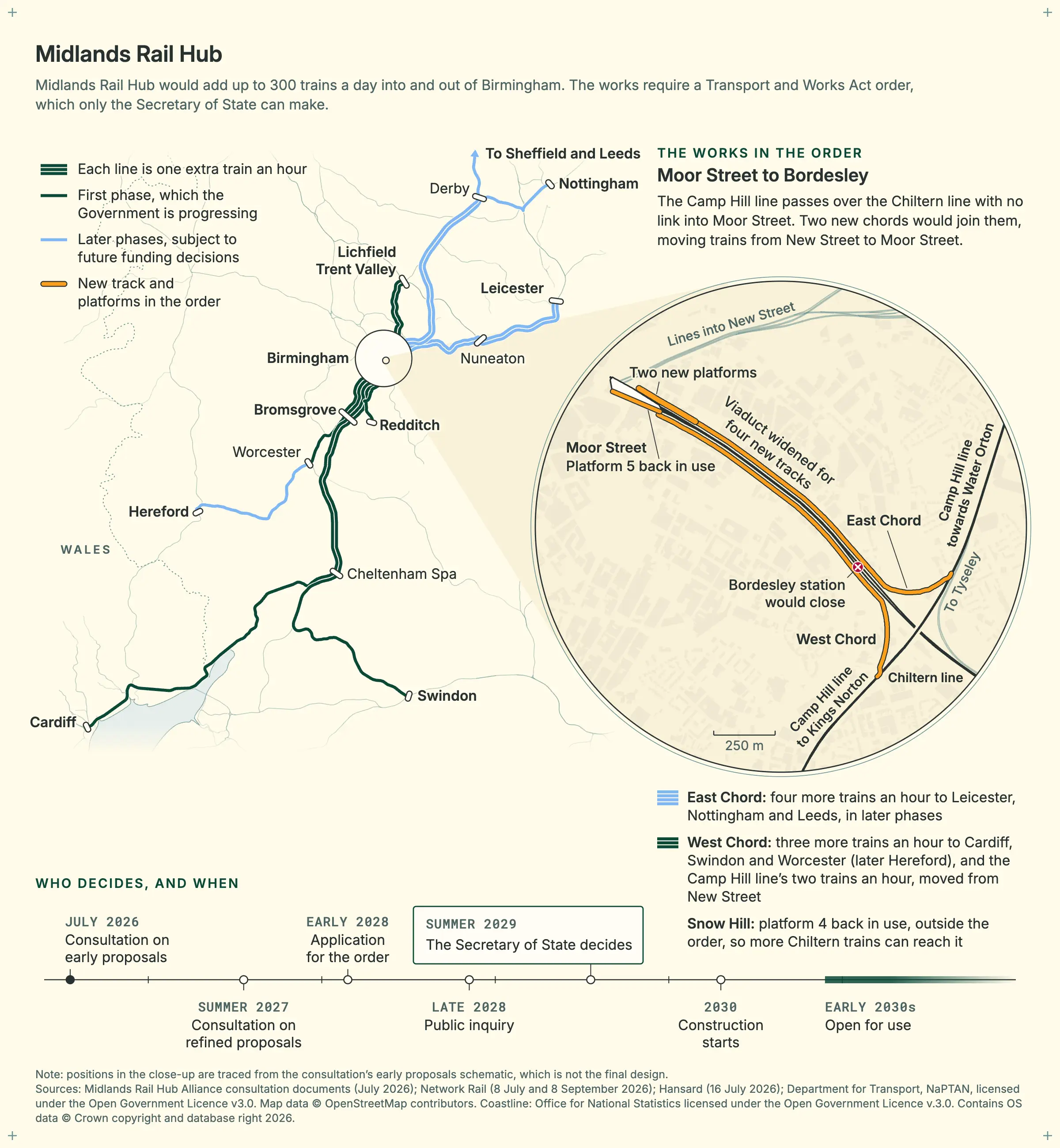
CASE STUDY Midlands Rail Hub Midlands Rail Hub is a £1.75 billion programme to run up to 300 extra trains a day in and out of Birmingham. It requires a Transport and Works Act order: new chords between the Camp Hill and Chiltern lines, two extra platforms at Moor Street, and a wider viaduct at Bordesley. The promoter plans to apply in early 2028, with a public inquiry in late 2028 and a Secretary of State decision in summer 2029. With the powers in 1.1, the West Midlands mayor could make the order, and grant the planning permission alongside it, without being dependent on Whitehall. |
Optional powers
The essential powers set out above would devolve the existing DCO and TWAO regimes as they are. The optional powers below would allow mayoral orders more complete coverage than orders under the existing national system. This would move it closer to being a single authorisation for projects of high strategic importance, and allow mayors to deliver them more quickly and more effectively.
Specialist consents
A DCO can already include other consents like an environmental permit, a watercourse consent, or a wildlife licence. But under section 150 of the Planning Act 2008, where a consent is 'prescribed' in regulations, the order can only remove the need for it if the regulator agrees. In practice, this often makes that provision unworkable; Government guidance records that ‘little use has been made’ of this provision so far. Regulators have little incentive to agree to cede powers. Where a regulator will not agree, applicants are required to seek the approvals separately from the DCO process, which may entail a separate timetable and little control over how the approval is prioritised. At Net Zero Teesside, the permit application to the Environment Agency was made in June 2022, and the permit was finally issued in May 2024, three months after the separate development consent, itself a lengthy process, was granted.
We suggest giving mayors the power to grant, replace or vary through their orders any consent or permit needed to construct or operate the authorised development, including operational environmental permits, without requiring the agreement of the body otherwise responsible. Without this power, a mayoral DCO could function as a single authorisation only where every regulator agrees to cede the decision.
Making this process workable does not necessarily require primary legislation. The list of prescribed consents is set in secondary legislation, so the Government could remove appropriate consents from that list by statutory instrument.
Let mayors set their own DCO thresholds, create an optional tier, and include large-scale housing developments
We suggest allowing mayors to change mayoral DCO thresholds for projects in their area and also to create an elective DCO tier for their area. In the elective tier, projects above a lower threshold could opt to apply to the relevant mayoral strategic authority for a DCO, or proceed through the ordinary planning system. The present, higher thresholds for nationally significant infrastructure projects (NSIPs) would remain the point at which the DCO route is compulsory. An elective tier would let promoters choose the route that is more efficient and appropriate for the scheme. The DCO process is demanding, and would be disproportionate for many smaller projects, so it should be an option rather than a requirement.
At the moment, the DCO regime is specific to infrastructure projects, and only allows up to 500 dwellings, which must be functionally or geographically tied to the development (for example, housing for on-site workers). Large housing and mixed-use schemes instead go through the ordinary planning system, where roads, utilities, land assembly, and heritage often need separate consents on separate timetables. On sites of 2,000 homes or more, it takes an average of 6.3 years from validation of the first planning application to completion of the first home. We therefore suggest allowing mayors to add a new category such as for strategic housing and mixed-use schemes in their area.
CASE STUDY West Midlands Sports Quarter Knighthead, owner of Birmingham City FC, has assembled more than 60 acres in Bordesley Green, east Birmingham, for a new £3 billion Sports Quarter. It would include a 62,000-seat stadium, with housing, leisure, and commercial space, and a Metro connection whose funding is included in the Government’s £2.4 billion regional transport package. The scheme is still at pre-application stage. A mayoral TWAO (1.1) could authorise the tram link. A mayoral DCO extended to strategic mixed-use schemes (1.3) could grant consent for the stadium, surrounding development, access roads, utilities, and land powers in one order. The alternative is a string of separate permissions, each assuming someone else delivers the missing pieces. |
Design choices
Devolving the DCO and TWAO powers to mayors raises a number of design questions. Below we consider three: what happens when the mayoral strategic authority promotes a scheme itself, how schemes crossing a boundary are handled, and which authorities receive the power.
Where the mayoral strategic authority is also the promoter
For DCO/TWAO powers to be genuinely useful for local regeneration projects, a mayoral strategic authority should be able to determine an application for its own scheme, as long as proper formalities and internal divisions are observed. There should be safeguards to ensure that the human rights of the subjects of compulsory purchase proceedings are protected. Spatial development strategies could be helpful in planning for such projects.
This follows existing planning practice. Local planning authorities already determine applications for the development of their own land, and the Secretary of State for Transport decides DCO applications from National Highways, which is a company wholly owned by the Secretary of State; the Lower Thames Crossing, for example, was approved this way in March 2025. Without the same ability to determine its own applications, a mayoral strategic authority could not use its order-making power for its own tram line or regeneration projects, which are among the projects most likely to benefit from devolution.
The Government is using the same approach for the Holocaust Memorial and Learning Centre. The application was made by the Housing Secretary, and is being decided by a different minister in the same department, under published arrangements that separate the applicant team from the decision-making team.
Schemes crossing a mayoral boundary
Rail lines, river crossings, reservoirs, and energy schemes often cross administrative boundaries, even where most of their effects are concentrated in one area. For schemes crossing a mayoral boundary, the options include joint decisions wherever possible, or the mayoral strategic authority deciding only the parts within its own area. The English Devolution and Community Empowerment Act 2026 establishes a duty to collaborate, so cross-boundary work of this kind now has specific statutory mechanisms to support it.
Which authorities receive the power
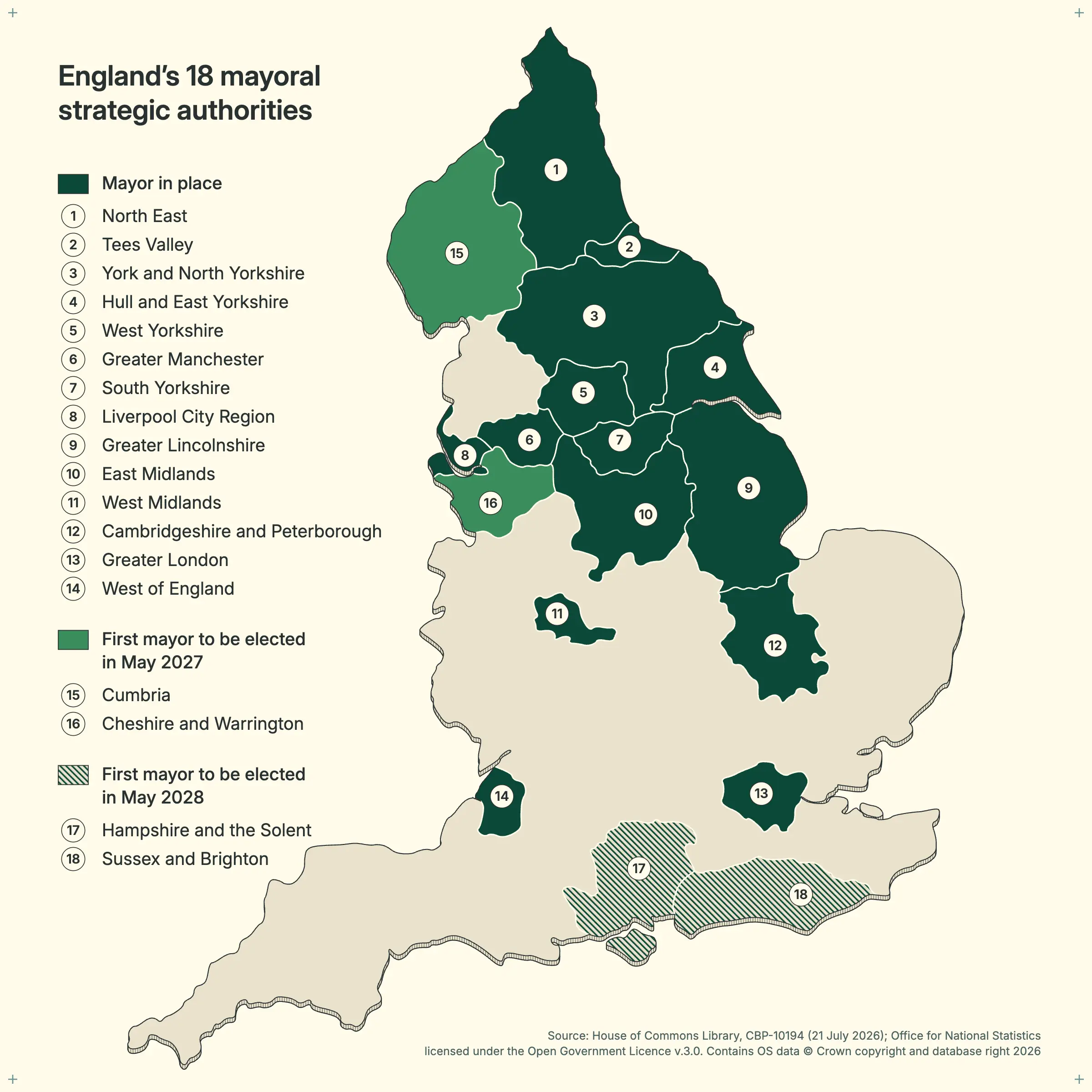
England now has 18 mayoral strategic authorities, with four new authorities formed in 2026 and new mayors due to be elected in Cumbria, and Cheshire and Warrington, in May 2027; and Sussex and Brighton, and Hampshire and the Solent, in May 2028.
The Bill must identify the public bodies that may become a consenting authority. We suggest it confers the power on all mayoral strategic authorities, which include combined authorities, combined county authorities, and the Greater London Authority. Conferring the power on all mayoral strategic authorities avoids creating a further tier of eligibility.
We also suggest that the mayoral strategic authority should be able to designate MDCs to use the power on its behalf. Allowing the designation of MDCs would let the power sit with the body delivering a scheme.
Further devolution via primary legislation
Project-specific orders like DCOs and TWAOs enable very large infrastructure projects. However, they do not alter the rules that apply generally to the planning system. Most development in a mayoral area will fall outside these regimes. While the national rules do try to distinguish between different types of area as far as possible, they are rarely sufficiently detailed to consider all relevant local factors or strategic priorities. This means it is hard to reflect the difference between sites appropriate for denser development or infrastructure and sites that are not, and leaves mayors unable to change the rules that most affect whether homes and businesses in their area are delivered.
The proposals in this section would let mayoral strategic authorities set some of those rules locally, within national safeguards. Each needs primary legislation; some have weaker versions, in Section 3, that could be piloted first.
Mayoral Environmental Delivery Plans
Environmental Delivery Plans (EDPs), introduced in the Planning and Infrastructure Act 2025, let a single strategic plan and levy replace site-by-site mitigation for a specified environmental impact. The goal is to ensure that development results in the maximum possible improvement in the environment while reducing the amount spent on consultants and lawyers. They are prepared by Natural England, or another body the Secretary of State designates, and made by the Secretary of State. In December 2025, Natural England said it would prepare 23: sixteen for nutrient pollution and seven for great crested newts. Mayors have no power of their own to prepare a plan for their area, despite their overall spatial and strategic responsibilities.
We suggest that a mayoral strategic authority should be granted powers to initiate, prepare, make, amend, and revoke EDPs for development in its area, including for protected species, and to administer the levy they raise. Where a developer uses a mayoral EDP, no relevant consenting authority could require site-specific surveys or mitigation for the features and impacts it covers. Proposal 3.1 sets out a weaker, pilotable version of this that does not require primary legislation.
The Act already lets the Secretary of State, by regulations, designate any person to exercise Natural England's EDP functions for a particular area, including preparing plans and collecting and spending the levy (see 3.1). Primary legislation is needed only to let the mayoral strategic authority make the plan itself, rather than the Secretary of State.
Mayoral biodiversity net gain rates
Mandatory biodiversity net gain (BNG), i.e. the requirement that biodiversity on a developed site must be increased by at least 10%, has been in place since 2024. Where a developer cannot secure the gain on site or through the off-site market, it must buy statutory credits as a last resort, at £42,000 to £650,000 per credit, with two credits needed for every biodiversity unit. The Government has already accepted that a singular national rule is not appropriate for every site.
The national 10% biodiversity net gain requirement is set in legislation, and mayors cannot currently change it. Mayoral strategic authorities should have the power, subject to defined national criteria, to alter the rate. This may be a general power or limited to specific categories of development or to designated parts of their area, such as high-density brownfield regeneration zones.
Restoring and devolving the power to update EIA rules
Before a major development can go ahead, its likely effects on the environment have to be assessed and published. The rules that determine which schemes need an assessment, and what the assessment must cover, are set nationally. Ministers used to be able to update them, but that power was removed in anticipation of a new system of Environmental Outcomes Reports (EORs), which has not yet arrived, and a temporary power to amend retained EU law has since lapsed. The Government’s own roadmap says assessments ‘routinely run to many thousands of pages’; the Lower Thames Crossing application, for example, ran to 359,000 pages.
The power in the Town and Country Planning Act 1990 to update environmental impact assessment (EIA) regulations should be restored and modernised to enable powers to be devolved by statutory instrument to designated mayoral strategic authorities. They should be able to decide which developments require assessment, and set thresholds and exemptions that vary across their area, within limits set nationally. They should also be able to determine when an assessment of a whole zone meets the assessment requirements for individual projects within it. Restoring the power, and allowing it to be devolved, would mean these rules could be changed locally without national legislation, and would allow them to reflect local conditions and priorities.
Mayoral Environmental Outcomes Report schemes
Environmental Outcomes Reports (EORs) are the Government’s planned replacement for environmental impact assessment. They are intended to make the process of assessing the environmental impact of a development less onerous. In an EOR, a plan or project would be assessed on whether it supports a set of environmental outcomes chosen by ministers, using standard templates and data. The new rules must not reduce the overall level of environmental protection. The primary legislation has been passed, but the outcomes and the detailed rules are still being drawn up. At present, only ministers and the devolved governments can make EOR regulations.
The stated aim is for EORs to replace the 2017 EIA Regulations by the end of 2027, although that target has repeatedly slipped. The framework could be reformed to enable designated mayoral strategic authorities to make local assessment schemes for all or part of their area. Within national safeguards, schemes could set assessment categories and thresholds, standard mitigation and monitoring requirements, and the circumstances in which a plan, area, or zone assessment satisfies all or part of a later project’s assessment requirements. Provision should be made to carry devolved assessment powers into the EOR regime as it replaces EIA.
Building a mayoral role into the system while it is being designed would be simpler than retrospectively reforming it later. It would let a mayor assess a whole growth area once, so that separate schemes within it could rely on that assessment for the effects it covers. Today each scheme that needs an assessment must produce its own.
Environmental permits within mayoral development consent orders
At present a project needs planning permission from one body and environmental permit(s) from another. A mayoral development consent order for an industrial site should be able to grant the environmental permit as well as planning permission, in a single decision, so that the operator can build and run the site without a separate permitting process. It is possible to remove the requirement for cumbersome agreement before a DCO can include a permit, for orders made by the Secretary of State, by statutory instrument (see 1.2). Mayoral orders under the same regime would then benefit automatically. The Bill would then only need to expressly enable mayoral orders to depart from national policy statements and modify requirements imposed by primary or secondary legislation governing the construction and operation of the development, subject to safeguards expressly preserved in the legislation. (Proposal 3.2 sets out a weaker option that does not need primary legislation.)
The mayor should set the permit conditions, subject to the statutory safeguards. The Environment Agency would be consulted like any other consultee but would have no power of direction, and would enforce the permit as it does now, keeping its subsistence charges, unless the mayoral strategic authority has become the regulator (as we suggest in Section 3).
Mayoral rule-making in designated areas
The general policies for everyday development (permitted development rights, national policy, and building regulations guidance) are currently set by an awkward one-size-fits-all process for all of England. The Government is already consulting on how mayoral development orders (MDOs; see Proposal 2.7) should be implemented, but we recommend going further. In areas it designates, such as growth zones, a mayoral strategic authority should have the full armoury of possible tools to permit development. That should include permitted development rights; statutory regional development management policies that, like statutory national development management policies, prevail over conflicting local plan policies; and guidance on meeting the building regulations.
Secure mayoral development orders
A mayoral development order (MDO) lets a mayor grant planning permission in advance for specified development on specified sites. The MDO regime was created for London in 2015. The English Devolution and Community Empowerment Act 2026 extends them to every mayoral strategic authority and removes each council's veto over making, revising and revoking them.
These are welcome reforms, but as drafted, an MDO is a weak basis for investment. A mayor can revoke or revise an order at any time, without notice, and the Secretary of State can revoke one whenever they think it ‘expedient’. A mayor can also stop development that has already started from being completed. Compensation is only payable if the landowner reapplies for planning permission within twelve months and is refused or given worse conditions. It is not payable at all if the mayor gave 12 months’ notice before building began. A new mayor elected shortly after an order is made can therefore withdraw permission for recently granted schemes, sometimes at no cost. This makes lending against such schemes inherently highly risky.
Before the regime is commenced, it should be amended so that permission granted by an MDO can be relied upon:
- the Secretary of State's powers to revoke an MDO or direct its revision should be removed;
- withdrawing permission, whether by revocation or revision, should require at least 12 months’ notice, and any development started before the withdrawal takes effect may be completed;
- compensation for sites not yet started should be payable directly, without reapplying, unless at least three years’ notice is given.
Care should be taken to close potential loopholes in these protections, so that, for example, unstarted projects cannot be delayed beyond the notice period by refusal to approve pre-commencement conditions. Mayors would remain free to change course, but developers would have a clear window in which to build, enabling them to secure finance for their schemes.
Land readjustment powers
The main tools for assembling land for regeneration schemes in England are private negotiation and, where that fails (as it often does in areas with many landowners), compulsory purchase orders (CPOs). In a compulsory purchase order, the authority must compel transfer of each plot, pay for it, and, where the order is contested, receive confirmation from the Secretary of State. It can be a slow and contentious process.
Land readjustment allows an authority to designate an area in which all plots are pooled; the area is then replotted with land set aside for streets, parks, and other infrastructure, and each owner gets back a similar but smaller and more valuable serviced plot. A qualified majority of participating landowners must consent, so one holdout cannot block a scheme. It is widely used in Spain, Germany, Japan, and other countries around the world, as a highly effective and often less contentious alternative to CPO, when there are a number of landowner interests to address. It can require much less up-front capital than CPO.
The Greater London Authority’s own review of land assembly recommended a new statutory land pooling mechanism for London, which could be led by landowners or by the GLA and boroughs, and it has been backed by a long list of organisations including IPPR, the Joseph Rowntree Foundation, and UN-Habitat. Several mayoral strategic authorities interviewed for this report stated that land readjustment would be ‘incredibly useful’ for regeneration projects they are currently planning. England still has no statutory land readjustment scheme.
Mayoral strategic authorities, MDCs, and even local authorities should have new powers to run land readjustment schemes. This would not detract from CPO powers, and would also enable CPO to be used as a backstop to encourage participation in land readjustment schemes where helpful.
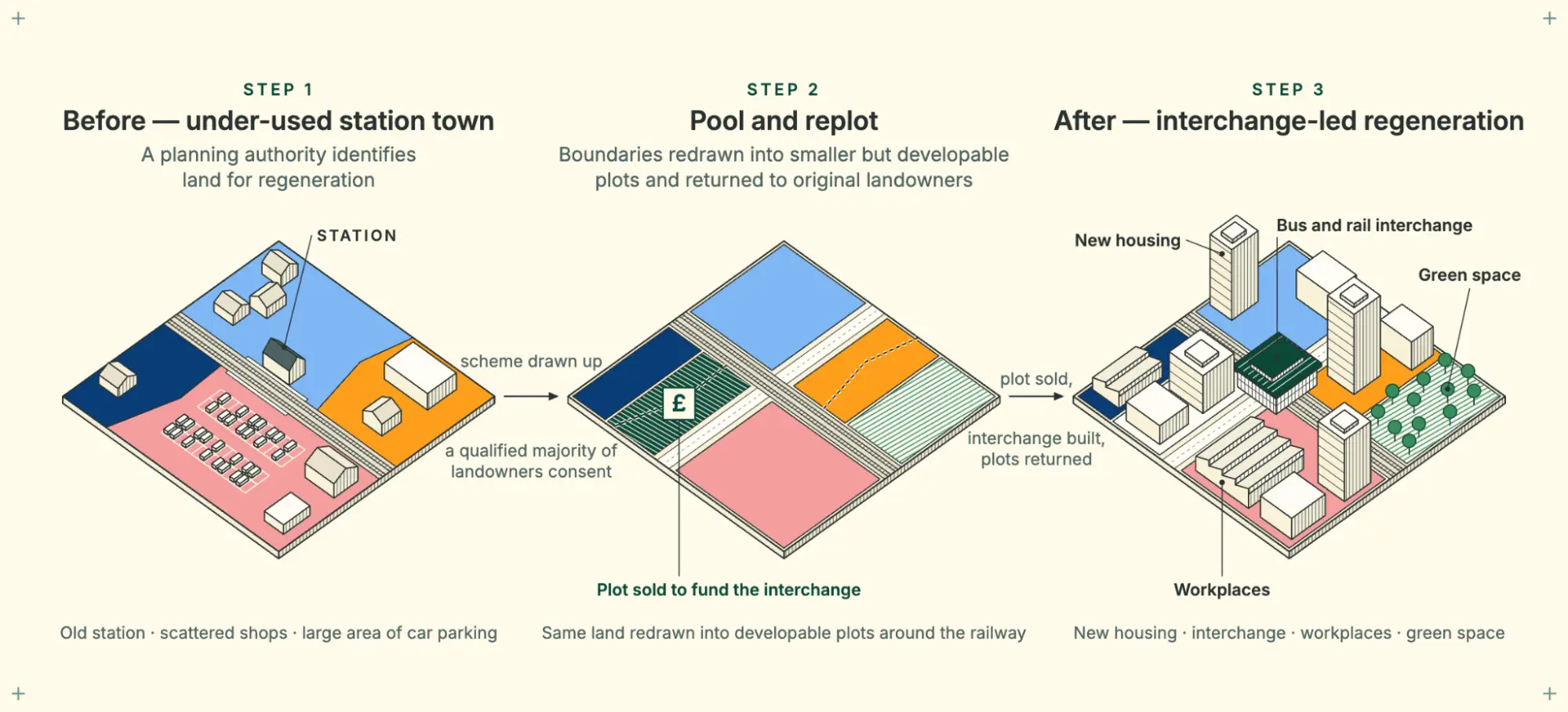
CASE STUDY Digbeth Birmingham City Council’s 2025 prospectus for Digbeth, just east of the city centre, identifies 35 development plots with capacity for more than 6,000 homes. The new Birmingham East Mayoral Development Corporation, launched in May 2026, is intended to coordinate regeneration there and at the Sports Quarter. Sites range from large estates, such as the 42 acres around the Custard Factory, to much smaller plots, and better streets and connections will often cross ownership boundaries. Land readjustment (2.8) would let the MDC pool the entire area and redraw the boundaries around new streets and infrastructure. They would then share in the uplift, without having to compulsorily purchase any of the land. |
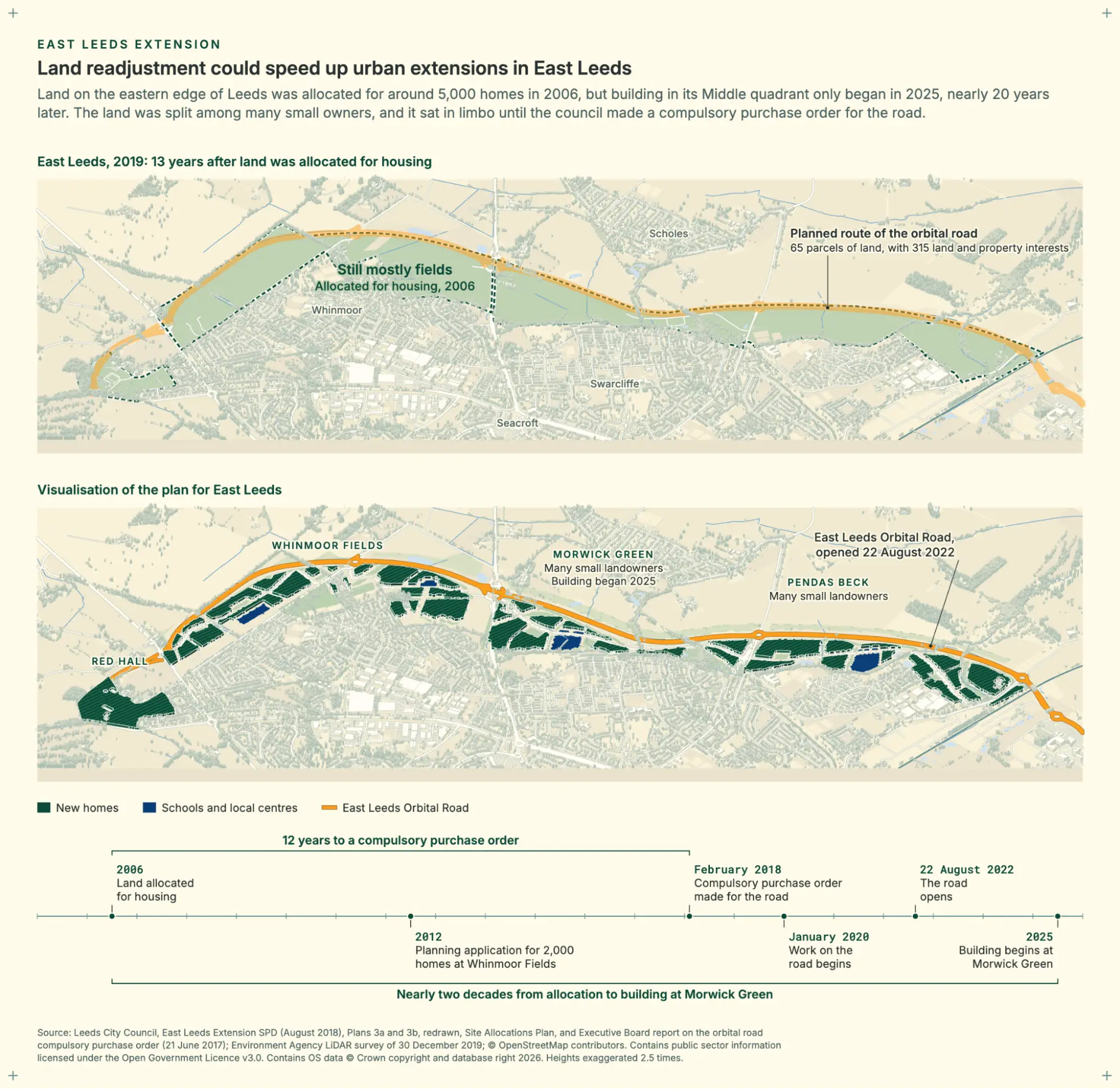
CASE STUDY East Leeds Extension The East Leeds Extension is 233 hectares on the eastern edge of Leeds, allocated for around 5,000 homes in 2006. Ownership of the land was highly fragmented across a number of small landowners. The council asked owners to form voluntary consortia across the schemes’ four quadrants to share the land values, so the cost of providing land for infrastructure would fall on them fairly; essentially a negotiated version of land readjustment. But a lack of engagement from some of the smaller landowners sitting along the route of the proposed new roads left the land sitting in ‘development limbo’ for some time, before a compulsory purchase order was eventually made to build the East Leeds Orbital Road. Building along Morwick Green only began in 2025, nearly two decades after the land was allocated. With land readjustment powers, the West Yorkshire mayoral strategic authority could have pooled the land itself, set aside what was needed for the road and community facilities in the replotting, and shared the uplift across all owners. |
Infrastructure delivery and duties on infrastructure providers
Infrastructure and housing development relies on connections to existing utility networks. However, the limited capacity of these networks is already holding back growth. In July 2022 the Greater London Authority warned that demand from new data centres was absorbing the remaining capacity on the electricity grid in west London. Applicants, including housing developments, were being told they could not connect for several years, in some cases until 2035. In Greater Cambridge, more than 9,000 homes and 300,000 square metres of commercial space were unable to proceed through planning in 2024 because the Environment Agency advised that local water bodies were at risk of deterioration, and that new water infrastructure was required before more development could proceed. Investment in this kind of capacity is decided nationally: regulators set the spending plans of water and energy companies, and how much they can charge customers to fund it, in five-year cycles, which do not necessarily align to local investment plans.
MDCs can already provide infrastructure, and developers can requisition water mains and sewers and demand electricity connections. But no infrastructure provider has to deliver upstream capacity, such as treatment works, substations, or junction upgrades, on a growth plan’s timetable, so faster planning and consenting alone sometimes only shifts the delay to the utilities. A mayoral strategic authority or MDC should have power to adopt an infrastructure delivery programme for a designated area, setting out the transport, water, sewerage, energy, school, and health infrastructure the area needs and when, and to commission and build that infrastructure itself. Water and sewerage companies, electricity transmission and distribution operators, NESO, National Highways and Network Rail should be required to comply with binding mayoral directions to provide specified connections and capacity, including upstream works, to an enforceable timetable, and to adopt assets built to their standards. The legislation should provide for cost allocation and recovery, enforcement and dispute resolution. The authority would fund its own works through the value capture powers proposed below in Section 4.
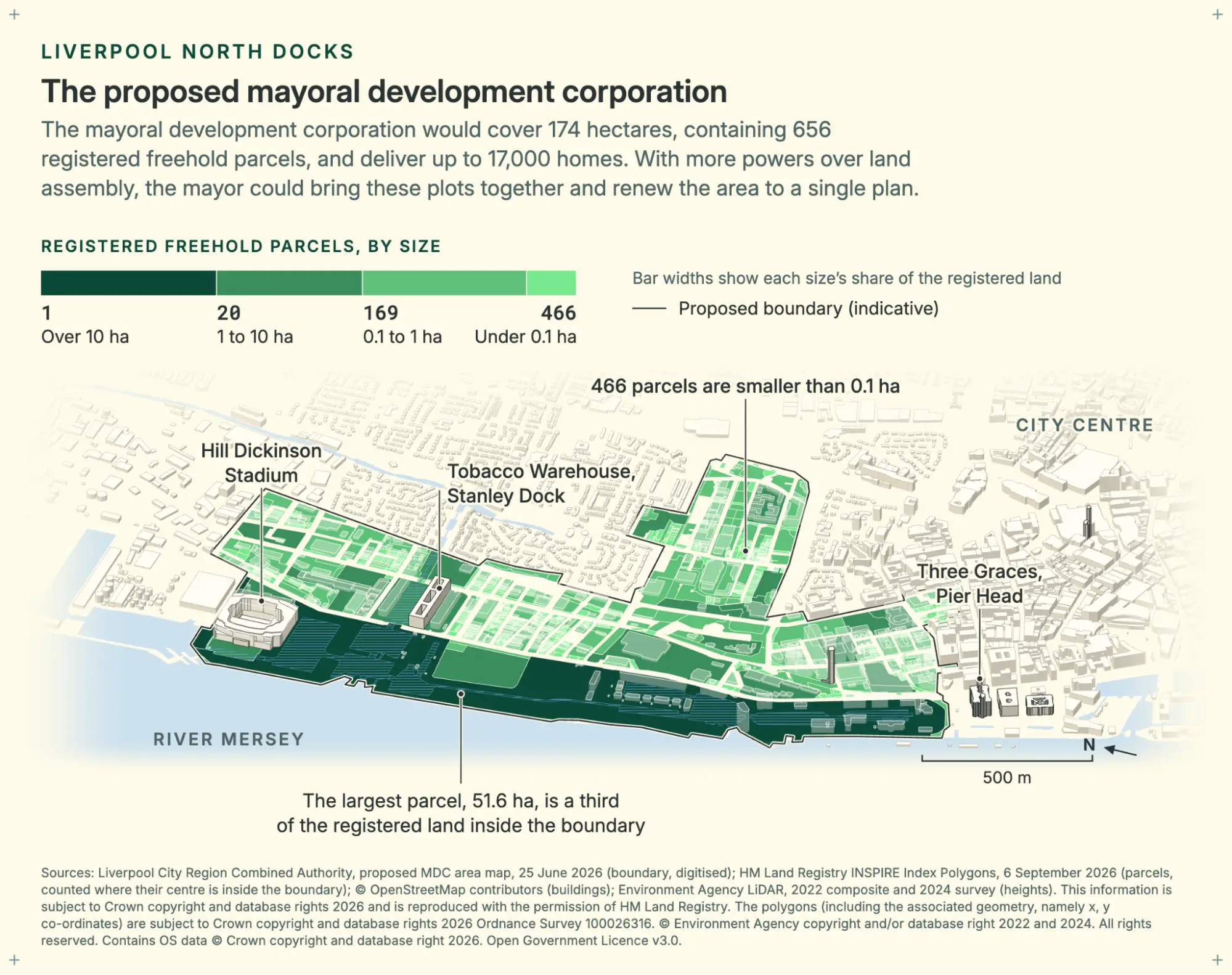
CASE STUDY Liverpool North Docks Liverpool’s North Docks cover 174 hectares of mainly brownfield land, stretching from the River Mersey to the Pumpfields and the commercial business district. The Liverpool City Region mayor is proposing a mayoral development corporation to deliver up to 17,000 homes, but it needs the Secretary of State’s approval of its business case and authorisation to use compulsory purchase, has limited means to recoup any of the value of its input, and would only be able to ‘work with utility providers’ on electricity, water, and sewerage connections, on their own timetables. With the powers in 2.8 and 2.9, it could assemble fragmented plots through land readjustment and require utilities to support its programme, and the value capture powers in Section 4 could provide ways to fund it. |
Local electricity pricing
Great Britain has a single national wholesale electricity market, so wholesale prices do not reflect local grid congestion. This creates enormous imbalances between supply and demand. This means that businesses have no reason to use electricity where supply is higher, so consumers end up paying large costs on their bills for curtailment. The cost of managing that congestion is added to everyone’s bills: it is the largest part of the balancing costs that the National Energy System Operator (NESO) recovers from consumers, over £200 million a month. Under nodal pricing, the wholesale price is set at each point on the network to reflect local supply, demand, and grid constraints. This means that new demand can be drawn to where power is plentiful, and new generation to where it is most needed. It has been used in New Zealand for decades, and across major US markets since 1998.
Mayoral strategic authorities should have the power to require NESO to introduce nodal pricing for so much of the grid as is practical within their area. That would allow local communities to rapidly see the benefits of new power generation and allow ambitious mayors to lead the way on lower electricity prices. Primary legislation should give mayoral strategic authorities this power and require Ofgem and NESO to implement mayoral decisions within a statutory timetable. Ofgem should also be required to allow third-party transmission connections, so that new job-creating demand in these areas can connect directly to local generation without waiting for the incumbent network operator.
Night-time economy licensing
The number of nightclubs in the UK fell from 1,240 in 2020 to 835 in 2024. In most of England, individual councils are responsible for licensing decisions, which are themselves guided by four nationally determined ‘licensing objectives’, none of which consider economic, social, or cultural value. When Islington Council revoked the nightclub Fabric’s licence in 2016, it only reopened after a public campaign.
The English Devolution and Community Empowerment Act 2026 now gives the Mayor of London a role in licensing applications of potential strategic importance to Greater London, including a power to direct the licensing authority, but it applies only to London, and only in limited circumstances.
A mayoral strategic authority should be able to take over night-time economy powers for its area. In the strongest version, the mayor could become the licensing authority across the whole area or in designated Night-Time Economy Zones. Optional additions include new planning powers and nuisance protections for licensed venues or devolving Sunday trading hours.
Potential pilots before a Bill
The proposals in this section may apply to the consent process in general, and do not require primary legislation.
Nutrient mitigation and Environmental Delivery Plans
Nutrient neutrality is a national rule that applies where a protected water body is already polluted with nitrogen or phosphorus, typically from agricultural run-off. In those areas, Natural England advises that new development, including every new home, may only be approved if the developer shows that it will add no extra nutrient pollution. The rule affects 27 catchments across 62 local authority areas, and the Government estimated in 2023 that it was blocking around 16,500 homes a year. In 2022–23, nutrient neutrality rules stalled around 21,000 homes across the North East, most of them in the Tees catchment and the mayor had no powers to resolve the problem.
By adopting a more joined-up approach, it is possible to make vastly greater improvements in the environment at lower economic cost. The Government’s own analysis found that housing makes ‘a very small contribution’ to the pollution, and that the rule had ‘placed an unavoidably burdensome process around the offsetting of small quantities of nitrates and phosphates… while achieving little to improve water quality’.
Addressing nutrient pollution across a whole catchment, rather than on a site-by-site basis, improves water quality more effectively and allows more homes to be built. Strategic licensing schemes for great crested newts, run with Natural England, have enabled more than 70,000 new homes, as well as creating or restoring almost 5,000 ponds. The first scheme for nutrients, in Norfolk, is expected to enable over 15,000 homes. There are three options for giving mayors a role in these plans.
The first is a mayoral nutrient mitigation partnership: the Government should offer funding for a volunteer mayoral strategic authority to establish a wetlands habitat bank in a catchment area where nutrient neutrality requirements are affecting housing supply. The same model could also work for protected species, with the mayoral strategic authority creating the required habitat as a delivery partner to Natural England’s strategic licensing schemes and, later, its species EDPs. This requires no statutory instrument.
The second, which needs a statutory instrument, is mayoral EDP and Nature Restoration Fund delivery: the Secretary of State can designate a mayoral strategic authority as the delivery body for an EDP in its area. This could be either as a pilot in one catchment, or as a standing rule for established mayoral strategic authorities.
The third, which needs a statutory instrument or an agreement under the Natural Environment and Rural Communities Act 2006, may cover decisions outside EDPs: where no Environmental Delivery Plan applies, a mayoral strategic authority could determine specified protected species and Sites of Special Scientific Interest (SSSI) cases in its area by agreement with the Secretary of State for protected species or with Natural England for SSSIs.
Environmental permits
Many developments need an environmental permit, from the Environment Agency or the local council, as well as planning consent. At Brent Reservoir in north-west London, £3.5 million of statutory safety works needed an Environment Agency flood-risk activity permit, a Water Framework Directive assessment, and Natural England’s assent, because the reservoir is a SSSI. Industrial sites need one for their installations; works on or near a main river, flood defence, or floodplain need one for flood-risk activities; and others need them for waste, water discharges, or groundwater. At Net Zero Teesside, the Environment Agency’s bespoke permit took about 23 months, although the environmental effects had already been examined during the development consent process.
Giving the mayoral strategic authority regulatory powers would put these decisions with the body already planning the area’s growth. The Environmental Permitting Regulations 2016 should be amended, by statutory instrument, so that the mayoral strategic authority is the regulator for every class of regulated facility in its area.
Locally made standard permit rules
Becoming the regulator carries no rule-making power itself: at present the rule-maker is the Secretary of State where a council regulates and the appropriate agency otherwise. Where 3.2 makes a mayoral strategic authority the regulator, it should also become the rule-making authority for standard permit rules for that class.
Standard rules matter because applying for a standard rules permit is quicker and costs less than a bespoke permit. Yet only about 3% of the flood-risk activity permit applications received by the Environment Agency in 2024 qualified for one; the other 97% needed a bespoke permit. A mayoral strategic authority able to write standard rules for the activities it regulates could move more routine, low-risk work onto that faster route.
Funding
New powers are only as useful as the capacity to use them. Planning capacity is already stretched: The Government estimates that planning fees fell around £330 million short of the cost of handling applications in 2024-25. Local government raises very little of its own revenue: just 6% of UK taxes are collected below the national level, the lowest share in the G7. The Government has begun to act, with mayors able to retain a share of business rates from April 2027, and a fiscal devolution roadmap expected in the upcoming Budget. The options below would let mayoral strategic authorities fund the new powers from the growth they enable. We suggest:
- Powers to set application fees above national levels for mayoral TWAO and DCO powers (Section 1), allowing generous cost recovery in exchange for a more efficient service.
Major schemes already have this option: the Planning Inspectorate charges over £220,000 a year, plus VAT, for its enhanced pre-application service for Nationally Significant Infrastructure Projects. For ordinary planning applications, the Planning and Infrastructure Act 2025 allows regulations to let planning authorities set their own fees, and the Government has confirmed it will allow fees up to 30% above a national default where evidence supports it. Applying the same principles to mayoral orders would allow mayoral strategic authorities to establish the specialist teams required by the new powers.
- The strongest possible version of fiscal devolution for mayors.
Fiscal devolution gives mayors a direct stake in the growth that they enable. Where a mayor’s consents enable new homes and businesses, a share of the resulting tax receipts should come back to the area. The commitments already made on business rates, income tax, and the Overnight Visitor Levy are a strong start, and the fiscal devolution roadmap due alongside the Budget should set out the strongest possible path.
- Mayors should get control over how at least a portion of the CITB levy raised in their area is spent.
The CITB levy is paid by construction employers and is forecast to raise about £243 million a year from 2026 to 2028. Skills are a constraint on delivery. CITB estimates that construction needs an average of 41,200 extra workers a year between 2026 and 2030. The levy is charged at 0.35% of payroll and 1.25% of payments to subcontractors. Giving mayors a say over the levy raised in their area would ensure construction training is tailored for the pipeline of schemes unlocked by these new powers. The options range from a share of the levy raised in each mayoral area being set aside for grants in line with the mayor’s local skills plan, to full devolution, in which mayors set up their own training board or take on CITB’s powers for their area and set the levy rate themselves.
In Liverpool’s North Docks, the City of Liverpool College has already opened a Construction Academy at Liverpool Waters, training around 250 students on the site of the regeneration they could go on to build. A share of the levy raised in the city region, directed by the mayor, could expand provision of this sort.
- Three additional powers for mayoral strategic authorities, or at least the mayoral development corporations they establish, to capture land value uplift for the public.
- First, negotiated contributions: giving the mayoral strategic authority or MDC power to agree cash or non-cash contributions (for example equity shares) from landowners, which are binding once agreed and can be treated as a material consideration when granting permission. Agreeing contributions early gives landowners and developers certainty and helps viability. They need not be spent within the boundary of the development in question, and could support mayoral priorities elsewhere.
- Second, business rates on derelict or undeveloped land: where undeveloped or derelict land within the area of the MDC benefits from new infrastructure, we suggest a new power for the mayoral strategic authority or MDC to levy a modest business rate.
- Third, the power to do land readjustment (see Proposal 2.8), as practised to deliver regeneration and development in a range of other countries such as Germany, Spain, and Japan.
Planning permission and new infrastructure can create very large increases in land value. We estimated £30 billion of potential land value capture in South Cambridgeshire alone, enough to pay for East West Rail, the Fens reservoir, and a new Cambridge tram. Current tools to capture this value for the public are limited. Section 106 agreements and the Community Infrastructure Levy raised an estimated £7.0 billion in 2018-19, and planning obligations must be directly related ‘in scale and kind’ to the development. Some countries use annual charges to stop permissioned land being left undeveloped: Portugal, for example, multiplies its municipal property tax rate by ten for building land zoned for housing and left undeveloped in areas of housing pressure. The three powers above would let an MDC share in the value it helps to create, and strongly incentivise landowners to develop once permission is granted.
CASE STUDY Arden Cross, Solihull Arden Cross is a 140-hectare site around the planned HS2 Interchange station in Solihull, next to the NEC and Birmingham Airport. Its landowners plan up to 3,000 homes, 27,000 jobs and 6 million square feet of commercial space. Much of the value will come from public investment. The land was designated as green belt when plans were originally drawn up, and its prospects rest on a new high-speed rail station. The West Midlands Combined Authority has committed a £45 million loan, alongside a £50 million government grant, to fund infrastructure on the site. Development is not expected to begin until 2030. With the undeveloped land business rate proposed here, a mayoral development corporation could levy a small annual charge on the amount of land value that exceeds agricultural use, helping to repay the public investment that is creating the value for landowners. |
In the meantime, the pilot studies could be funded by grant funding to mayoral strategic authorities who choose to volunteer.
Conclusion
These powers are not only about improving our ability to build. Regeneration works best when the people already living and working in an area share in its benefits. Mayoral strategic authorities and MDCs are well placed to set out from the start what a scheme will deliver for them: local jobs and training, affordable homes, public space, and community facilities. Sharing the uplift of development ensures that communities can see themselves the value of the growth that their mayors deliver.
Questions and answers
Why devolve mayors additional consenting powers?
Mayors are already responsible for place-making. They are accountable for delivering transport and regeneration in their areas and for spatial strategy, but the Secretary of State holds the key consenting powers. This creates an additional veto point far from the area most affected, and it also means that mayors have the responsibility without the power. Whitehall decisions can be slow and defensive, and may not prioritise local matters as much as the area in question would. Fiscal devolution is already underway, and rule-making is the missing piece that allows mayors to turn funding into delivery on the ground.
Won't this create a regulatory patchwork, leaving businesses that work across several areas facing more complexity, not less?
Wherever possible, we have suggested that Mayors should be able to choose whether to use such powers and that scheme promoters should be able to choose the Mayoral route where it is offered if they wish, for example where it offers greater certainty on timing. Most of our proposals also reduce the number of consents a project has to deal with: one mayoral order could cover planning, environmental permits and other specialist consents that are now handled separately. Mayoral DCOs and TWAOs use the existing regimes, so a promoter who knows one knows them all. The powers cover consents for specific sites and areas, not rules on goods and services traded across the country, so the internal market isn't fragmented.
If given a choice between regimes, won't developers just shop around for the most permissive regime?
There are two separate issues here. For a specific local piece of infrastructure, the only choice is who decides, not which rules apply. A tram line in Birmingham may be consented by either the West Midlands mayor or the Secretary of State, but both would apply the same statutory regime. The difference is that it creates a route for mayors to prioritise schemes of strategic local importances, rather than waiting in a national queue.
For general types of investment that can be made in different locations, such as a new factory, different places always differ in how welcoming they are. That is in part the point of place-based policy. Fundamentally, devolution entails trusting democratically elected mayors to weigh up the costs and benefits of policy decisions for their area. Places that want to attract investment can offer faster decisions, joined-up infrastructure and a skilled local workforce. National environmental safeguards will remain.
Would devolving these powers risk weakening environmental protections?
Every Mayoral power operates within national safeguards, and the EOR framework will require that overall environmental protection is not reduced. Strategic, area-wide approaches deliver more for nature than site-by-site rules: strategic licensing for great crested newts has enabled more than 70,000 homes and created or restored almost 5,000 ponds. The Government's own analysis found that site-by-site nutrient offsetting achieved very little benefit for water quality, at huge cost. Mayors also answer directly to voters who live with the environmental consequences, unlike a distant regulator.
How can a mayor fairly decide on schemes their own authority is promoting?
This is established practice. Councils decide their own planning applications (sometimes even refusing them!), and the Transport Secretary decides National Highways schemes. Independent examination, separation of functions within the authority, human rights protections for CPO and judicial review would all still apply. Without this power, mayors couldn’t use it for their own tram lines and regeneration schemes, which are the projects most likely to benefit.
Do mayoral strategic authorities have the in-house capacity to use these powers?
Many mayoral authorities currently have small planning teams, and they may not be able to implement the proposals directly. However, we propose various ways for mayors to get the resources to increase planning capacity. The powers are optional, so authorities can take them up when they are ready to do so, or delegate them to an MDC.
Doesn't this hand mayors broad powers outside parliamentary scrutiny?
For too long the UK has been too centralised. Westminster should not expect to micro-manage every effect within a particular area. Mayors are democratically elected and subject to democratic replacement. The principle of subsidiarity means that Mayors should be able to decide on issues that do not have effects outside their area. And Parliament would establish the regime with a Bill, so they would be able to build in safeguards as we have suggested. Mayors are also directly elected and subject to local scrutiny committees and judicial review.
How would land readjustment and business rates on derelict and undeveloped land affect landowners’ property rights?
Land readjustment is designed to be a more collaborative alternative to compulsory purchase powers. It is widely used in Europe. Owners end up with a serviced plot and share fairly in the scheme uplift. The process can only go ahead if a qualified majority of them agree. Negotiated contributions are agreed voluntarily. The charge on derelict and undeveloped land reflects a current anomaly of the English tax system in contrast to other systems. Holding key areas of a city derelict for years imposes a substantial cost on others. Like Portugal's equivalent, the proposed power to set a business rate for particular areas can be used to encourage landowners to build rather than putting off investment.
For more information about our initiative, partnerships, or support, get in touch with us at:
[email protected]For more information about our initiative, partnerships, or support, get in touch with us at:
[email protected]