
Table of Contents
- 1. Summary
- 2. What is the Renewable Transport Fuel Obligation?
- 3. Are you palm oil in disguise?
- 4. Picking losers
- 5. Solution 1 — picking a winner, subsidise electric vehicle miles
- 6. Solution 2 — abolish it and pass all the savings to consumers
- 7. Solution 3 — abolish it and pass all the savings to the Treasury
- 8. Solution 4 — abolish it and use some of the savings to fund better access to EVs
- 9. Solution 5 — a mix of some or all of the above
- 10. Authors
Summary
- The Renewable Transport Fuel Obligation (RTFO) requires fuel suppliers to blend a rising share of low carbon fuel into petrol and diesel. It costs more than £2 billion a year, which is paid by drivers at the pump. This is equivalent to around 4p a litre (2024 prices).
- Even on the government's own figures, the scheme is an expensive way to cut emissions. The scheme’s cost per tonne of carbon saved is far above the UK Emissions Trading Scheme price.
- Many of the supposed savings are doubtful. Used cooking oil made up 46% of UK low carbon fuel in 2024, but no chemical test can confirm that it is actually waste oil. There is circumstantial evidence that a significant proportion could be palm oil and other fraudulent sources.
- The additional cost imposed by the RTFO could instead be channelled towards encouraging electric vehicle (EV) adoption, which would be better for the environment and more economic for the UK.
- The government could reform or replace the RTFO scheme in several ways:
- Let EVs earn certificates. Petrol and diesel drivers would save around £600 million (2024 prices), and the proceeds could cover about a third of the new per-mile charge on EVs.
- Abolish the scheme and pass the saving to drivers. This would be worth around 5p a litre (2025 prices).
- Abolish the scheme and reverse the 5p fuel duty cut. Pump prices would stay the same, but the Exchequer would collect about £2.7 billion extra each year.
- Abolish the scheme, increase fuel duty and use the first two to three years of that revenue to support EV infrastructure, such as through cheaper public charging for drivers who cannot charge at home.
- The above reforms could also be combined to save the Exchequer money while encouraging EV adoption. Our only firm view is that the current system must be changed.
What is the Renewable Transport Fuel Obligation?
Any importer or manufacturer of more than 450,000 litres of fuel a year must take part in the Renewable Transport Fuel Obligation (RTFO). This added 4.1p per litre to fuel costs in 2024.
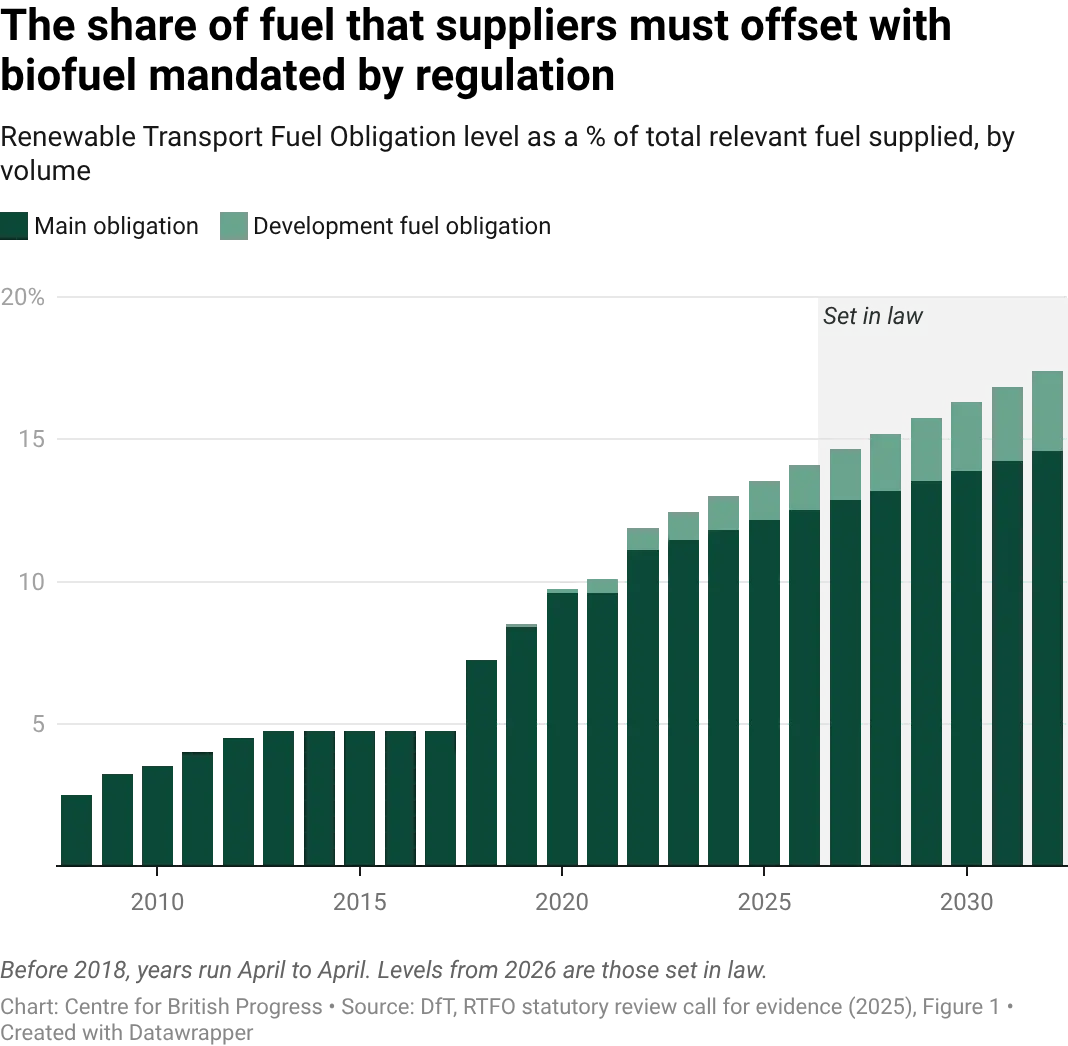
The RTFO requires fuel companies to buy Renewable Transport Fuel Certificates (RTFCs) to cover a percentage of their fuel. The certificates are generated by companies that supply sustainable low-carbon fuel into a covered UK transport use and have proven it to the DfT’s Administrator. The percentage of fossil based transport fuels that need to be covered by certificates is set by DfT ministers in secondary legislation, subject to consultation and a parliamentary vote. Currently it is 16.4% and will rise each year until it reaches 21.1%, the level set for 2032 onwards. Certificates are earned per litre of low carbon fuel produced. For some fuels, one litre is worth one certificate, for others a litre is worth two. Some fuels also qualify for the ‘development fuel’ part of the obligation, designed to support more innovative fuels.
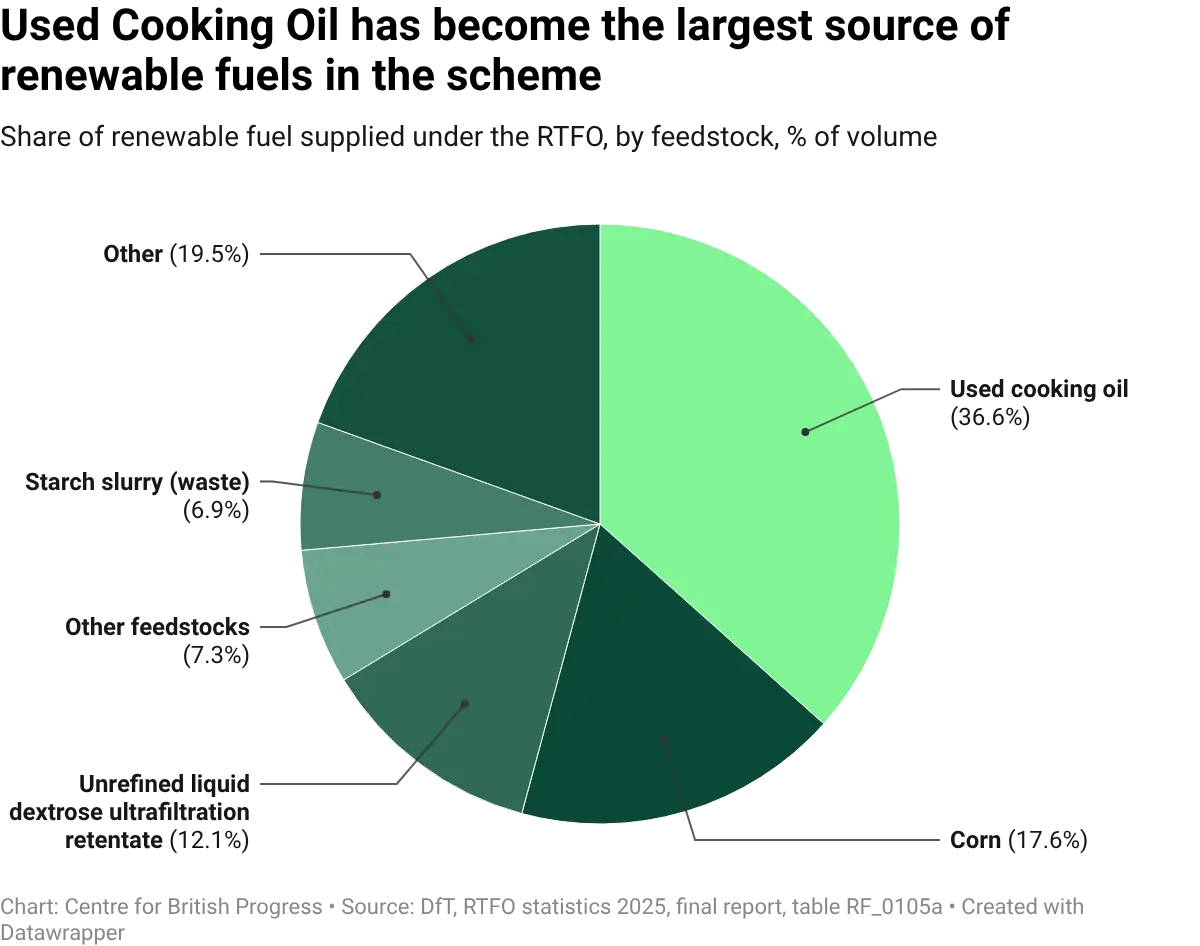
These low carbon fuels are created from many different sources, but used cooking oil is by far the largest.
Even on its own terms, the obligation gives rise to many bad incentives. Fuels are given certificates not on the basis of the amount of emissions saved (as long as they pass the threshold), but on volume.One litre of an energy-dense fuel that saves 100% of carbon dioxide relative to burning a fossil fuel generates one certificate. One litre of a much less energy-dense fuel that saves only 55% of carbon dioxide relative to burning a fossil fuel also generates one certificate. Gases are judged by their weight, rather than the amount of energy they provide or the amount of carbon they save. The purpose of the system should be to incentivise reducing emissions, not using larger volumes of liquid or larger weights of gas.
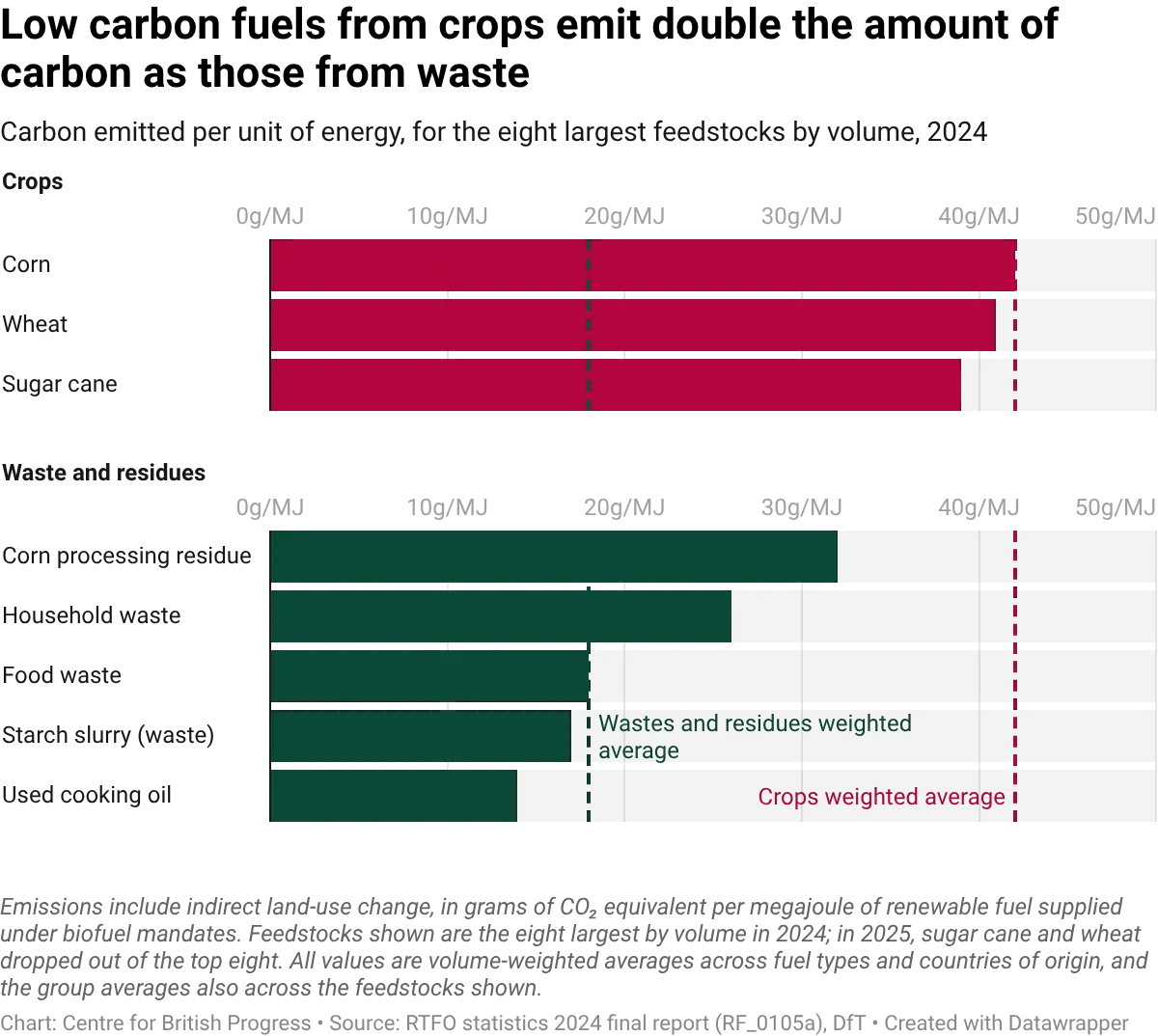
Most fuels receive 1 certificate per litre. However low carbon fuels made from wastes receive 2 certificates per litre. Therefore there are strong incentives to create fuels from waste.
Benefits
Low carbon fuels make significant reductions to our carbon emissions, at least if you take government data at face value.
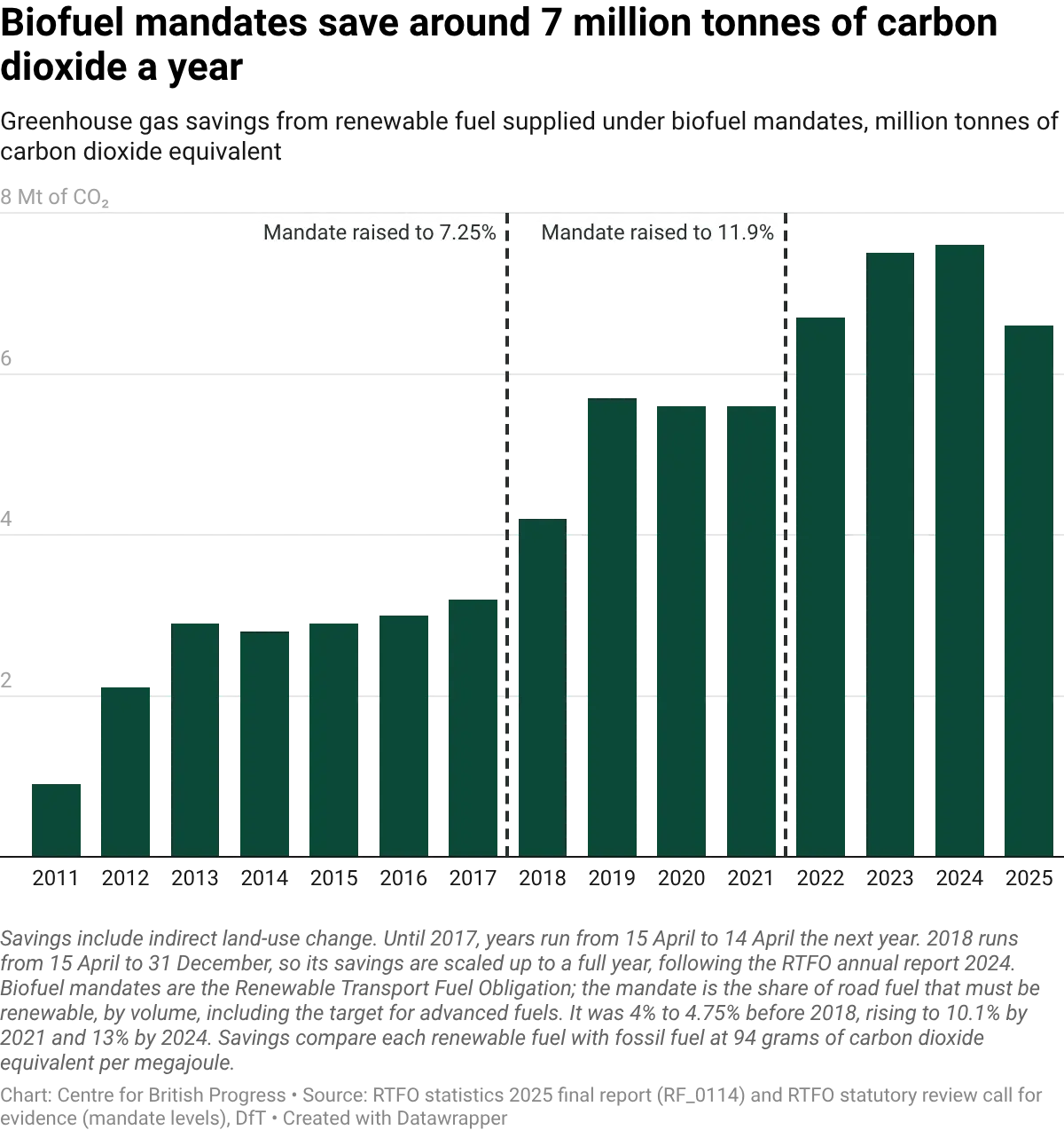
6.6 million tonnes of Carbon Dioxide equivalent is not an insignificant amount, it is around 2% of all UK emissions in 2025. It is only slightly less than the emissions of Armenia and slightly more than the 6.27 Mt CO2 equivalent emitted in the Liverpool City Region in 2024.
Costs
These savings are not free. Low carbon fuels cost more to produce than the fossil fuels they displace. Therefore, the obligation adds costs to fuel bills, including for every diesel and petrol car and van in the country, every time they fill up.
Therefore we need to consider whether these emissions cuts are good value for money.
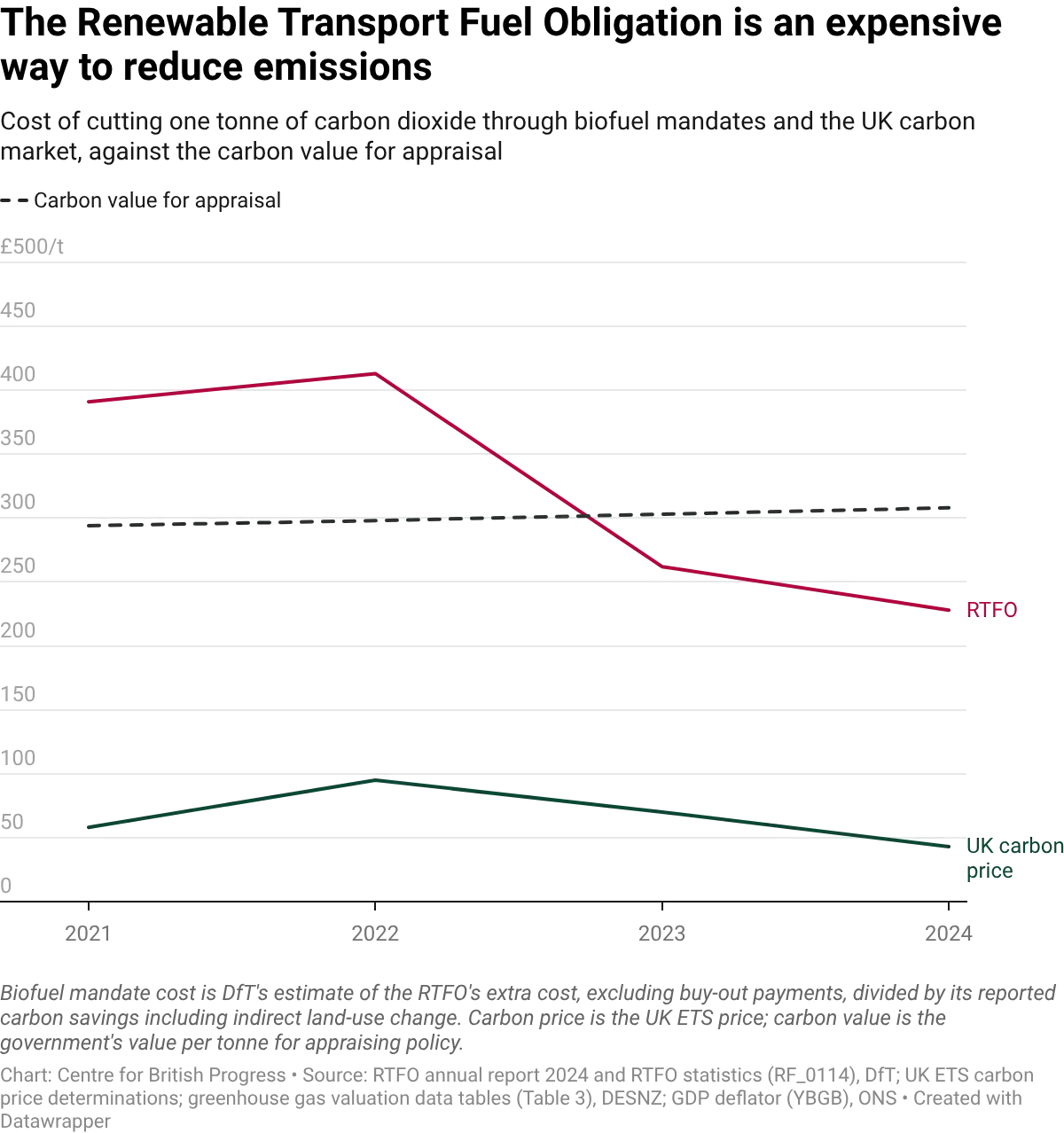
The DfT has forecast that the cost of the scheme rose to £2.6 billion in 2025, though full figures have not yet been published. This is because the amount of low carbon fuels delivered fell. More fuel providers will be going for ‘buyouts’ that return to the treasury and less emissions will be saved.
The Carbon value for appraisal is derived from the UK’s Net Zero 2050 target. It is meant to reflect the marginal cost of emissions abatement on pathways consistent with net zero by 2050, and rises each year along a published trajectory. It is used in cost-benefit analysis across governments.
The ETS carbon price is the market cost of carbon, as per the government’s ETS scheme, which covers much of the UK economy. The ETS price provides a guide to the cost of reducing the marginal tonne of carbon from UK emissions, at the scheme’s current emissions cap. The fact that the RTFO’s theoretical abatement cost (before considering potential fraud) already sits so high above the UK ETS, suggests that it is a particularly costly decarbonisation policy.
Are you palm oil in disguise?
Our figures so far have taken the government’s figures at face value. There is no reason to doubt the financial figures. However, the carbon savings are more questionable. There is strong circumstantial evidence that there is widespread fraud in the renewable fuels system. In 2025 we imported substances from 101 countries and 4 territories to make different kinds of fuel eligible for the RTFO. From many of these countries, several different types of fuel and fuel feedstock are imported.
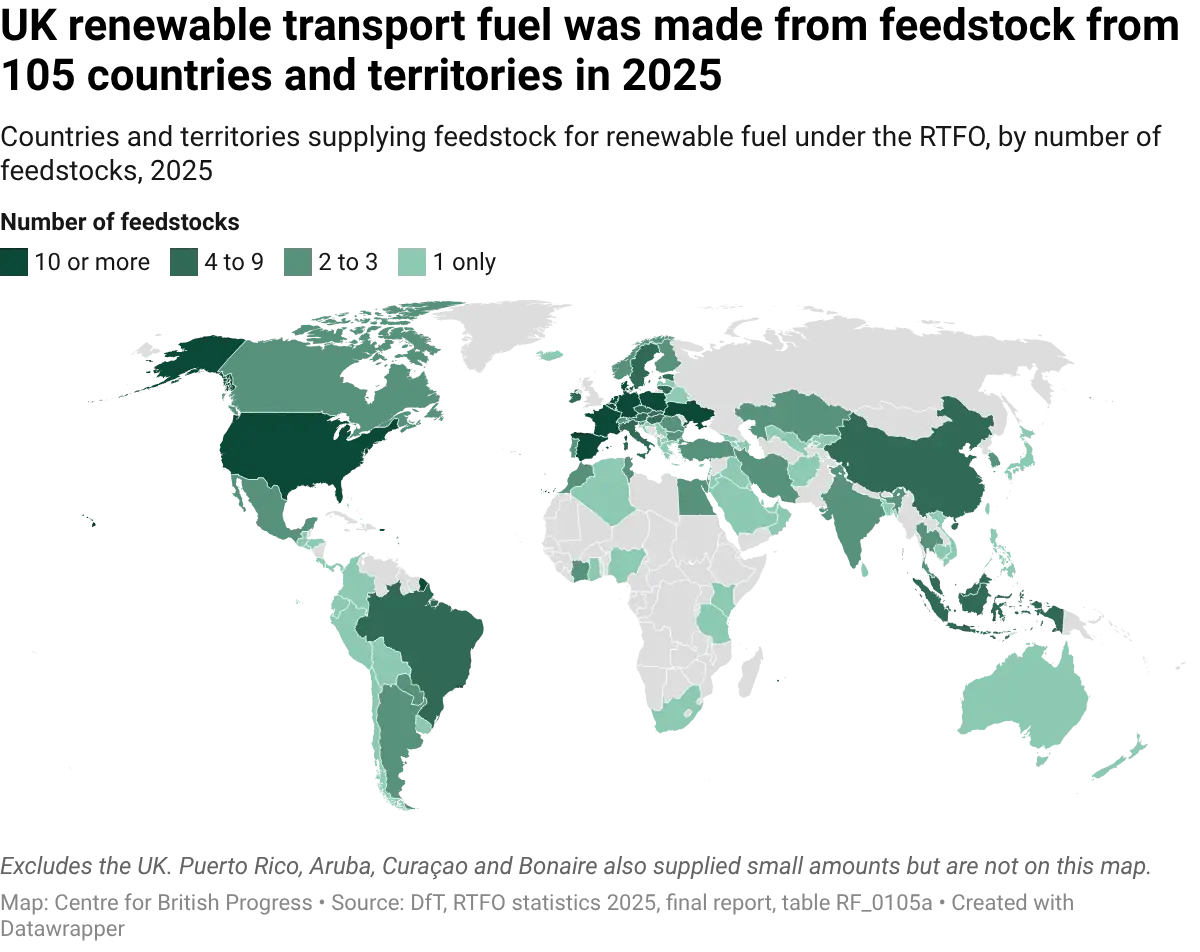
For each of these countries and fuel types, DfT has figures for the carbon emissions of collecting, transporting and processing the oil. The emissions savings are derived by comparing this with fossil fuels.
However, it is difficult to believe that they can be fully sure of the origin of all of these fuels. Because of the price premium of biofuels and the legal requirement to provide certificates or pay a large ‘buyout’ fee for fossil fuel suppliers there is an incentive for suppliers to secure them even from the unlikeliest of sources.
So far in 2026, the UK has imported 1 million litres of ‘used cooking oil’ from Taliban-run Afghanistan for use as a feedstock in UK diesel. In 2025 we imported 2.3 million litres. The UK has no diplomatic presence in Afghanistan, and the Foreign Office advises against all travel there. Verification is supposed to be able to show a ‘chain of custody’ for wastes back to where the waste arises. For used cooking oil, that means the restaurant or food-processing facility it came from. This will be difficult to do in Kabul.
A freedom of information request to DfT revealed that there are 3 different ‘reporting parties’ supplying UCO from Afghanistan to the UK. None of these imports were selected for further checks, the DfT has carried out no risk assessment on the possibility of fraud from UCO imported from Afghanistan nor have they corresponded with any verifier on this matter. It is difficult to escape the conclusion the DfT is accepting Afghan UCO on faith.
To earn a Renewable Transport Fuel Certificate, there is no need to prove that importing the fuel didn’t simply lead to someone else using a fossil fuel to replace it. In a very poor country like Afghanistan, it seems unlikely that used cooking oil wouldn’t otherwise have been used, whether as a feedstock for a cruder form of biodiesel, as ‘gutter oil’ (essentially used again as cooking oil), burned directly (it can be used in basic wick lamps) or made into soap. All of these displaced uses are met with materials that will lead to CO2 emissions. None of this is accounted for in the emissions figures.
With hundreds of sources of fuel, even in nearby countries or within the UK, it is going to be very difficult to prove the provenance of most of them. Ultimately the government must do its best to judge whether the sources of the fuel are genuine, based on documentation provided by private companies. As the Department’s own guidance puts it: “At this time, the Administrator does not consider that any chemical test is definitive for the identification of a feedstock or a resulting renewable fuel such as used cooking oil.” Perhaps the most questionable imports come from Malaysia, Indonesia and China.
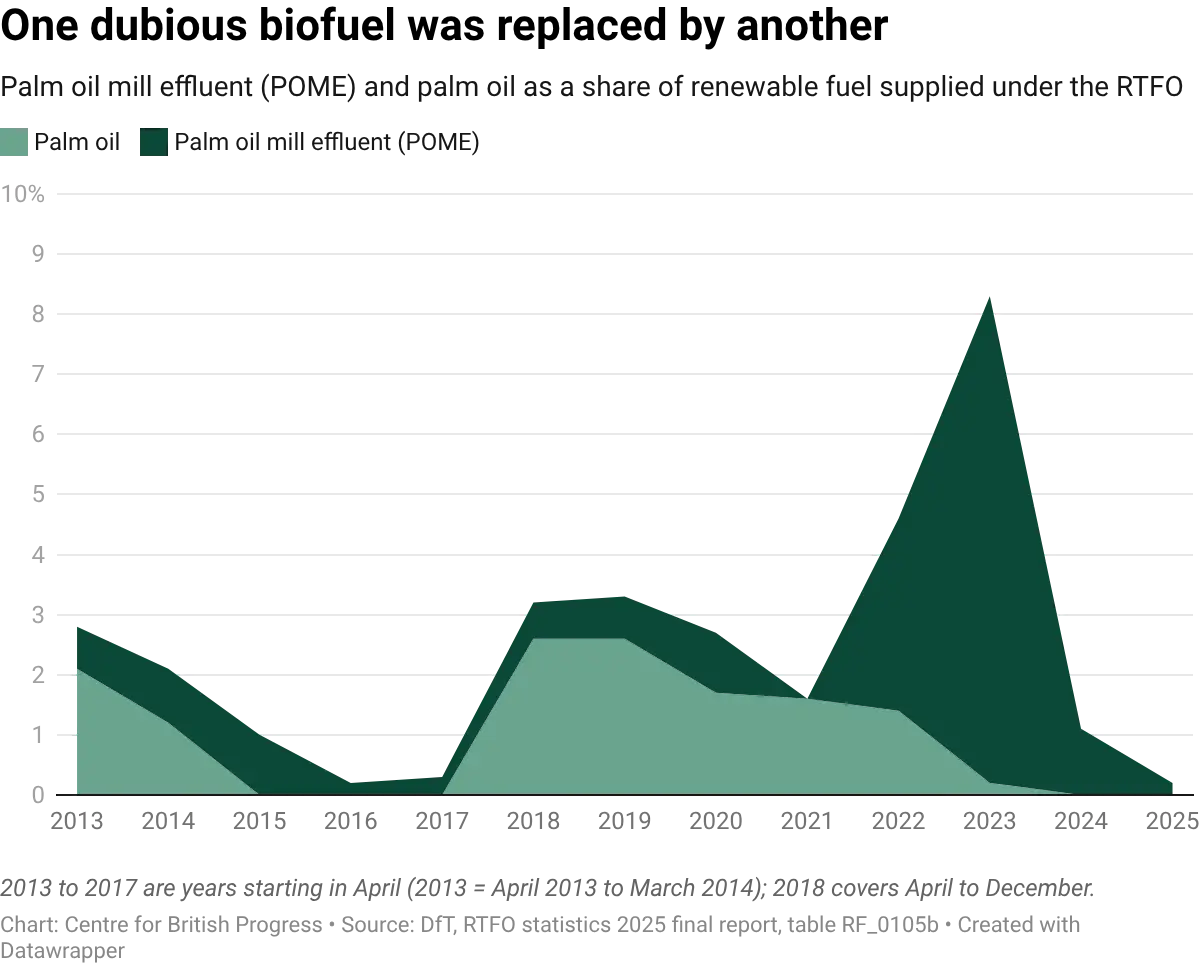
Malaysia is the world’s leading producer of palm oil, once a minor feedstock for low carbon fuels in the UK. Concerns that palm oil was leading to the cutting down of huge amounts of rainforest has led to it being phased out as a source of UK low carbon fuels, ceasing altogether in 2024.
The fall in use of palm oil as a low carbon fuel feedstock has coincided with the rise of a waste product of the palm oil industry, known as Palm Oil Mill Effluent (POME) as a feedstock. In theory, this makes a lot of sense. POME is a genuine waste stream that would otherwise sit in open lagoons, releasing large amounts of methane. Therefore, turning it into fuel removes emissions that would happen anyway without using extra land or competing with food crops.
In 2025 an investigation by The European Federation for Transport and Environment found that reported Palm Oil Mill Effluent materials used in low carbon fuel reached 2 million tonnes in the EU and the UK combined, in 2023. However, the highest plausible figure for global POME production was just 1 million tonnes. It seems difficult to avoid the conclusion that a huge amount of fraud is taking place in the Palm Oil Mill Effluent supply chain. Indeed, Germany is banning POME from its low carbon fuel supply chain as a result of these concerns. The UK has not done this, though volumes have fallen, possibly due to actions taken in the exporting countries. At its peak, low carbon fuel derived from materials that claimed to be POME made up 8.1% of the UK’s supply.
POME is not the only feedstock that should trigger some scepticism. Used cooking oil derived fuels made up 36.6% of UK low carbon fuels in 2025. The number has always been over a third in recent years.
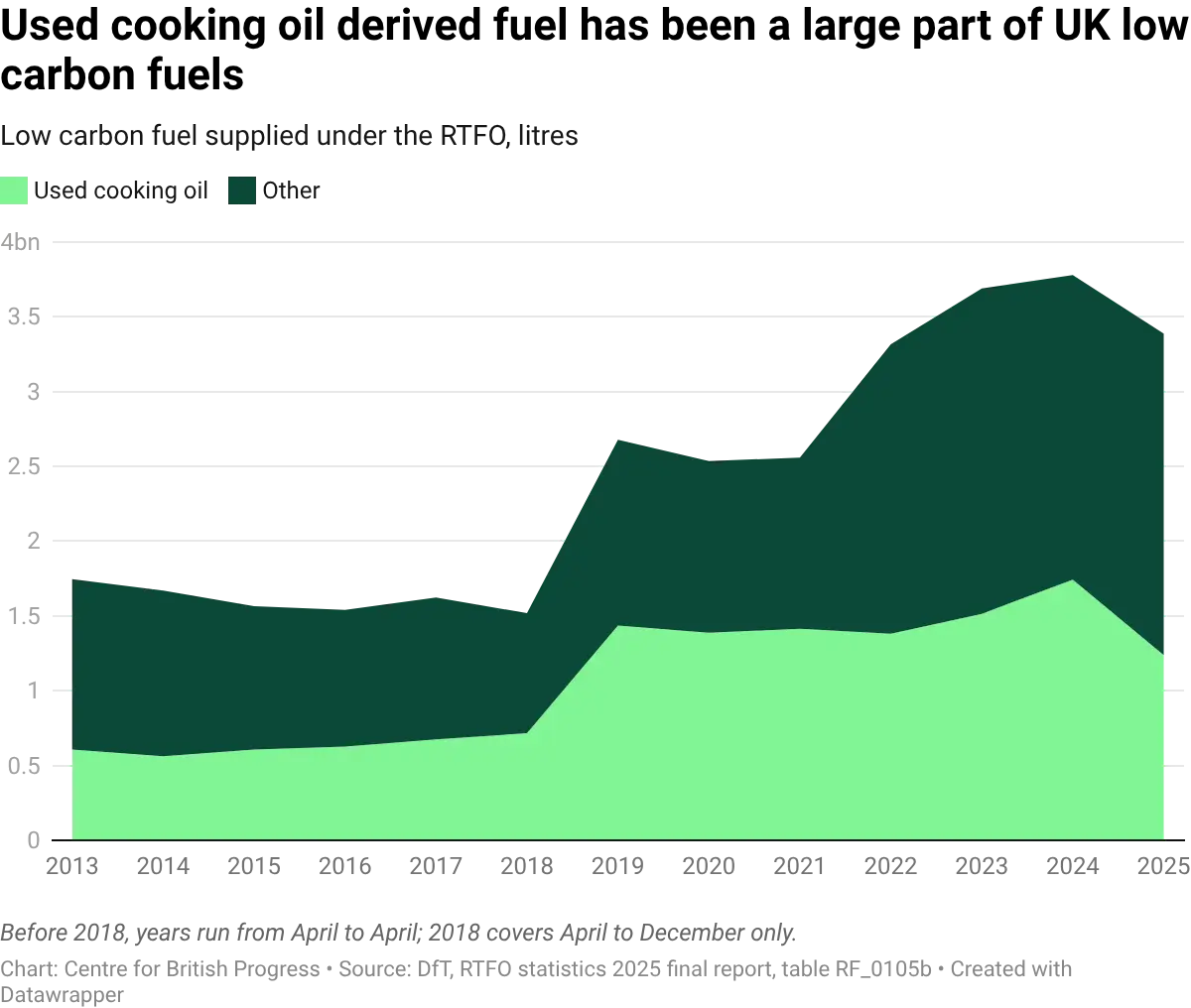
There have been several doubts raised about the carbon emissions from used cooking oil.
Indonesia’s government discovered widespread fraud, where virgin palm oil was being passed off as used cooking oil. The UK imports large amounts of used cooking oil from Indonesia.
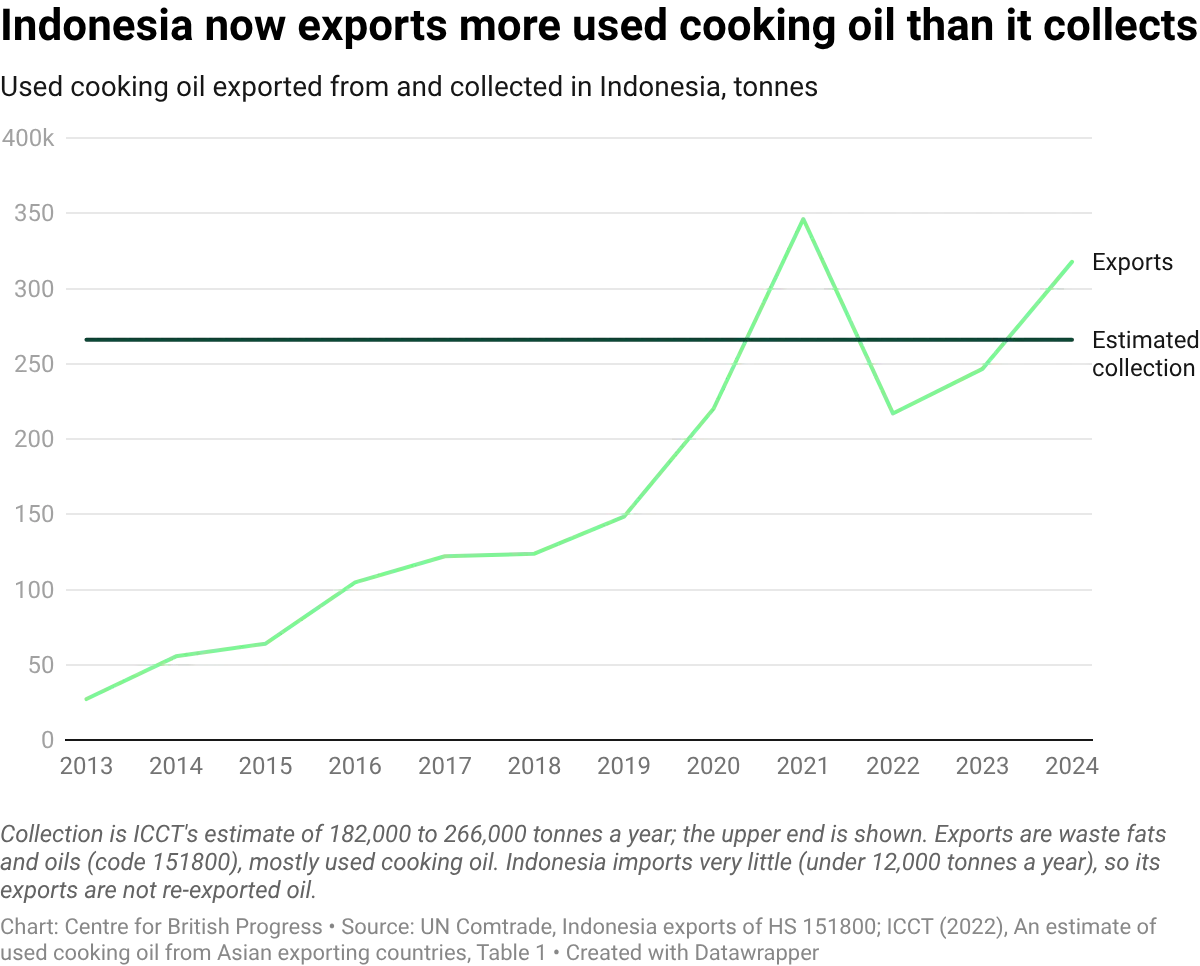
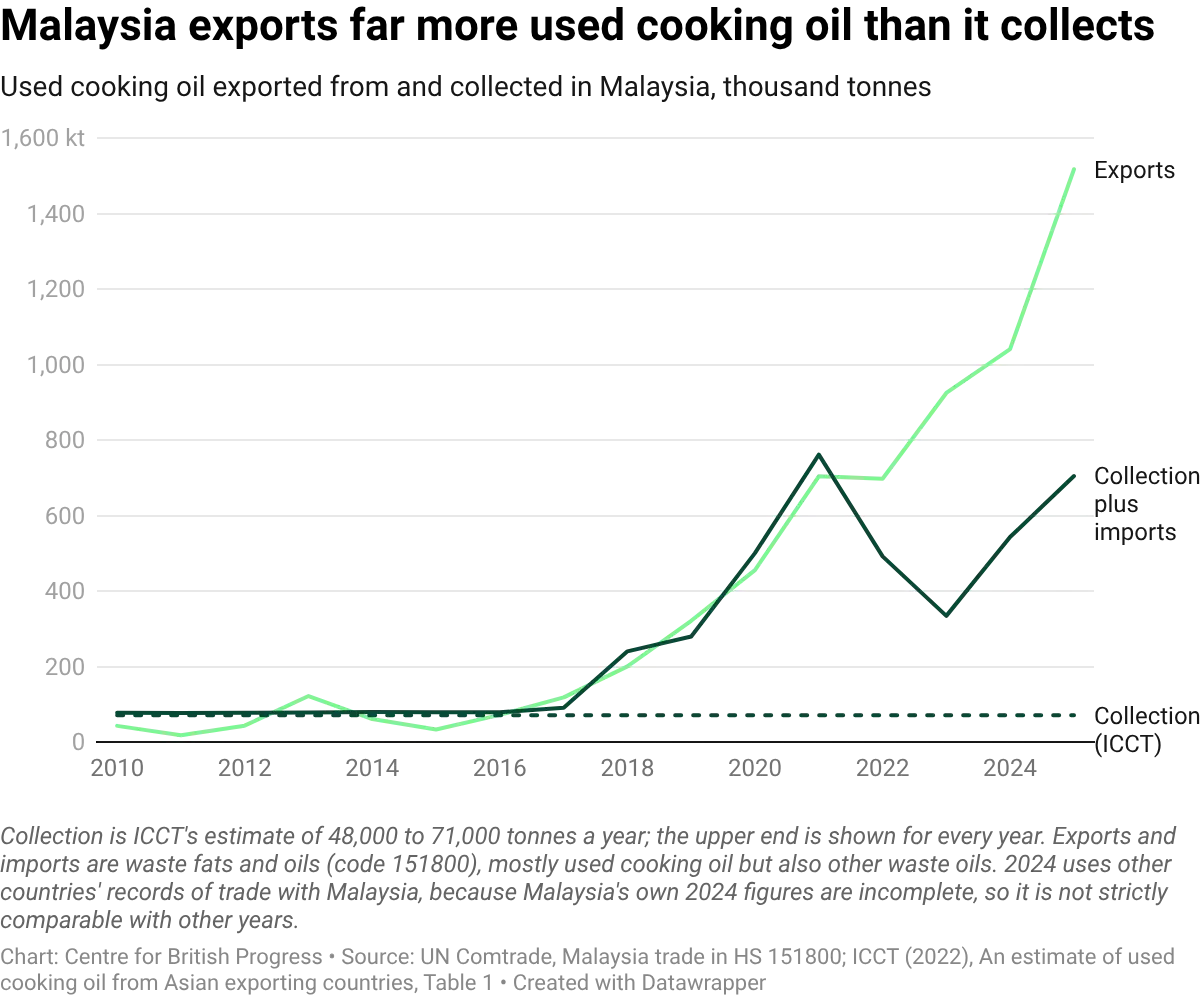
Malaysia’s exports of ‘used cooking oil’ were three times higher than the amount collected in the country in 2023. It is difficult to exclude the possibility of widespread fraud.
Chinese used cooking oil is by far the largest source of used cooking oil imported by the UK, making up 66.9% of used cooking oil in 2024 and 43.3% in 2025. There is less evidence that Chinese supply chains contain fraud than Indonesia and Malaysia.
However, there are still some reasons for suspicion. Industry bodies estimate that used cooking oil collection was 5.2 billion litres in 2024 in China, with 3.3 billion going into production for biofuels within China. Meanwhile, nearly 2.95 million tonnes of used cooking oil was exported from China in 2024, around 3.2 billion litres. Therefore, exported used cooking oil used in domestic manufacture of biofuels and raw feedstock seems to be over 1 billion litres higher than the amount collected. All of these numbers contain a degree of uncertainty.
Auditors have also found specific problems. In 2023, the certification scheme ISCC suspended three Chinese exporters for inaccurate records, lack of traceability and mislabelling of raw materials. China scrapped a tax rebate for exporting used cooking oil in 2024. State media reported that one of the reasons was because of widespread fraud, with exporters mislabelling other materials as used cooking oil. One state media outlet reported that around £1 billion (10 billion Renminbi) worth of tax fraud was due to people mislabelling materials.
Blogs and analysis from Chinese experts in the industry are also instructive. One blog produced by the renewables consultancy STIN Group states, matter of factly, that ‘Some exporters imported palm oil from countries like Malaysia or Indonesia, then added domestic waste oil, and further processed it into the industrial blended crude oil (UCO) needed by European customers.’
Because they are some of the lowest emissions fuels by the DfT’s methods of calculation, the UK awards double certificates to fuels derived from ‘used cooking oil’ meaning big profits are available. As STIN group put it, when asked why Chinese exporters blend palm oil into their UCO, ‘the main reason is price’.There are huge financial incentives for products to be labelled as derived from waste. Double counting for fuels made from waste was originally an EU rule, introduced in the 2009 Renewable Energy Directive. While, EU countries are now free to move away from this, partly over fears of fraud, the UK has continued to use this system. Germany has moved to end double counting entirely.
DfT does sometimes revoke certificates. In most years this is a small number, under 0.1% of certificates issued. However, in some years tens of millions of certificates are revoked, and no explanation has been given as to why. In 2021 and 2023 the number jumped dramatically, to tens of millions of certificates. DfT attributed this to ‘identifying supplier or DfT administrative errors.’
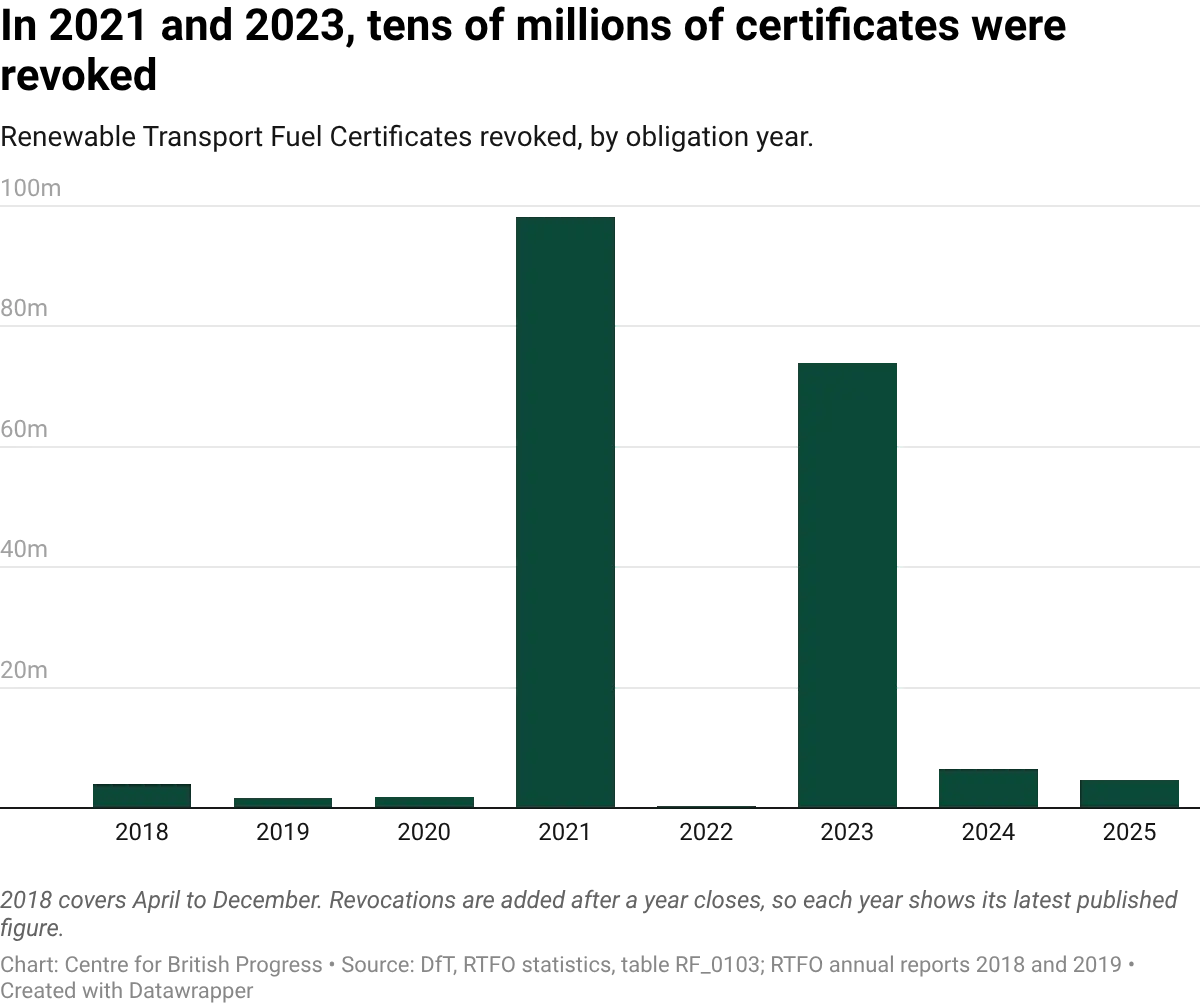
As far as we have been able to find, though, no fuel supplier, feedstock supplier or verifier has ever faced a civil or criminal penalty after having certificates revoked. DfT have confirmed that ‘No civil or criminal penalties have been issued in relation to revoked RTFCs.’ There appears to be minimal risk in submitting questionable certificates, as there has never been punishment for misleading the state. Therefore it appears the downside risk of committing fraud is essentially zero.
For these reasons, we should be extremely sceptical of the claimed carbon savings of the RTFO.
At the very least, we should be following the lead of Germany, which caps used cooking oil fuels and is excluding palm oil products, by ending the use of double certificates for used cooking oil and the use of palm oil and palm oil related products in the scheme.
Development Fuels
A growing share of Low Carbon Fuels are now required to be ‘development fuels’. These are fuels not currently widely used in low carbon fuels. It is not going well as it is simply not economic to produce the volumes of these fuels the obligation requires. A very large percentage of the development fuels requirement has not been met.
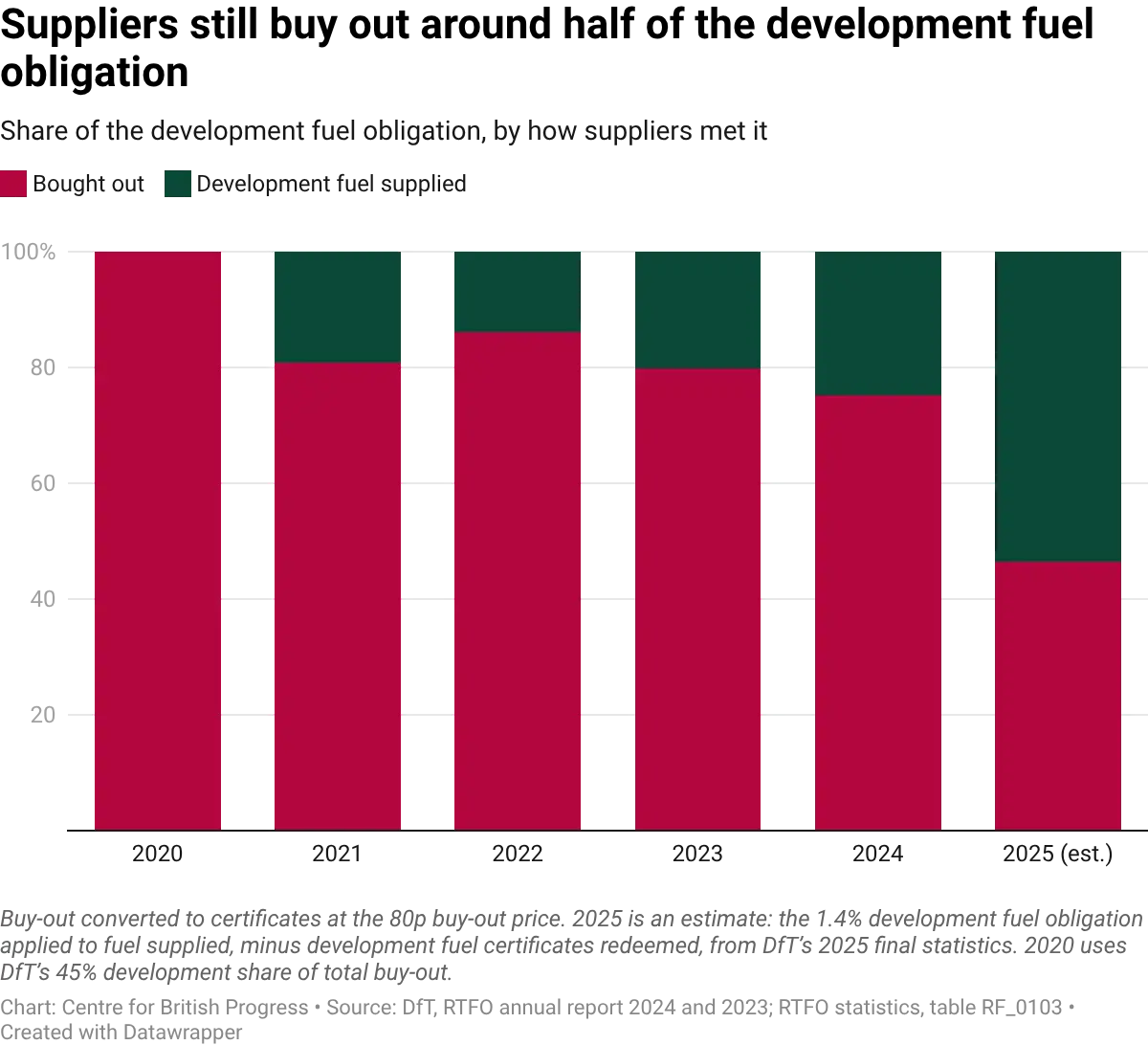
Suppliers who cannot supply or procure enough development fuel must seek ‘buyouts’. In 2025, 16 out of 22 firms sought buyouts for at least some of their development fuel, down from 19 out of 20 in 2024. 75% of the development fuel obligation was met with buyouts.
The buyouts cost 80p per litre. In 2024 that means that fuel suppliers were unable to find development fuel for less than 80p premium over the cost of fossil fuels. Given the highest price for diesel in 2024 was 79p (the low for petrol was around 60p) even at a minimum of double the price, it was not economically viable for suppliers to buy these fuels most of the time.
It is not clear these fuels can scale much further. Hydrogen is eligible but provides almost none of the fuel supplied- it is destined to always remain the fuel of the future. Recycled carbon fuels may one day be more viable, but are ultimately a by-product of the fossil fuel industry- they do not provide a route to decarbonised road transport. The majority of the development fuels provided are ultimately derived from American landfill. Attempts to create facilities doing the same with UK waste have not proved financially viable. This does not seem to be a source likely to scale. Yet the requirement is due to double by 2032, from 1.4% to 2.8% of fuel. Meeting it would need development fuel supply to rise around fourfold from its 2025 level.
Ultimately, the development fuels part of the obligation mostly functions as a tax on fuel. If the government wants to raise taxation on road users, they should do so transparently via fuel duty. The development fuel obligation is planned to increase dramatically in the next few years. If the market cannot meet this obligation, the government should scrap the development fuels requirement and merge it with the wider scheme.
Picking losers
The Obligation was first created in 2008. Decarbonising road transport was at the time considered a really difficult problem to solve. Renewable transport fuels like bioethanol were one of the few proven technologies that could reduce emissions. Hydrogen cars were also proposed as a solution. Hybrid cars were beginning to become available, but even their electric motor was powered, directly or indirectly (via regenerative braking), by the petrol or diesel engine. Plug-in hybrids and fully electric vehicles were not widely available commercial products. It was somewhat plausible that the route to decarbonising transport ran through alternative ways of making hydrocarbons.
However, no one believes now that low carbon fuels could ever decarbonise our road transport in full. Countries that have tried much more ambitious programmes of low carbon fuels than the UK, such as Sweden, have had to roll them back. Genuine waste feedstocks are a limited supply, and are best reserved for genuinely difficult to decarbonise sectors, like aviation. This is why rising demand for waste has been partially met by likely fraud. Crop based fuels compete with food for land. Some estimates show that when accounting for land use changes, using crops actually increases carbon emissions. The current UK vehicle Internal Combustion Engine (ICE) fleet is not compatible with 100% low carbon fuels. If we are replacing the entire ICE vehicle fleet, electric vehicles are clearly a better choice. For these reasons, while biofuels may have been useful for reducing emissions from ICE vehicles in the short term, they are not an option for the decarbonisation of road transport in the long run. We have now pushed demand beyond where it can be realistically met by reasonably priced, low carbon supply.
The 2025 statistics show that while the obligation rose, the volume of renewable fuel supplied fell by 10%, from 3.8 billion to 3.4 billion litres, and the number of certificates issued fell by 8%, from 6.7 billion to 6.1 billion. Part of this fall reflects renewable jet fuel moving out of the RTFO and into the new Sustainable Aviation Fuel mandate. But the wider picture suggests suppliers are struggling to source enough low carbon fuel at a reasonable price. Where they fall short, they must use certificates carried over from previous years or pay the buy-out, which costs drivers money without delivering any low carbon fuel.
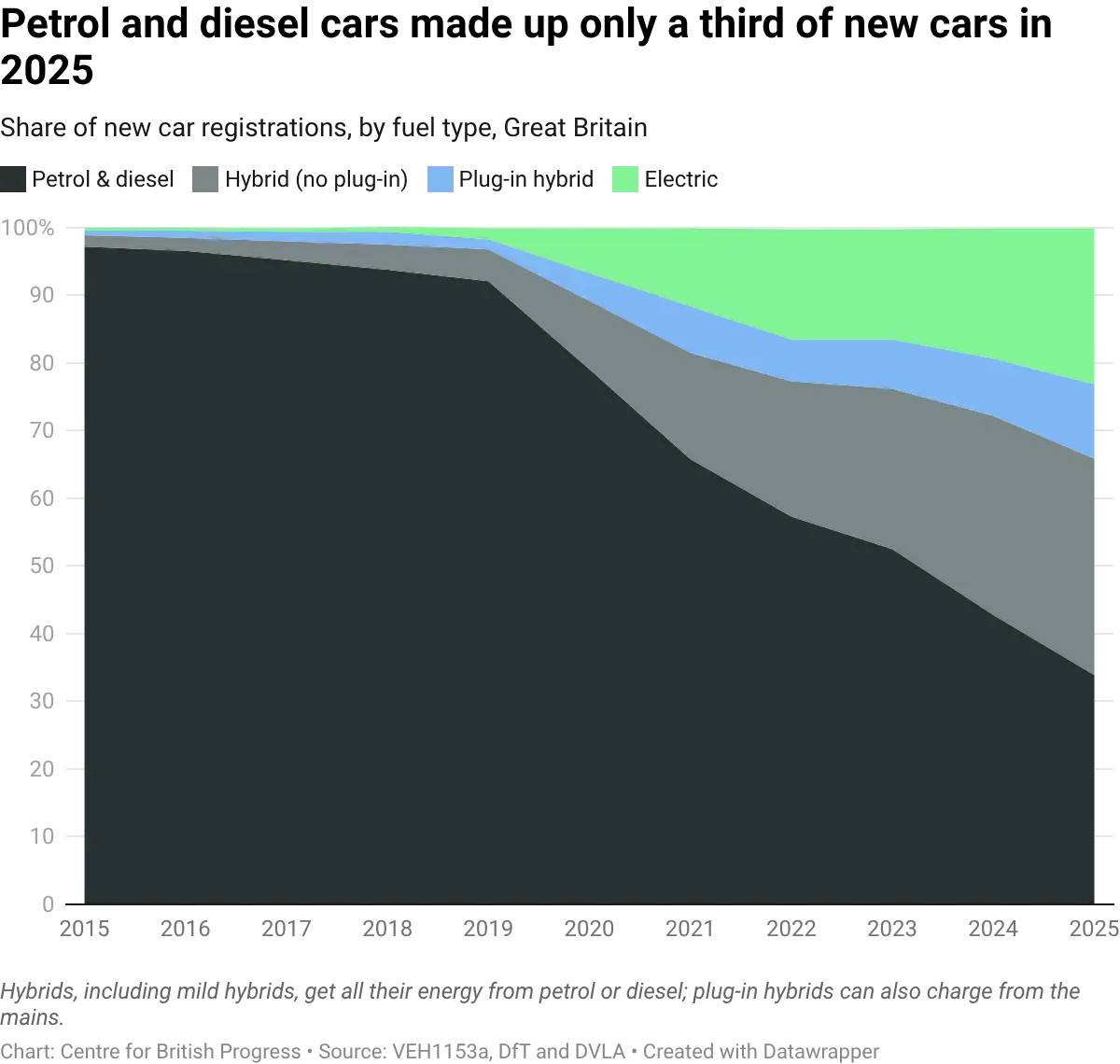
In contrast, since 2008, both plug-in hybrids and fully electric vehicles have gone from strength to strength.
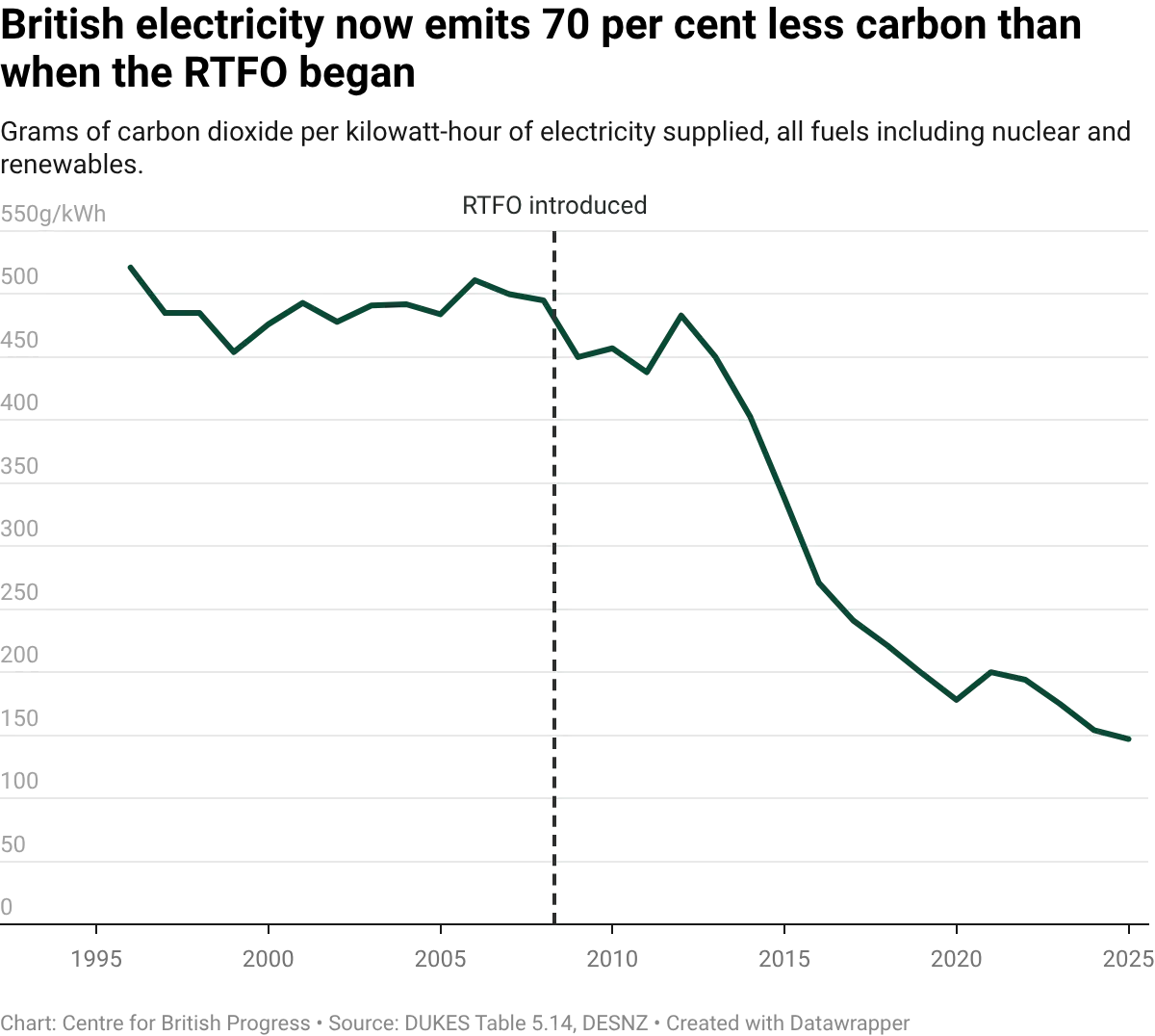
At the same time, the carbon intensity of the UK electricity grid has been dropping dramatically.
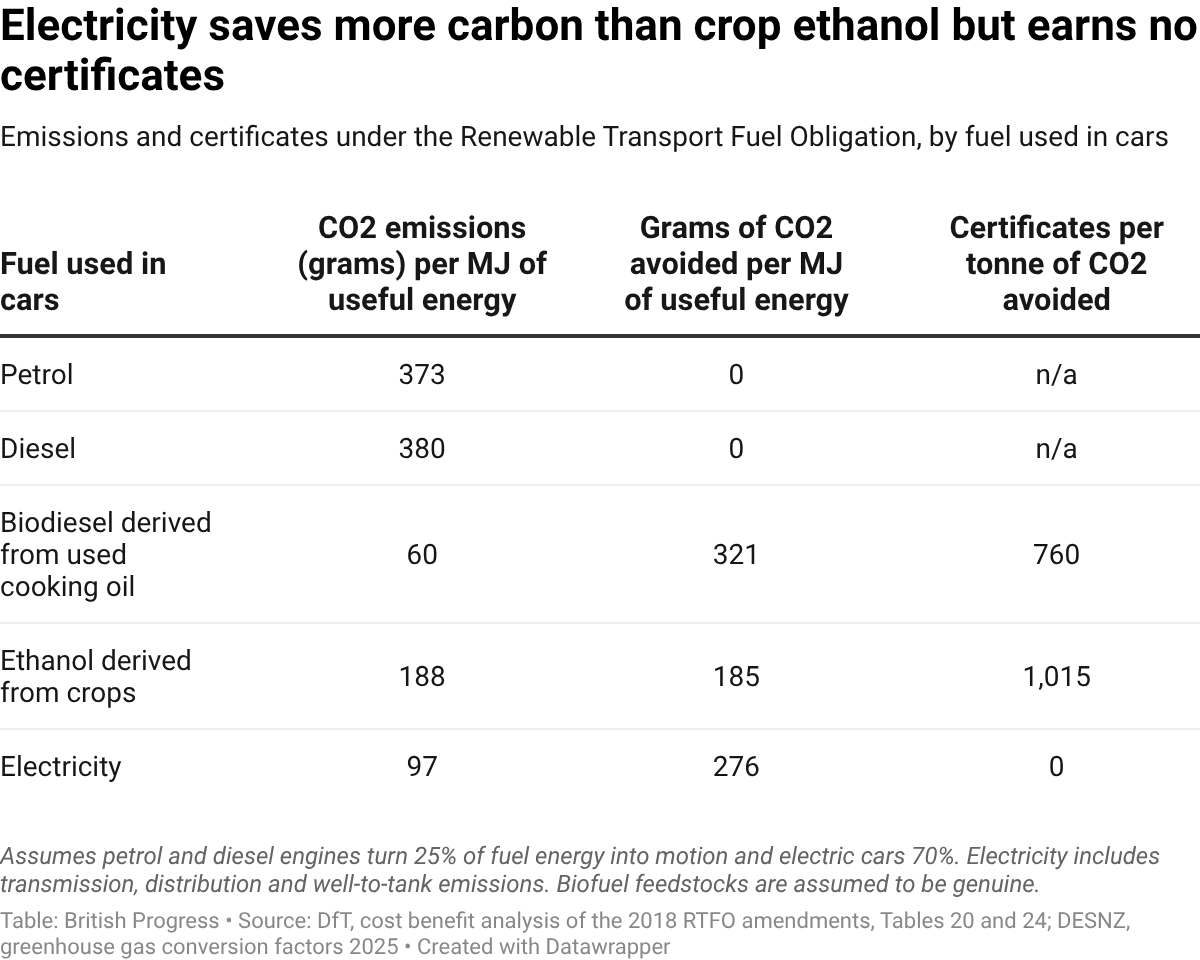
The table below shows the emissions of different types of fuel and for non fossil fuels, the emissions they save relative to using fossil fuels and how many certificates they receive under the obligation.
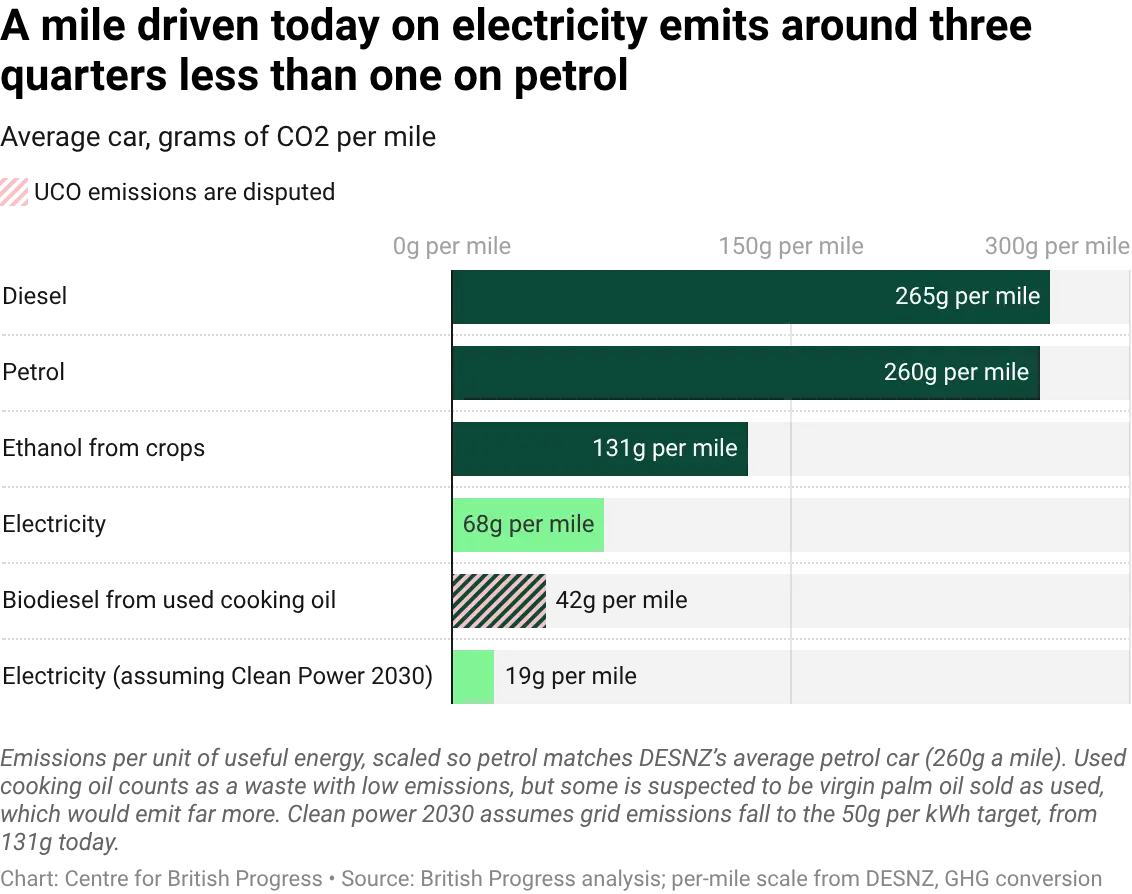
Electricity used to power electric cars is much more effective at reducing carbon emissions per unit of useful energy than ethanol, and comparable to biodiesel even when you assume all feedstocks are genuine. With our grid getting greener over time, electricity will soon overtake biodiesel, and that will still be true even if Clean Power 2030 targets are missed by a wide margin.
There is no doubt that electricity is a relatively low carbon fuel. In 2025, 90.8% of the electricity supplied in the UK was generated here, on a grid that is decarbonising rapidly. France is the largest single source of imports, with 21.9 TWh of the 29.7 TWh of net imports in 2025, and its grid is even cleaner than the UK's.
However, electricity does not qualify as a low carbon fuel under the obligation. Therefore while ethanol derived from plants will receive over 1,000 certificates per tonne of CO2 avoided under the scheme, electricity receives none at all.
Electricity also has the potential to decarbonise our road network to a much greater extent than other low carbon transport fuels. Ultimately ethanol and biodiesel will always be mixed with fossil fuels. In the UK the limit on fuel sold at normal petrol stations is 10% ethanol in petrol, and 7% biodiesel in diesel.
Solution 1 — picking a winner, subsidise electric vehicle miles
We already have a renewable transport fuel that works. It is called electricity. If we are going to subsidise low carbon fuels, we should allow subsidies to be paid to a renewable low carbon fuel that works and can be scaled.
From April 2028 the government will be collecting mileage data for all EVs to pay the new Vehicle Excise Duty for electric vehicles (EVs) at a cost of 3p a mile, with plug-in hybrids electric vehicles (PHEVs) paying 1.5p a mile. This is a reasonable tax change- EV and PHEV drivers should pay something towards the maintenance of the road network they use and the government is facing a huge loss of revenue from fuel duty in the medium term as EVs and PHEVs become more popular. But it clearly disincentivises people from using EVs.
The government is also consulting on weakening the Zero Emission Vehicle mandate, with options to cut the 2030 target for new cars from 80% to as low as 50%. Again this is a reasonable policy change. The mandate is costly for carmakers, and some say they are recovering the cost through higher prices for petrol cars. However, it reduces the incentives to buy EVs.
Therefore, when government support for decarbonising transport is decreasing, we should be looking to make most effective use of the subsidies that we do have.
The easiest way to do this would be to allow electricity used to power electric cars to earn Renewable Transport Fuel Certificates.
If we assume that all EV drivers drive very efficiently and that they are driving the most efficient vehicles they will use 0.72 MJ of electricity per mile driven. This will translate into 0.50 MJ of useful movement energy at a 70% conversion rate. To give electricity a comparable number of certificates per tonne of CO2 avoided to ethanol, they should therefore receive a certificate for every 7 miles driven. Calculating compared to a used cooking oil fuel gives a figure of 9 miles. To give a barrier of safety on these calculations we propose that Electric Vehicles generate a certificate for every 10 miles driven (every 20 miles for PHEVs). This would likely mean EVs and PHEVs are displacing more emissions per certificate than the fuels that make up the bulk of the supply in the scheme.
Using DfT data on the number of miles driven using electricity, the price of certificates and data on the price of biodiesel and ethanol in previous years we have been able to generate estimates of the EV subsidy and the savings to drivers each year that would have been created by allowing electric vehicles into the scheme, assuming no other policy changes.
In our proposal, EV certificates would replace the most expensive biofuel certificates, so the certificate price would fall. We estimate how the supply of biofuels would respond to the market price using monthly data from 2025 and 2026.
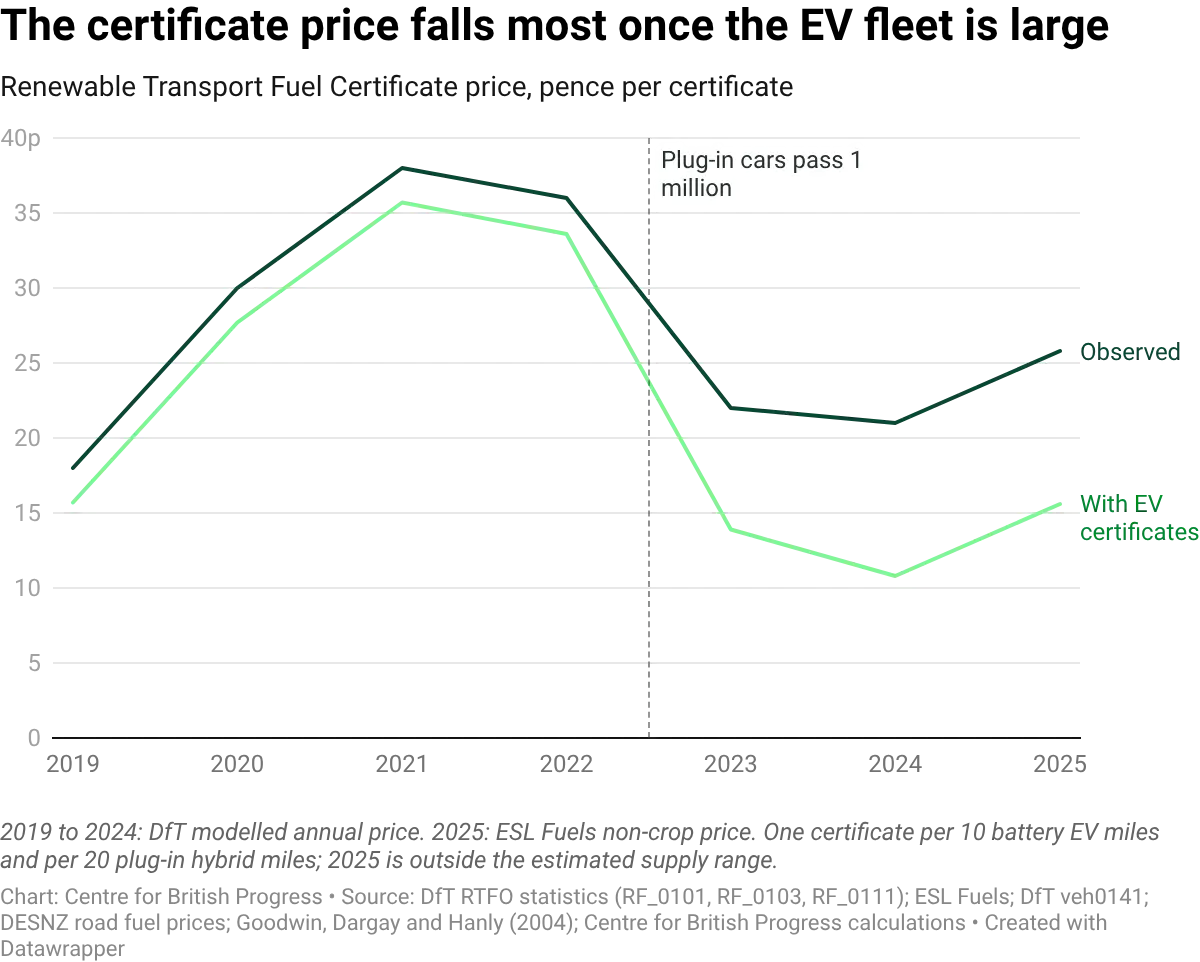
Projecting these estimates backwards, we estimate that from 2019 to 2022, EVs would have earned 0.2 to 0.6 billion certificates a year, and the price would have been about 2p lower. In 2024 they would have earned 1.5 billion, which is about a quarter of the certificates used.
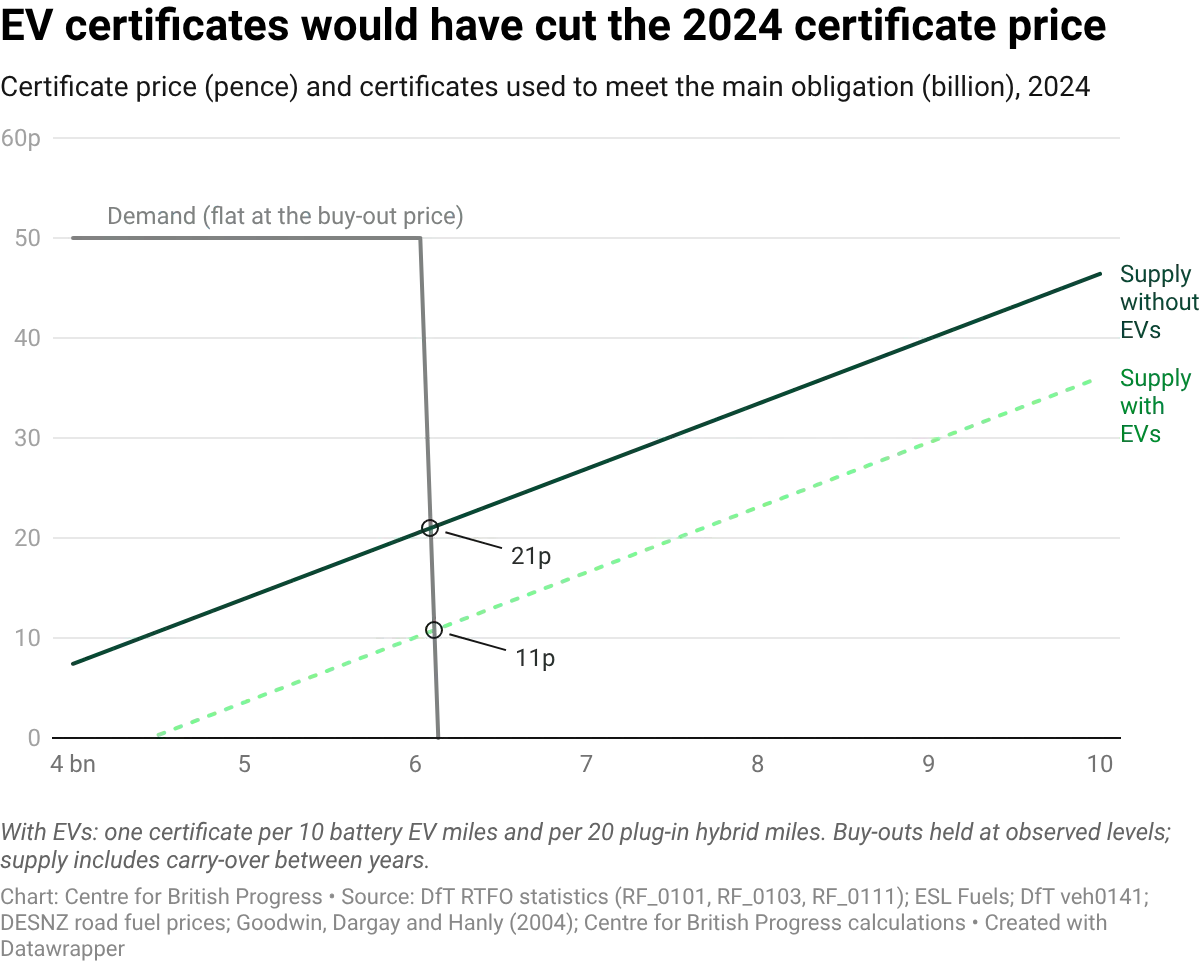
Our analysis further suggests that if EVs and PHEVs had been part of the scheme in 2024, the price of certificates would have fallen to 10.8p. Because we propose awarding a certificate per 10 miles driven (or per 20 miles driven in a PHEV) that would amount to 1.08p per mile for an EV.
The government should collect the certificates centrally, sell them intermittently throughout the year into the market (ideally in a way that smooths the price for both producers and drivers) and then send the proceeds back to electric vehicle drivers as a rebate on their EVED charge.
If EVs and PHEVs had been generating certificates in previous years it would have lowered certificate prices (therefore with some benefits flowing to drivers of ICE vehicles) and provided a subsidy to EV drivers. This would mean that, in 2024, drivers of petrol and diesel vehicles would have saved £623 million, or 1.36p a litre, while EV drivers would have received £161 million. The saving is larger than the subsidy because the lower price applies to all the certificates that fuel suppliers buy, about 6.1 billion in 2024, while the subsidy pays only for the 1.5 billion EV certificates. Drivers of petrol and diesel vehicles would have saved more than EV drivers received in every year from 2019 to 2025 except 2021 and 2022, when the certificate price was 36p to 38p and each EV certificate earned more.
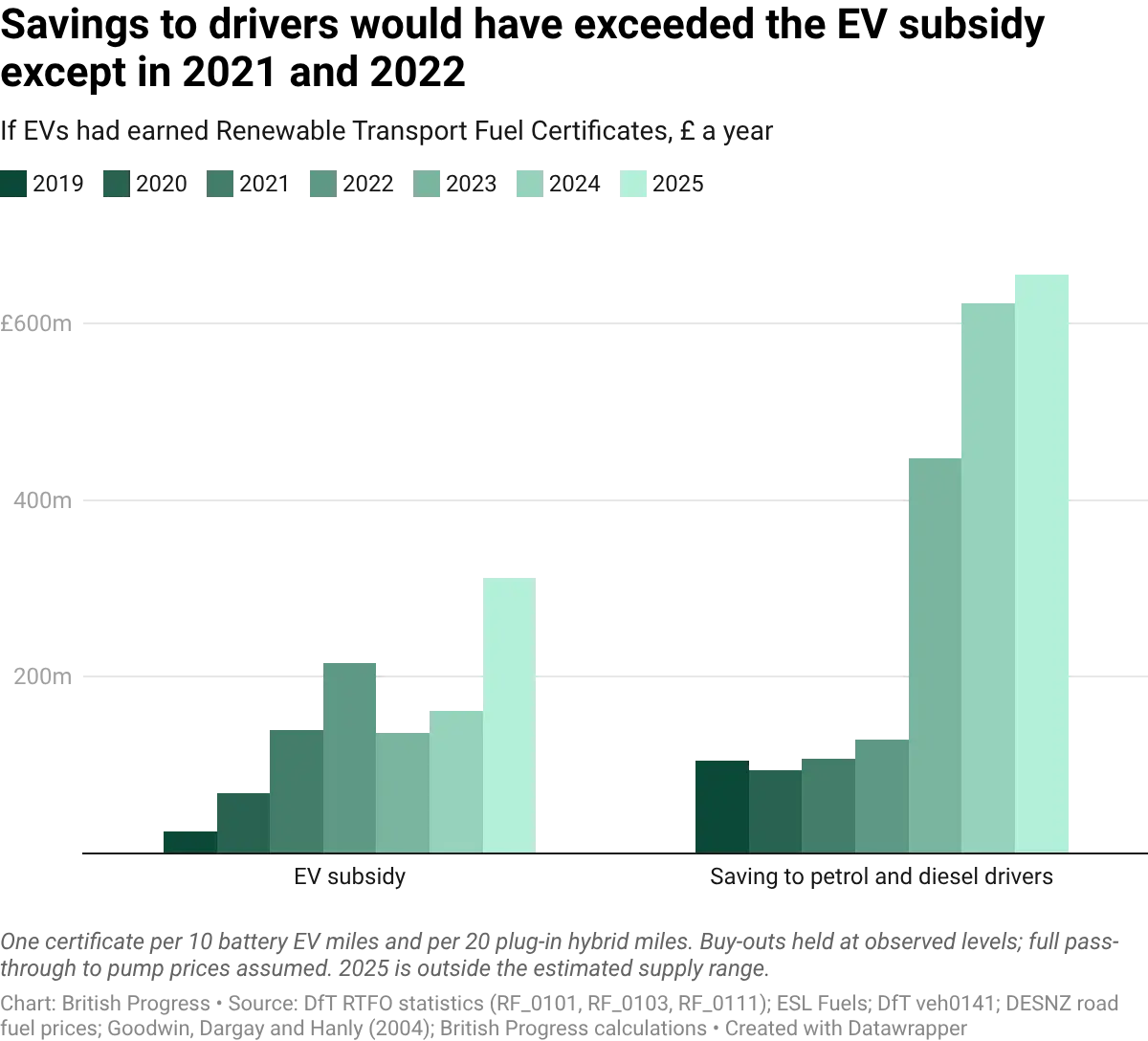
These estimates assume that fuel suppliers pass the full certificate cost on to pump prices. Across the range of supply responses consistent with the data, the 2024 price would have been between 5.9p and 13.3p, and savings to drivers between £471 million and £921 million. The 2025 figures use a provisional market price and are more uncertain.
If we apply this as a rebate to the EVED it will mean that 36.0% of the EVED would be covered.
The OBR projects that in the financial year 2028-9, if the EVED had not been introduced, 45.6 billion qualifying miles would have been driven by EVs and PHEVs. With the EVED introduced they project that will fall to 38.6 billion miles.
One potential objection is that many of these certificates would reward miles that would have been driven anyway. That is true. However no fuel in the obligation has ever been required to show that emissions savings are additional, and electricity should compete on an equal basis. The OBR projecting a 6.6 billion fall in the number of qualifying miles driven by EVs and PHEVs in 2028-9 due to EVED shows the real importance of incentives at the margin to use EVs. A rebate covering around a third of the charge would have a significant impact on increasing electrically driven mileage, much of which will displace fossil fuel vehicles.
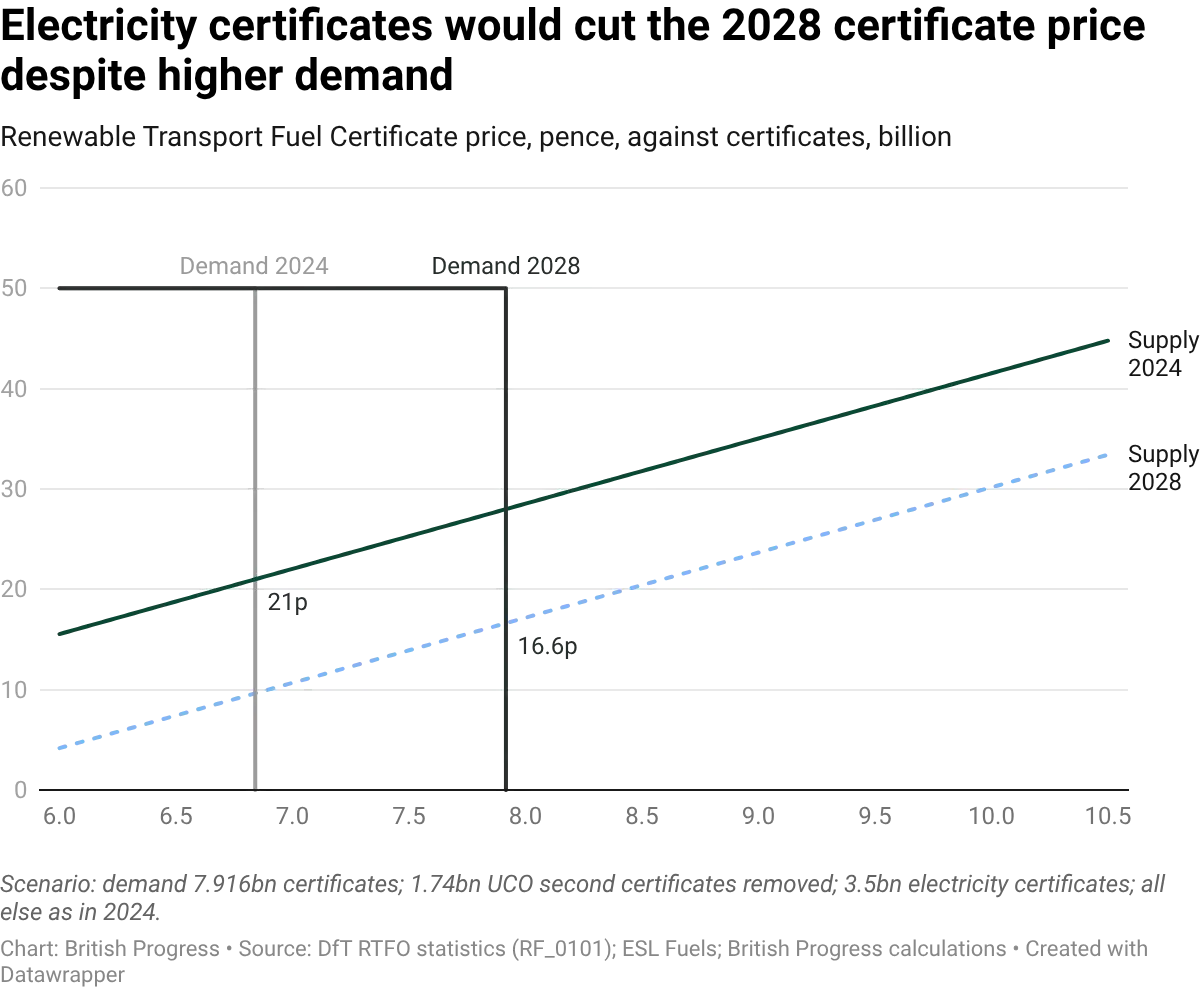
Therefore electric vehicles should generate in the order of 3.7 billion certificates in 2028-9. One problem of stopping the double counting of Used Cooking Oil, as proposed above, is that it would need more low carbon fuel to be produced and therefore increase the cost of the scheme. 1.74 billion 2nd certificates were given to used cooking oil in 2024. Allowing electricity into the scheme more than covers this loss of supply.
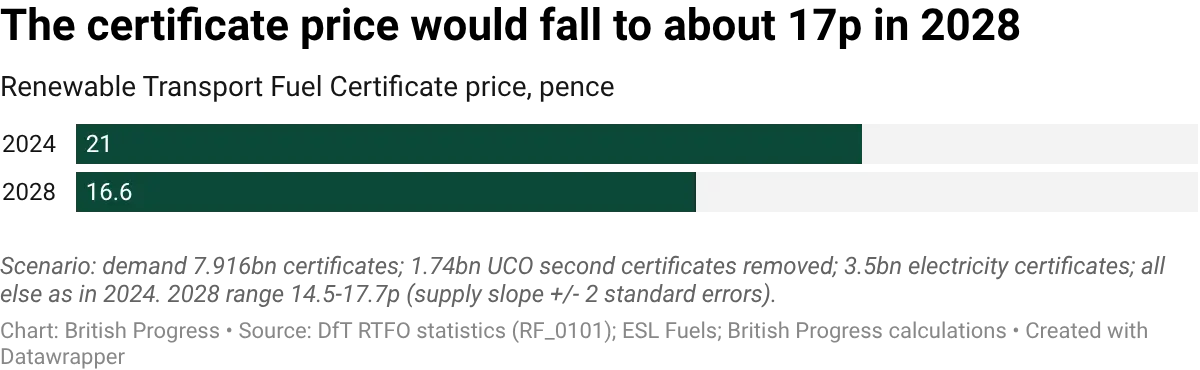
Taking the 2024 certificate price of 21p and the 2024 supply of certificates as the starting point, we apply the higher demand for certificates in 2028,assume used cooking oil no longer receives double certificates, and add EVs and PHEVs to the scheme. Demand for main obligation certificates rises from 6.21 billion to 6.88 billion. Used cooking oil loses its second certificate, which removes 1.74 billion certificates. EVs and PHEVs add about 3.67 billion certificates (one per 10 battery EV miles and one per 20 PHEV miles, applied to the OBR's 38.6 billion miles for 2028-29). Everything else stays at 2024 levels. At 21p, supply would therefore rise by 1.93 billion certificates, 1.26 billion more than the rise in demand, so the price falls to 13p. Across the range of supply responses consistent with the data, the 2028 price is between 9p and 15p.
It is reasonable to sometimes subsidise new technologies in their early phases. But that subsidy should fall over time as the technology becomes established.
However, low carbon fuels subsidies have not decreased over time. The cost of biodiesel and ethanol has not consistently fallen in recent years, either absolutely or relative to petrol and diesel.
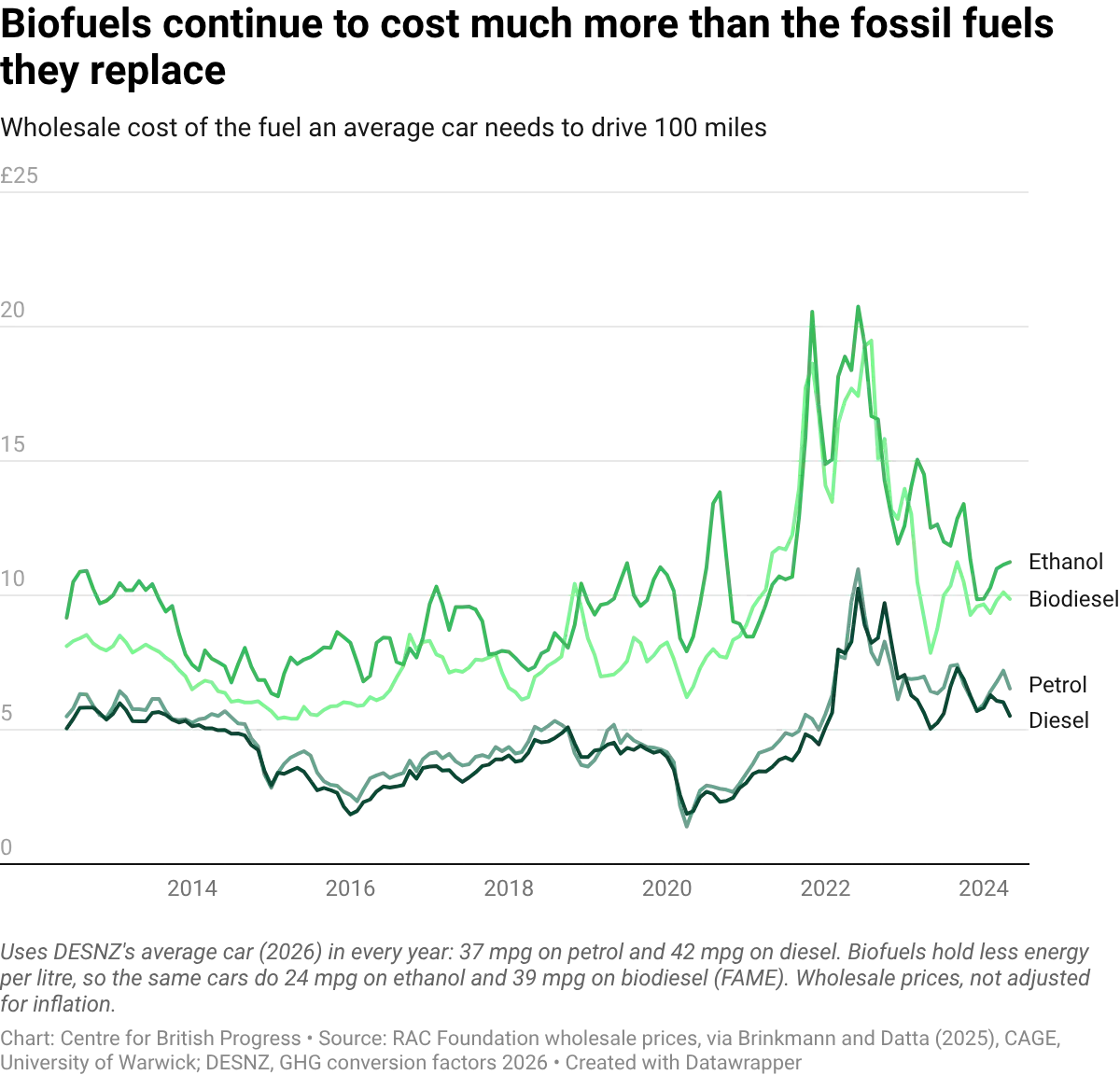
It is possible that this will change and that low carbon fuels will become a cost-effective way to reduce emissions. If we have a subsidy mechanism for green road transport it is fair that low carbon fuels are allowed to compete on equal terms with electric vehicles.
However, if that competition is allowed to proceed on equal terms, the most likely outcome is that electric cars will win. Electric cars are already a cheaper way to get around than petrol or diesel cars. They would therefore enter the certificate market with a price of £0.00. As electric cars continue to grow their share of the road vehicles market, only boosted by this new subsidy, eventually the certificate price would likely fall to zero. Policy makers could reasonably see this as meaning the obligation had succeeded in its original purpose- providing a large proportion of transport fuel in a renewable way at the cheapest price possible.
Alternatively policy makers could increase the size of the obligation. One approach would be to work backwards from a price they want certificates to be. This would mean that some biofuel continued to be used for a while, EV drivers still received a subsidy, and ICE drivers still bore some extra cost. It would also mean that the obligation was always reducing emissions at the margin.
The UK would be far from a first mover on this. Germany has allowed electricity to count in its equivalent scheme (the greenhouse gas reduction quota) since 2022. While the scheme is different in detail (electric vehicles are paid a flat payment rather than on mileage, PHEVs are not covered at all) from our proposed scheme, it provides similar incentives for road users to move to greener vehicles and greener fuels. Since 2022 Germany has also led on removing fraudulent fuels from the scheme, including ending double counting for some fuels, excluding Palm Oil Mill Effluent and requiring on-site inspections by state officials for all facilities making renewable fuels to be possible. The details differ, but tightening fraud-prone supply while expanding verifiable supply from electric vehicles is the same package we propose here.
Solution 2 — abolish it and pass all the savings to consumers
Another option is simply to scrap the obligation. This has already been endorsed by Reform UK. It would almost immediately reduce fuel bills for households and businesses all over the UK, at zero cost to the Treasury. The estimated saving per litre of fuel would have been 5.4p in 2025. It will likely be an even larger saving in 2026 as the costs of the scheme are expected to rise.
As with fuel duty, this obligation falls on suppliers, who add this cost to the wholesale price. Prices for consumers at the pump reflect the cost retailers face plus their own mark-up. Estimating the speed of this transition is beyond the scope of this paper, but there is evidence that suggests the adjustment could be quick. From the US, evidence on the US Renewable Fuel Standard, which also uses tradeable certificates, suggests that wholesale prices responded to certificate costs within days. Between half and three-quarters of a change in certificate prices was passed through to retail prices on the same day, with the share rising over the next few business days. There was full pass-through in the long run. At the pump, full pass-through of the US certificate subsidy to high-ethanol fuel took four to six weeks.
Similar evidence from the UK points to similar timescales. A study by the Office of Fair Trading found that changes in oil prices can take up to five weeks to pass fully to UK pump prices, and it found no evidence that cuts pass through more slowly than rises. Following the 5p cut on fuel duty in March 2022, supermarkets, which sell 44% of road fuel, cut prices by just over 5p immediately, and other retailers cut by 2p to 3.5p in the following days. It is reasonable to expect that most of the savings would reach drivers within one to two months. Nevertheless, it is plausible some retailers may absorb part of this cut in their own margins. In 2022, the CMA found that Asda cut prices more slowly as wholesale costs fell and other retailers followed, and that average supermarket margins rose by 6p a litre between 2019 and 2022.
Solution 3 — abolish it and pass all the savings to the Treasury
Fuel duty was cut by 1p in 2011 and then frozen in cash terms until it was ‘temporarily’ cut by 5p in 2022. Given the already high levels of taxation on motoring, this is a reasonable political and economic choice. Road users make a net contribution of £14.1 billion to the Exchequer.However, at a time when the public finances are deeply strained, it may be necessary to raise taxes on road users. In real terms, the duty on petrol and diesel has fallen by 41% since 2011, adjusted for CPI.
Motoring is also one of the sectors where a clear route to decarbonisation exists, so at the margin it makes sense to incentivise people to switch from petrol cars to EVs. Abolishing the obligation and handing the savings to consumers would be a cut in tax on road users, and would therefore disincentivise EV take-up. Therefore the government could still abolish the scheme but instead of all benefits flowing to road users, they could leave road users breaking even by reversing the ‘temporary’ fuel duty cut of 5p from 2022. A 6 month extension of the 5p temporary reduction was costed at £1.35 billion at the recent budget.It is widely expected that this ‘temporary’ cut will be extended again when it next expires in June 2027. Abolishing the obligation would mean that road users are on average no worse off, with the treasury in credit by around £2.7 billion a year.
Solution 4 — abolish it and use some of the savings to fund better access to EVs
This proposal is the same as solution 3, except the first 2-3 years of revenue raised from the increased fuel duty could be earmarked for directly funding the transition to EVs, recognising the difficulties that understandable government decisions on the ZEV mandate and the EVED will create for the transition.
The recent ‘Cost of Public Electric Vehicle Charging Review’ showed that while our public charging infrastructure is well built out, partly due to public subsidy, it is not well utilised. This leads to developers needing to fund upfront infrastructure investments from few users, leading to high prices, leading to less usage and so on.
This doomloop is not great for any EV user. However, it is potentially fatal to those EV users who cannot access cheap charging at home. This is why 90% of EV users can charge at home. It makes a lot less financial sense to switch if you can’t charge at home. Especially when prices have been rising rapidly for publicly charging- the sums may add up today, but you can’t be sure they will add up tomorrow.
Philip New’s Review proposes many solutions. All of them either need some funding from someone, or would be eased into existence by some funding.
New’s headline suggestion is ‘tariff porting.’ Those with driveways and garages pay for a one-off home charger and then get access to cheap charging at home for years to come. Tariff porting opens up a similar opportunity for those who cannot charge at home. They pay a fixed fee per year (New suggests around £200) to secure access to a lower powered local charger, which they can then use at the same price as their electricity at home. In the long run, New aims for this policy to pay for itself. However, in the short run there are a number of ways money could help.
Porting will take some years to implement fully. In the meantime, New suggests a subsidy for discount prices at lower powered chargers. The government have committed £100 million a year for two years from Spring 2027 to this. This commitment should be made longer, and deeper.
The trials and pilots for porting will cost public money. While not a large amount they will need to be funded.
The access fee at £200 will still dissuade many low mileage car users from switching to EVs. There may be a case for subsidising this too, at least in the early years.
Beyond Porting, New suggests other policy changes that need a small amount of funding. Ofgem’s Targeted Charging Review turned residual network charges into fixed charges based on connection capacity. This means that developers aiming to build out the network we will need in a few years time, pay high costs now. Fixed standing charges for operators have risen between 83% and 283% since 2021. New wants to change this through Ofgem’s Cost Allocation and Recovery Review. But that will take time and will ultimately be paid for by other electricity network users at a time when household electricity bills are already too high. So instead we could provide funding to ensure that these standing charges are reduced, at least temporarily.
New also proposes extending subsidies for chargers to install batteries. This allows them to have smaller grid connections and to draw power from the grid when it is cheapest. This fund already exists but is just £10 million a year.
Other small changes with a small cost that could be funded include an electric charger equivalent of Fuel Finder which shows people the price of different chargers near them (the price can vary a huge amount), and better signage for electric chargers.
Beyond New’s review there are other policy proposals the government may wish to explore for supporting the EV transition that would benefit from a small amount of funding. There are several proposals from industry, think tanks and advocacy groups to create guarantees for leasing schemes to allow greater access to EVs for lower income households as there is some evidence that the lower end of the vehicle leasing market for EVs needs some support, though this is disputed.
Other possible uses for funding are extending DfT funding for pavement gullies for on-street parking outside people’s homes and for support for Vehicle to Grid chargers in public and work place car parks. This would allow people to charge their vehicles at home overnight when electricity is cheap, plug them in when they are at work and sell electricity to the grid during the day, before driving them back home again. This opportunity to use their vehicle as a battery would create a revenue stream for drivers from their EVs, making adoption more financially appealing.
Analysing in detail which combination of these many proposals to directly support the EV transition are the best to take forward is beyond the scope of this paper. However, all of them would help increase EV adoption and therefore reduce emissions, at the margin. It is highly unlikely that any of them would be less effective than the RTFO at reducing emissions.
Solution 5 — a mix of some or all of the above
The options above are not mutually exclusive. Allowing electric vehicles into the scheme will automatically cut costs for ICE vehicle drivers unless the obligation is increased in size. Some of these savings could be diverted to The Treasury with a small increase in fuel duty.
Reasonable politicians of different political persuasions will differ in the priority they give to reducing the cost of living, dealing with problems in our public finances and more effectively addressing climate change. Keeping the Renewable Transport Fuel Obligation as it currently stands is not the best approach to achieve any of these goals.
For more information about our initiative, partnerships, or support, get in touch with us at:
[email protected]For more information about our initiative, partnerships, or support, get in touch with us at:
[email protected]