
Table of Contents
- 1. Introduction
- 2. Britain has a comparatively poor mobile network
- 3. Planning constraints restrict investment in mobile infrastructure
- 4. Market failures also limit improvements in connectivity
- 5. Reforms to support better mobile connectivity
- 6. Conclusion
- 7. Authors
Introduction
Britain’s mobile network is the worst in the G7 and lags behind every member of the European Union except Cyprus. It is common for people across Britain to experience dropped calls and endless buffering, even in major city centres. Their large populations of paying customers make investment in network improvements commercially attractive, but operators are blocked from building the necessary infrastructure.
Mobile network operators need to install and upgrade masts and other telecoms equipment near their users, but going through the planning system can take many months, sometimes more than a year, and there’s no certainty a mast will get built at the end of it.
In some local authorities the refusal rate for new masts is 100%. Each refusal wastes the money an operator has spent preparing the application and stops it building on a site it was prepared to pay for. Having to repeat applications or conduct appeals can turn what would otherwise be a sound investment into something not worth their time, saddling ordinary people with a slow and overcrowded network. Buffering Britain and the Centre for British Progress estimate that congestion already reduces the value consumers receive from their mobile connections by between £490 million and £785 million every year.
We propose a national right to build mobile infrastructure, under which standard installations meeting certain criteria could go ahead 28 days after the operator notifies the council with no need for the latter’s approval. Most masts already have permitted development rights, but the prior approval process lets councils delay or refuse them.
These revised rules will allow enough space for operators to share a single site and for that equipment to be improved in future as demand grows and technology improves – to prevent the current situation from recurring.
We further propose a national pattern book of approved designs. This would encourage operators to use masts that the public find more attractive, helping to alleviate concerns among those living nearby. Masts built to an approved design would then count as standard installations because their appearance would already have been judged suitable for their surroundings.
Public bodies should also have a financial incentive to host equipment on their rooftops and street furniture, and a duty to answer requests from operators within a set timetable.
We propose that building owners who pay for a shared indoor system should have the right to buy connection to it from every network. Consumers will also need better information about the quality of their local network, so that they can make more informed choices about choosing a provider, and to encourage operators to win new customers by improving their service.
We argue that the removal of existing planning restrictions should take first priority, as this is directly within the government’s control, and could deliver immediate dividends. The specific planning policies in this report apply only to England; however, we recommend equivalent reforms for the devolved administrations.
Britain has a comparatively poor mobile network
Britain’s mobile network is getting left behind by the rest of the world. We now rank 68th for average mobile download speed, lagging countries including Kazakhstan, Brazil, and Kenya. On consistent quality, we don’t fare much better, ranking a dismal 48th, and we sit 53rd overall. Our network performance is the worst in the G7 and is bettered by every member of the European Union except Cyprus.
Despite being among the first nations to adopt 5G, the rollout hasn’t been smooth. In a 2025 study, London ranked last among fifteen major European cities for the experience of users on 5G-enabled devices. It’s no surprise, therefore, that dropped connections and the scourge of the buffering wheel are frequent complaints among consumers.
The national regulator, Ofcom, estimates that 96% of the UK’s landmass gets outdoor 4G coverage from at least one operator, and 84% receives coverage from all four operators. The threshold for reaching these figures is low, requiring only the high probability of there being enough network connection to support a 90-second voice call and a download speed of 2 megabits per second. For contrast, the latter is less than 1% of the maximum broadband speed the average home can receive. With group video calls on Teams, high-resolution video, and increasingly data-intensive websites now a part of everyday life, the figures provided by Ofcom provide little real-world assurance that the network can do what consumers need it to. Coverage differs from capacity, however, and a strong signal doesn’t guarantee good speeds when lots of people are trying to use the network at once. Signal often fails exactly when people need it most: friends coordinating their meeting place at a busy football match, or a worker trying to connect to a team meeting from a city-centre cafe.
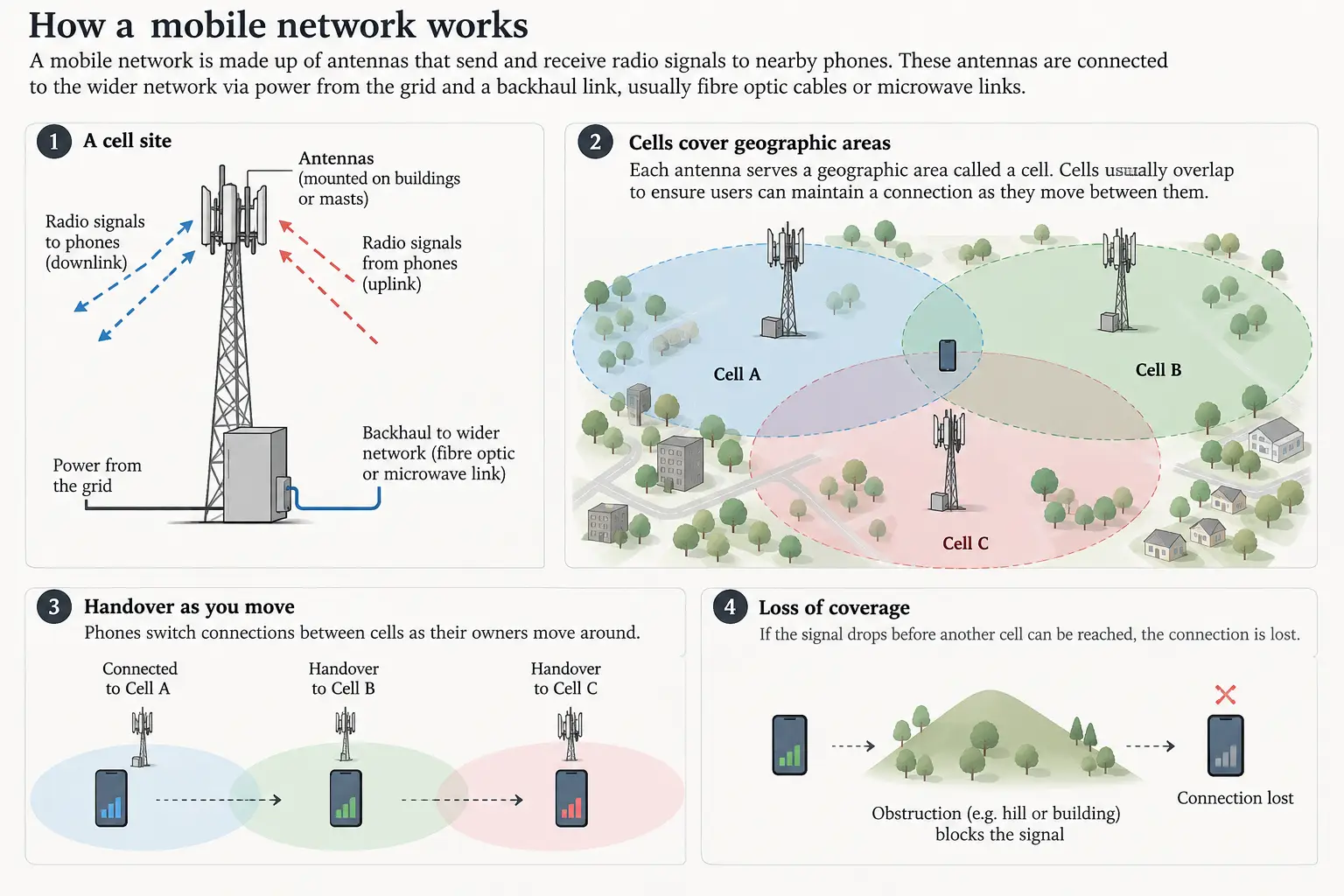
The mobile network is made up of antennas that pass radio signals to nearby phones and receive radio signals in return. Usually, these antennas are mounted on buildings or masts, at heights sufficient to clear most nearby obstructions. These sites require both energy from the grid and a connection to the wider network known as “backhaul”, which is usually provided through fibre optic cables or microwave links. These antennas serve geographic areas called cells, with cells usually overlapping to ensure users can maintain a connection as they move between them. Phones switch connections throughout the day as their owners move around; if coverage drops before another cell can be reached, the signal fades and the end user loses their connection to the outside world.
The shape of the built environment can diminish signal even when a mast is nearby. Buildings can obstruct radio waves, and the higher-frequency 5G bands are more vulnerable to this. This is also why mobile signal can weaken as soon as one steps indoors.
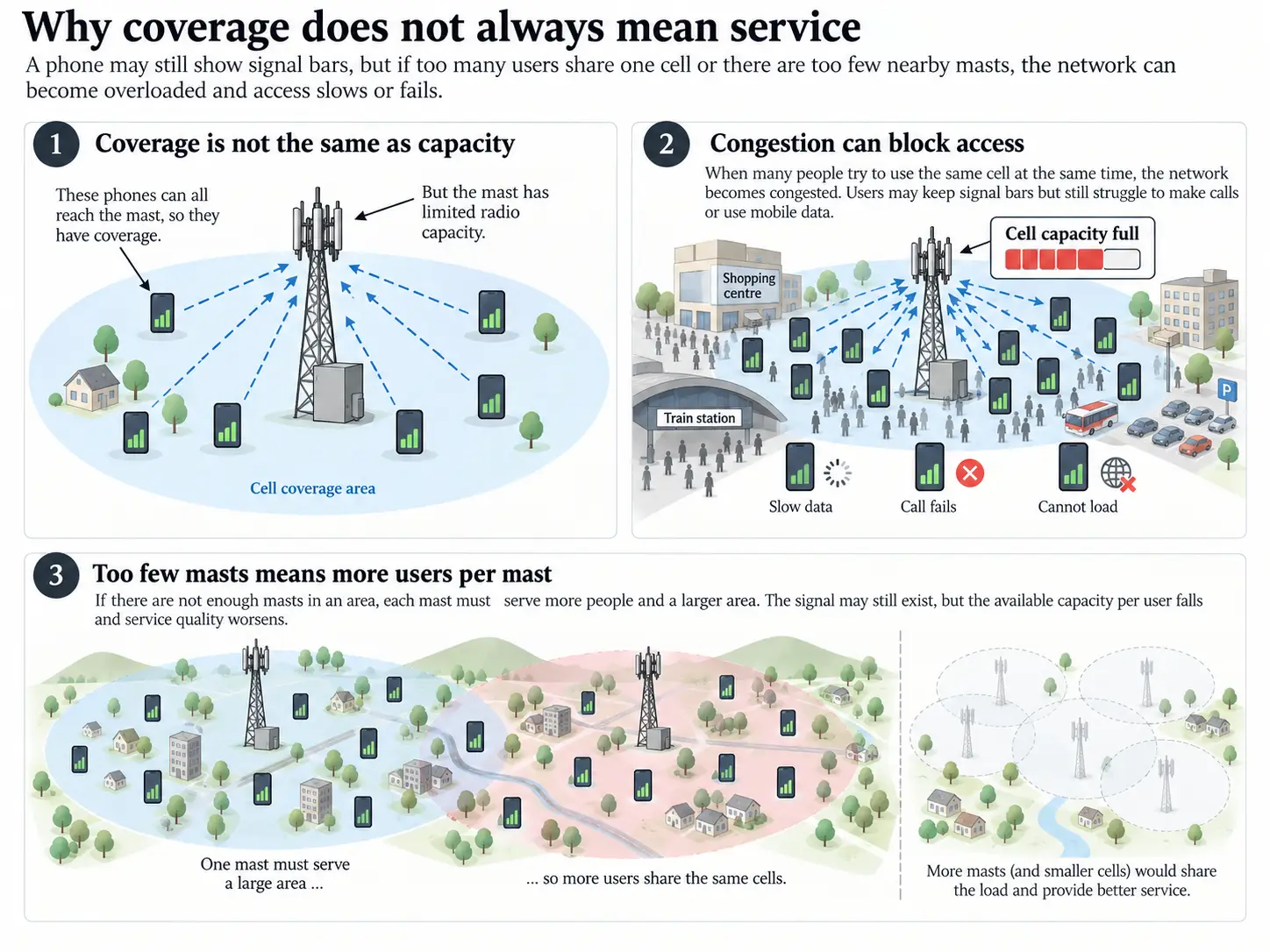
The bars in the corner of a phone screen give a rough indication of how strong the connection is to the relevant antenna. But this doesn’t tell the full story of the user experience: each cell only has so much capacity for sending and receiving data. This capacity is pooled between all the devices trying to connect. When too many people join at once, demand can exceed supply and connections slow to a crawl. Anyone who has tried to book an Uber after a busy gig will be able to relate to this experience. It’s perhaps understandable that an occasional surge in demand like this might hit speeds, but a failure to expand the capacity of our network has made such capacity constraints a regular occurrence in our large cities. And crucially, this doesn’t show up in the data, as maps of predicted signal strength don’t reflect these capacity constraints, and therefore don’t tell us how well the network is coping with demand.
Mobile coverage also needs to improve, though on this measure, the UK is less of a developed-world outlier. Coverage remains considerably worse in rural areas than in urban ones, and there are still micro black-spots in major cities, which can lead to dropped calls as people move around. Modern construction methods can also reduce indoor reception even when a strong signal is available outside. Improving outdoor coverage is therefore only part of the solution.
We estimate that congestion costs mobile users between £490–785 million a year in lost value. We arrived at this range by using Opensignal data to compare mobile speeds at busy times of day with the speeds delivered when the network is less congested. We then valued the difference using survey data asking how much people would pay to gain a faster connection. It’s important to add that this only covers the impact of slower speeds on consumers and not that of dropped connections. Businesses that rely on the mobile network to reach their customers or to take payments are experiencing the consequences of our lagging network too. A market trader whose card reader can’t connect loses the sale, and a delivery driver whose app drops out can’t pick up the next job.
If we don’t fix this problem, it’s only going to get worse. UK mobile traffic surged by almost 500% between 2018 and 2025. Demand will grow further as fixed wireless access (home broadband delivered over mobile networks) spreads and as more businesses adopt 5G. Meeting this demand will require both better coverage and more capacity in overworked cells. Operators will need to upgrade existing sites and to install new antennas closer to users.
Planning constraints restrict investment in mobile infrastructure
In England, mobile masts can usually be built using permitted development rights (PDR), so they don’t need separate planning permission. However, new ground-based masts must still go through prior approval by the local authority before they can go ahead. Although the PDR means that councils can’t refuse a proposal on the grounds of it being a mobile mast, they can reject it on the grounds of siting and appearance, and have 56 days to decide whether to do so. If no decision is issued within that timeframe then qualifying developments can go ahead automatically. The PDR covers new ground-based masts up to 30 metres on unprotected land outside highways, and up to 25 metres on highway land or in certain protected areas, subject to other conditions. The height limits exclude the antennas.
The rights also cover equipment on rooftops and upgrades to existing sites; however, separate limits apply on their size and siting. Any proposals outside these rights require a full planning application. Even after a mast-builder has found a gap in coverage and arranged to pay to install the technology in a suitable location, a refusal on the grounds of appearance can still prevent construction from going ahead.
Many councils use these powers to block masts. Over five years, Glasgow and Cardiff refused every prior approval application they received, Richmond upon Thames refused 96%, and Islington 74%. Builders can appeal refusals, but this commits more money to a site they may not be able to build on anyway. Even if successful, an appeal process adds delay and cost. Finding replacement sites requires further negotiations with another landowner and submitting another application – assuming that another suitable place can be found.
Each delay adds further costs, and on some sites this means the total cost is greater than the revenue the mast will realistically earn once in use. As a result it doesn’t make commercial sense and the project is scrapped. Meanwhile, consumers continue to pay for congested or unreliable connections, even where there was enough demand to support investment in the absence of those extra costs.
The status quo is a bad deal for taxpayers too. One example is the Shared Rural Network programme agreed between the government and the four operators in 2020. The scheme saw the operators pay £532 million to cover the cost of masts in partial not-spots – where some but not all operators had coverage – while the government would spend £501 million to subsidise the construction of masts in total not-spots. By January 2024 the operators had submitted around 1,000 planning applications for the programme but these typically faced delays of up to 4 months and some sites were delayed by more than a year. Removing planning barriers would make more sites viable, reducing the need for government subsidies while also cutting wait times for coverage taxpayers have already paid for.
Planning restrictions on the dimensions of mobile equipment also limit the capacity of existing sites. It’s usually easier to add antennas to a mast that already exists than to build a brand new one elsewhere and operators can often share existing masts if more antennas can be built onto them. But current planning rules often get in the way of such collaboration. Adding antennas and supporting equipment often increases the width of a mast. The current rules allow a mast to be widened without prior approval up to a threshold tied to its original width meaning smaller masts have less room to expand before another application is needed. For a mast less than a metre wide, for example, an increase of more than two-thirds triggers that requirement.
In April 2022 the government raised the permitted height of new masts from 25 to 30 metres on unprotected land and from 20 to 25 metres on highway land and in protected areas, while keeping the requirement for prior approval. But sharing space requires more space at ground level too, where extra cabinets and supporting equipment can also trigger another prior-approval application. Where the work falls outside permitted development rights, a full planning application is needed.
Smaller antennas known as “small cells” can be affixed to existing street furniture, such as lampposts, bus shelters, and CCTV poles, to provide additional capacity in densely built areas; these can often be designed to accommodate all of the mobile networks. The rules for small cells, however, cap their size at 50 litres, which makes shared units harder to build, so either more small cells are needed or some networks get worse coverage. Operators told the government’s 2025 call for evidence that these limits haven’t kept pace with multi-operator equipment, and that shared systems can consequently require a full planning application. This makes it more expensive to use a limited amount of space to its maximum potential.
The August 2026 National Planning Policy Framework (NPPF) offers stronger support for mobile infrastructure. Councils were already instructed to accept a need for more network development but now have to give “substantial weight” to improvements in network capacity with regard to upgrades allowing for future expansion.
We welcome these changes, particularly as demand will often grow after a site has been brought online. But the government hasn’t gone far enough, as councils are still able to refuse the equipment proposed to meet demand. New sites will still require evidence that existing structures have been explored, and development will remain subject to a requirement to reduce visual impact as far as practicable. However, the requirement for prior approval in the permitted development rules remains unchanged, allowing councils to refuse proposals on siting and visual grounds, even though the NPPF accepts the need for more capacity. In practice, we expect determined local authorities to continue finding reasons to refuse new mobile infrastructure.
Better connection brings benefits that extend beyond a mast’s immediate neighbours. Commuters, visitors, and people who live nearby but can’t see the mast all experience the inconvenience of poor service. Benefits are dispersed among people who may have little involvement in the local planning decision, but it’s often people who are affected visually whose voices are loudest. National rules need to give those wider benefits more weight by making clear in advance what types of installation are acceptable. This would allow providers to invest with a proper right to build and councils could enforce compliance with the conditions attached.
Market failures also limit improvements in connectivity
The planning system isn’t the only barrier to a better network; there are also issues with the way the market operates. Operators invested around £2 billion each year between 2020 and 2024, but their revenues fell by nearly a fifth in real terms between 2019 and 2024. Lower prices benefit consumers, and cheaper deployment of network infrastructure would allow providers to improve connections at prices people are willing to pay. But such improvements also have to earn a return, which is hard when consumers often can’t identify a better service or pay for a connection that performs reliably where and when they need it.
If you have poor reception at home, comparing the price of different mobile offers is easier than working out how each network will perform in your area, particularly inside your home or office. Ofcom’s consumer research found that many people assume quality is the same across networks. The regulator’s more recent Map Your Mobile checker helps in this regard by combining predicted coverage with information about performance at a postcode-district level. But these averages still leave uncertainty around capacity, especially at busy times and more detailed measurement is needed. Providers would then have more of an incentive to invest where the resulting improvements could win them new customers.
Poor indoor coverage is often the result of weak incentives for operators to co-operate. Independent suppliers offer systems that use shared equipment to provide signal from several or all networks inside a building that would otherwise receive no signal. But each network decides whether it wants to connect and the operators have little commercial reason to co-operate. At present such systems can come online with networks missing even after the building owner has committed the funding. At Manchester’s Co-op Live arena a shared system carries the EE, O2, and Vodafone networks but not Three, whose customers experienced a markedly worse service when Ofcom tested the venue in February 2026.
Rural areas need to be treated differently because there are fewer customers to support the cost of each new mast. Subsidy programmes like the Shared Rural Network scheme are justified when the wider benefits of coverage exceed the cost of delivering coverage, but lower building costs would make more rural sites commercially viable while requiring less subsidy for the rest.
Reforms to support better mobile connectivity
5.1 Grant national permission for standard mobile infrastructure
As with other types of infrastructure, the planning system creates uncertainty. Providers must commit time and money to projects before knowing whether a council will give them the go-ahead. Repeating applications or taking them to appeal can leave otherwise viable projects uneconomic. New national rules can remove this uncertainty by establishing in advance what can be built and how much space may be occupied.
We propose establishing a national right to build mobile infrastructure that meets standard requirements on size, siting, and design. This should be introduced through changes to Part 16 of the General Permitted Development Order. Under this proposal, masts and supporting equipment that meet the national requirements would move from the current prior approval process to prior notification. The operator would tell the local authority what it intends to build and could begin work 28 days later without needing permission from the council.
We argue that national policy is a better place to determine the siting and appearance of masts and supporting equipment. Under the new system, councils could use the 28-day period to review the plans, but they wouldn’t be able to hold up installation. As with other permitted development rights, they would still be able to take enforcement action if they believed one of the national conditions had been breached. Operators already give councils 28 days' notice of certain smaller installations that go ahead without prior approval, so the mechanism would be familiar to both sides.
In most cases, our proposals would mean the operator could simply build once the 28 days had passed. Disagreements could still arise over whether an installation meets a condition, such as a height measurement or the space left on the pavement, and an operator would be reluctant to build under threat of enforcement. MHCLG should therefore set out a national notification form, with the plans and measurements needed to show that each condition is met. Checking these would be quicker than the judgement councils now make on siting and appearance. Operators should pay the same fee as they do for prior approval today, currently £610 per application and due to rise to £760 in December 2026, so councils' income is unaffected while their task becomes simpler.
A council should be able to object only by naming a condition the plans break and explaining why. General objections to siting or appearance should carry no weight, since the national conditions would already settle both. The operator should then be able to ask the Planning Inspectorate to rule on that condition alone, through a written procedure based on its expedited appeals process, and the Inspectorate’s existing power to award costs should apply to councils that object unreasonably. An objection shouldn’t stop the clock, so work could still begin after 28 days, at the operator's own risk if the ruling went against it.
Because the national conditions would be published in advance, operators could design their masts and supporting equipment around them, knowing they would be covered before committing any money. This would reduce the friction and cost of the current system, in which operators face different judgements on siting and appearance in each planning authority. We propose that the national conditions should permit new freestanding masts that use a design approved for that kind of setting in a national pattern book (see section 5.2), which would settle the question of appearance.
Most of the work needed to increase the capacity of the mobile network will be on masts that already exist. VodafoneThree says 96% of its planned upgrades are on existing sites, yet more than half of them will need planning permission of some kind. For upgrades to existing masts, we propose different national rules. A new mast changes how a place looks, but upgrading a mast that’s already built adds much less, no matter how ugly the original mast is.
Upgrades to existing sites should therefore also come under prior notification, within new national limits on size and siting, without the original mast having to be replaced or altered to match a pattern-book design. The same right should extend to independent infrastructure providers – not just the mobile networks – where they hold Electronic Communications Code powers, so that landowners and operators can commission masts from whichever provider is best placed to build them.
The national conditions should be specific enough for operators to design to and for councils to enforce. Most can be adapted from existing permitted development rights. For new ground-based masts, we propose keeping the existing height limits of 30 metres on unprotected land outside highways and 25 metres on highway land, with antennas excluded from the measurement. The right shouldn’t apply to new masts in protected areas such as National Parks, which would continue to be assessed individually, as now. The national conditions should cover the entire installation, including cabinets and other equipment at ground level, and should leave enough space for pedestrians to pass, in line with existing accessibility requirements.
National planning policy expects applications for a new mast site to show, where relevant, that the operator has explored putting antennas on an existing mast, building, or other structure. But operators already have a commercial incentive to use existing structures where they will work, because adding antennas to a mast is usually quicker and cheaper than building a new one. The requirement therefore adds needless bureaucracy, and it shouldn’t form part of the national conditions.
The limits for upgrades to existing masts should be set with mast sharing in mind. When networks share an existing site, fewer masts need to be built, reducing visual clutter. Each operator that joins a site still needs to add its own antennas to the mast, however. Setting limits that allow for these additions would make it worthwhile to build sites that can serve more networks and more users over a longer period.
As section 3 explained, the current rules trigger prior approval once a mast is widened beyond a certain point. Because the threshold is tied to a mast's original width, slimmer masts reach it more quickly. We propose replacing this sliding test with fixed limits on the size and siting of the finished installation. Upgrades should also be able to take an existing mast up to the full height and size allowed for a new mast, with notification and without prior approval.
Each network that joins a site also needs cabinets for its radio and power equipment, and the right to extend a mast is of little use if those cabinets still need a separate decision. At present, a single cabinet larger than 2.5 cubic metres outside a permitted area needs prior approval of its own. On unprotected land, cabinets should instead be covered by the same notification as the mast, within the existing cumulative limits of 90 cubic metres, or 30 cubic metres on the roof of a building. Operators could then add equipment as demand grows, with the national siting conditions deciding where it goes.
Operators can also add capacity without building a full mast, by putting antennas on rooftops to serve nearby streets from a height, and the same approach of fixed national limits and notification should apply there. Permitted development rights already cover rooftop masts rising up to eight metres above buildings taller than 15 metres, and up to ten metres above buildings of 30 metres or more. Any mast more than six metres above the roof on unprotected land, however, must first go through prior approval. We propose that on unprotected land, rooftop masts within these limits should instead be allowed after notification.
The same approach should apply to small cells. The current 50-litre limit applies to every unit, however many networks it serves, so a small cell shared between all four operators faces the same limit as one serving a single network. This penalises sharing, even though sharing means fewer small cells and less street clutter. We propose that the allowance should instead be 50 litres for each network a unit is designed to carry, up to 200 litres for four, with the surface-area limit of 5,000 square centimetres scaled in the same way. The national conditions should still cap the size and position of every installation. Meter cabinets, which supply the equipment with power, should be listed explicitly in the rules on equipment housing, so they can be installed under the same notification as the rest of the installation.
In protected areas such as conservation areas, National Parks, and National Landscapes, new masts should continue to need prior approval of their siting and appearance, as now, along with the safety requirements that apply to all development, while small cells and small cabinets continue under the existing rules. There, the national right should cover only changes that leave an installation looking the same, such as replacing antennas with ones of the same or smaller size in the same position and finish, or upgrading equipment inside existing cabinets. The reform would add to operators' options without removing any, so work that existing rights already allow with less procedure could continue as now. Operators would also still need the landowner's agreement, or a tribunal order under the Electronic Communications Code, to use a site, as they do today.
5.2 Give approved mast designs a right to build
The visual appearance of masts is often cited as a reason for objecting to them. But there isn’t as much incentive towards aesthetics as perhaps there should be. Better design is a more attractive investment if a manufacturer or operator knows that an approved design can be used in suitable locations across England without another decision on its appearance. A national pattern book should therefore specify which designs are appropriate for different settings while allowing providers to purchase designs with confidence that they meet planning requirements.
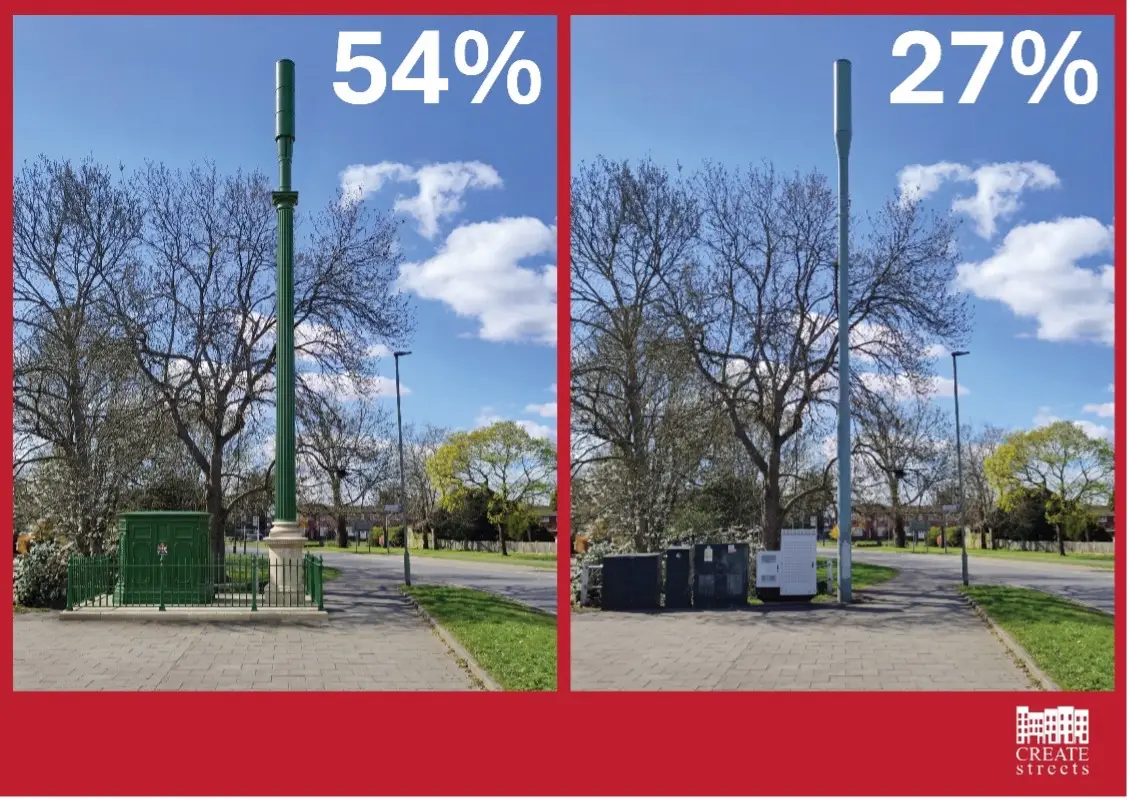
Research conducted by Create Streets for Buffering Britain shows why the choice of design is important. In one comparison, 54% of respondents preferred the redesigned installation concept compared to 27% who preferred the conventional alternative. Testing public preferences can help to identify designs that make the urgent upgrades to the mobile network more acceptable. A pattern book should therefore cover both the masts and any adjacent infrastructure including the cabinets at street level.
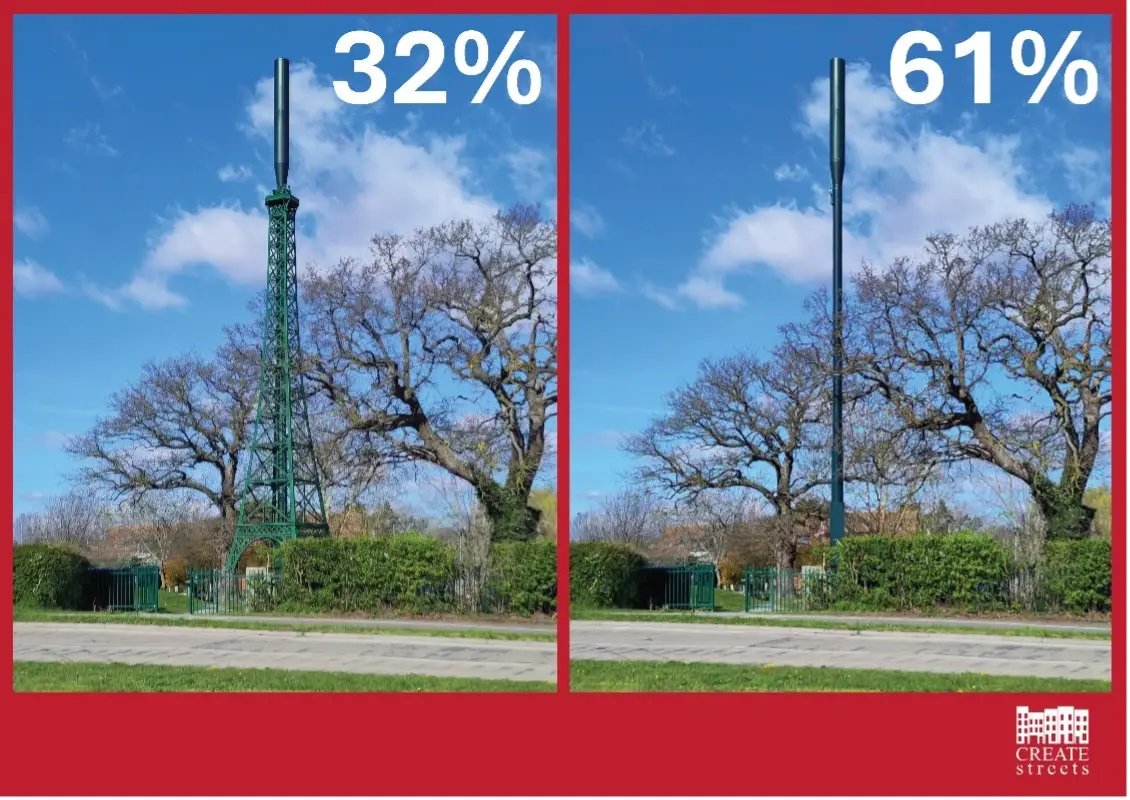
An ugly mast imposes costs on its neighbours, while the benefits from greater connectivity are more diffuse, and felt by people who live or work elsewhere. National design approval would allow those visual effects to be considered when granting a right to build. An approved design in its specified setting should therefore qualify for 28 days’ notification, while other new freestanding designs would retain the existing application routes. This distinction gives approval commercial value. An operator could justify paying more for an approved design if the extra purchase cost is outweighed by savings in planning costs and the reduced risk of refusal. Manufacturers would gain a market for products carrying that advantage across England, allowing the cost of design to be recovered through repeated sales. The book would remain optional, so an individual application could still secure permission for a design better suited to a particular site.
The pattern book should specify suitable settings and acceptable variations, so that equipment can be adapted within set limits. An approval that ceased to apply as soon as another network joined would leave operators uncertain about the future of the site. Each entry should therefore include the dimensions and finishes allowed as equipment is added or replaced. Public preference testing should inform the assessment of appearance, and a technical assessment should establish that the installation can provide the intended service and accommodate the sharing and upgrades for which it’s approved. Manufacturers would then be rewarded for designs that remained useful as demand grew. An operator using an approved design should notify the council in the same way as for any other installation under the national right, citing the pattern-book entry to show the design suits its setting. Councils should have no further discretion over the appearance of a design used in its approved setting. Manufacturers should also gain access to an open, published process for submitting future designs to keep up with improvements in technology.
MHCLG and DCMS should build the first edition of the pattern book through an open design competition, much as the Post Office did in the 1920s when a design competition produced Giles Gilbert Scott's K2 telephone kiosk. Designs already on the market could be entered alongside new ones, but the departments should require every entry to pass public preference testing against the masts in use today, so that only designs people prefer are approved.
MHCLG and DCMS should set the competition's technical requirements, such as height and the number of networks a mast can carry, with input from operators, so that approved designs are ones operators can use, and they should approve designs for different capacities, so that slimmer masts serving fewer networks aren’t excluded. After the first edition, MHCLG should keep the book open, adding any manufacturer's new design that meets the same criteria.
5.3 Open public assets to mobile infrastructure
Public rooftops and lighting columns can provide sites close to people who need better reception. The public benefit comes when access allows extra coverage or capacity to be built. Reducing payments on an installation that would have gone ahead anyway may simply increase the operator’s return, so the case for reform depends on making more sites viable and reducing avoidable work for both sides.
Making assets available takes staff time and creates continuing responsibilities, while much of the benefit goes to people using the mobile network. Public bodies should be paid for the use of their assets, compensated for loss or damage under the Electronic Communications Code’s valuation rules, and able to recover the reasonable costs of hosting equipment, including continuing costs. The income remaining after those costs should stay in the budget responsible for managing the asset. Hosting equipment would then help fund that team’s other responsibilities, giving it a reason to devote staff time to deployment.
Agreements to put mobile equipment on council-owned lampposts typically take more than a year to negotiate, but standard terms can cut that time sharply. With support from WM5G, a company set up by the West Midlands Combined Authority in 2019 with government funding, Birmingham City Council signed its first agreements in six working weeks. Perth and Kinross Council, supported by Scotland’s Infralink programme, reached an open-access agreement with Freshwave in four weeks, and in October 2025 Freshwave and O2 announced six small cells in Perth under that agreement. Public bodies should offer standard terms on insurance, maintenance, and payment that cover all their suitable sites. Each installation would still need a check that the site is suitable, but agreeing the terms once would spread the cost of negotiation across many installations.
Providers also need to know which sites are available before paying for detailed surveys. DCMS should require councils, NHS trusts, and government departments to publish a list of the rooftops, lampposts, and other street furniture they own, giving the location and type of each and withholding sensitive information where necessary. Each list should also set out the body's standard terms and name a contact for requests. A provider could then establish whether a council had suitable lighting columns or rooftop space without lengthy enquiries across departments. Much of this information already exists. Councils keep an inventory of their street lights because their electricity bills are calculated from it, and government departments and their agencies must already record their buildings and land in the government's InSite property database.
DCMS should bring forward legislation giving councils, NHS trusts, and government departments a duty to consider requests from mobile providers to install equipment on suitable rooftops and street furniture, and to agree reasonable terms within a fixed timetable unless one of the grounds for refusal set out below applies. Standard terms and published lists would make agreements quicker and cheaper to reach, and the hosting income would give asset teams a reason to agree. Even so, the main job of the teams that manage these assets is keeping streets lit and hospitals running, and requests from mobile providers are often considered less important.
A duty with a fixed timetable would make sure every request is answered within a set period. We propose extending the Communications (Access to Infrastructure) Regulations 2016, which already cover public lighting, to the rest of the public estate, so that providers and public bodies follow the same process for every kind of asset. Under those regulations, the infrastructure operator must agree to grant a survey within one month of a request and, within two months, agree to provide access on fair and reasonable terms, unless it can show objective, transparent, and proportionate grounds for refusal, such as technical unsuitability, lack of space, or safety. Either side can refer a dispute to Ofcom if negotiations fail.
The duty should account for the public body's other responsibilities and the value of competing uses. A roof may be suitable for antennas but also needed for planned solar panels. The council, NHS trust, or department that owns or manages the asset should be able to refuse a request only where installing the equipment would prevent an evidenced alternative use, interfere with public services, or create a demonstrable safety or security risk that reasonable changes couldn’t resolve. Agreements should let the public body maintain, replace, or alter its assets, and should settle in advance who moves the equipment when that work requires it, and who pays. Public bodies would therefore know what hosting commits them to before they agree to it.
Companies that install and run shared mobile equipment for the networks, such as Freshwave, should be able to make requests under the duty in the same way as the mobile networks themselves. Where a public body appoints one such company to install equipment across its lampposts or roofs, that company should offer the same terms to every mobile network, so that a single lamppost or roof can carry equipment serving competing networks. As under the current regulations, either side should be able to take a dispute to Ofcom, which should decide the charges and conditions and rule on whether a refusal meets the grounds above, and its decision should bind both sides. A provider could then challenge an unjustified refusal, and a public body could make sure it’s paid and that the agreed terms are kept. Knowing that Ofcom could rule against them, both sides would have a reason to agree reasonable terms without a ruling.
5.4 Let building owners purchase shared indoor reception
Building owners benefit when staff, tenants, and visitors can get good mobile reception, whichever network they use. Where signal from outside masts doesn’t reach far enough indoors, an owner can pay a specialist supplier to install a shared indoor system – antennas and cabling inside the building that carry signal from several networks at once. At present, however, each operator decides for itself whether to connect its network to a given system, because the system uses that network's licensed spectrum and has to be linked to its equipment. Each operator has a commercial interest in improving service for its own customers and winning customers from its rivals, so connecting to shared systems is often not a priority. The building owner can choose between suppliers, but switching to a different supplier doesn’t change whether a network is willing to connect. Even when the building owner is willing to pay for the work, competition between suppliers can’t guarantee that every network will be available, as the example of Co-op Live in section 4 shows.
We propose a new right for building owners to buy connection to each network. Where an owner has commissioned a shared indoor system that meets published technical requirements, each operator should be under a duty to connect every network it operates to the system at the owner's request. No such duty exists today, and it would need legislation (see below). Under our proposal, the owner would pay the efficient costs of connecting and running each network's part of the system, including a reasonable return on any additional investment the network has to make. That payment would give an operator a commercial reason to connect a building it wouldn’t have paid to cover from its own budget. It would also allow the owner's chosen supplier to offer coverage from every network without depending on each operator's investment priorities.
Operators should offer connection on fair, reasonable, and non-discriminatory terms, giving the same published terms to every supplier whose system meets the technical requirements, so that suppliers can compete for this work on an equal footing. Where an owner or supplier disputes a charge, Ofcom should be able to determine it.
Suppliers will also need to know in advance what connection will cost. Each operator should therefore publish a charge sheet in a common format set by Ofcom, listing its one-off charges for connecting a system and its continuing charges for running it, so that different networks' charges can be compared item by item. Suppliers could then price their bids accordingly, and building owners could compare bids on the full cost of the service. The industry already has a Joint Operators Technical Specification, which sets common requirements for indoor systems. It could serve as the published technical requirements a system must meet to qualify, so suppliers could design shared indoor systems knowing every network would be required to connect to them.
A published charge sheet would still leave an operator free to discourage a project by setting its prices too high. The duty to connect must therefore extend to the terms on which connection is offered. Parliament should amend the Communications Act 2003 to create the right to buy connection and the matching duty, and give Ofcom the power to require connection at charges that reflect efficient costs and a reasonable return.
The duty would be of little use if a network could put off the date of connection indefinitely. Each operator's published offer should therefore include standard delivery timescales linked to the work required, which the network could extend only for technical reasons it can justify. We propose that an owner or supplier should be able to refer an unreasonable delay or refusal to Ofcom. Ofcom should have the power to impose an agreement setting the charges and delivery date, and to fine networks that fail to comply.
The duty should apply only where the building owner agrees to pay these charges. Because the owner would cover the full cost, no network would have to spend its own money on a building it hadn’t chosen to serve. A network should be able to refuse connection only where it can show a valid technical reason why the system can’t be connected, or a demonstrable risk to security or to the reliability of its wider service. In that case it should be required to explain the problem and set out the changes that would make the proposal acceptable. Once the system is installed, the network should test it and connect it when it passes. Each network would keep control of its own licensed spectrum throughout, as it does today. These limits would protect the networks' wider service while allowing building owners to pay for indoor reception that meets the technical requirements.
Public bodies can also create demand for these systems through procurement, particularly in buildings where people on every network need reliable reception. In 2024, a shared system connected all four national networks across fifteen buildings at Princess Alexandra Hospital. Planning for reception while a building is being designed allows cable routes, equipment space, power, and backhaul to be arranged from the start, reducing the need for disruptive work after it opens. We recommend that NHS trusts and other public bodies commissioning new hospitals and major public buildings include shared mobile reception in the design brief. This is guidance for public bodies acting as clients, and places no new requirement on private developers. Contracts for these systems should allow more networks to join later and give the owner the right to change supplier, so that the firm that installed the system doesn’t decide who can compete to maintain and improve it. Connection agreements with the networks should be signed during construction and fix the date each network goes live, so that reception is available from the day the building opens.
5.5 Give consumers the information to choose a better network
Operators will only invest where better performance wins customers, and that depends on people being able to see which network performs best where they live, work, and travel. Map Your Mobile shows predicted indoor and outdoor coverage and crowdsourced performance by postcode district, but it doesn’t show measured performance inside individual buildings or how performance changes through the day. Ofcom should extend the checker to show busy-hour performance for each network, drawing on the walk-testing it commissioned for Greater Manchester, and publish results for major stations, arenas, and hospitals. It should also require operators to report dropped-connection rates alongside speed, so that reliability becomes something networks compete on. Better information would then do some of the work that planning reform starts, giving every operator a commercial reason to fix the places where its customers suffer most.
Conclusion
There's nothing inevitable about Britain's poor mobile network. It is the consequence of a broken system blocking the investment needed to meet growing demand from consumers. The government can make that investment viable by cutting the uncertainty associated with the planning system. A national right to build would allow standard equipment to be built after notification, and existing sites to expand as demand grows and technology develops. Amending Part 16 should therefore be the top priority, with a pattern book developed alongside it to encourage investment in better design.
Making sites easier to build on would strengthen the effect of reforms to planning. Public bodies should have a financial incentive to host mobile equipment, and a duty to answer providers' requests on reasonable terms within a set timetable. Building owners willing to pay for better indoor signal should be able to buy connection to every network. Better information would help consumers to choose a provider that improves their service, further incentivising investment.
The success of these reforms can be measured through completed installations and upgrades, and changes in the real-world service that people receive. Tracking the time and cost of securing appropriate sites would identify delays. This evidence should act as a further guide on changes to development rights as technology advances and demand changes. Households and businesses are currently paying for connections that all too often fall short of their needs. Greater freedom to build would unlock more of the investment needed to meet them. It would also allow policy discussions on the structure of the market to take place in a planning environment that supports expansion of the network. Poor connectivity is a choice – it's time to make a different one.
For more information about our initiative, partnerships, or support, get in touch with us at:
[email protected]For more information about our initiative, partnerships, or support, get in touch with us at:
[email protected]